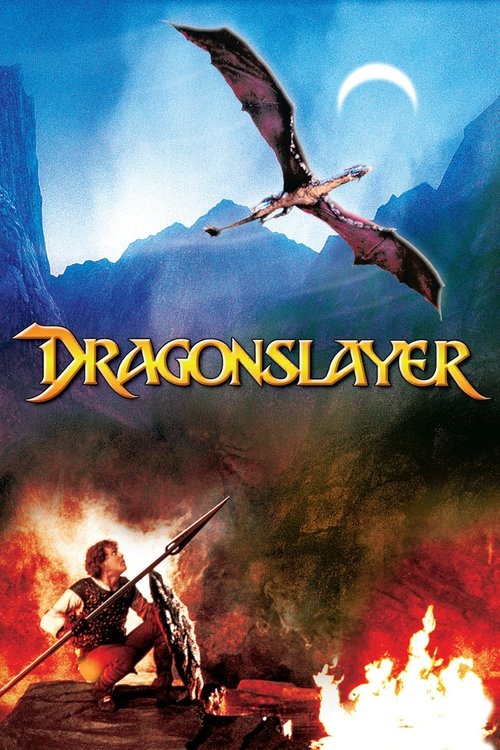
Dragonslayer
Dragonslayer Is About the Death of Magic and the Lie the New Order Tells to Take Its Credit
Directed by Matthew Robbins
A 1981 fantasy with a Vermithrax dragon so good the effects still hold. Under the sword-and-sorcery it is a cold, adult film about what replaces the old powers when they die.
Dragonslayer looks like a standard quest: a wizard and his apprentice set out to kill a dragon that the kingdom keeps appeased by sacrificing virgins chosen by lottery. The film is stranger and sadder than that. The old sorcerer Ulrich seems to die early, apparently killed on the road. His apprentice Galen inherits an amulet and a task he is not ready for. The dragon, Vermithrax Pejorative, is ancient and dying, breeding its young in a lake of fire beneath the earth. And the twist is that Ulrich engineered his own death, needing to be reduced to ashes so that he could be resurrected at the dragon's lair and expend the last real magic in the world to destroy the last real monster. When it is done, both are gone. Magic dies with the dragon it was made to fight.
Alchemical Reading: The Adept Who Must Be Calcined to Complete the Work
Alchemy's most demanding stage is the death of the operator himself. The adept cannot merely perform the transmutation from outside; at the final Work he must enter the fire, be reduced to ash, and be reconstituted purified. Ulrich stages this literally. He instructs that after his death his ashes be carried to Vermithrax's lair and scattered on the water, and from those ashes he rises, restored, to detonate himself against the dragon in a burst of light. This is the nigredo and the resurrection compressed into a single arc: the blackening death, the ash, the return of the philosophical body to finish what the living man could not.
Watch the burning shield Galen forges under the water-fairy's instruction, quenched not in water but by holding it in the lake of the dragon's own domain. The tool that will meet the dragon must be tempered in the enemy's element, opposites fused, a solar object cooled in the chthonic depth. Yet the shield alone never slays Vermithrax. Only Ulrich's self-immolation does. The alchemical teaching is exact and bleak: the great transmutation costs the transmuter his life, and what it produces is not gold but an ending. The Work here is the closing of the age of magic itself.
Jungian Reading: The Christian King Steals the Dead Wizard's Deed
Jung watched the numinous get colonized by the institutions that follow it. In Dragonslayer the psychology of that theft is the whole final scene. After the dragon dies through Ulrich's sacrifice, the newly Christianized King Casiodorus rides up, plants a sword in the dragon's corpse, and claims the kill for himself and for the new faith. The film cuts to the crowd hailing the king as dragonslayer. The one who actually did it is ash on the wind. The apprentice who carried it says nothing.
This is the shadow-move of every new order that supplants an old power. The rising ego, the Christian monarchy replacing the age of pagan magic, cannot create the numinous, so it appropriates the deed and rewrites the story with itself at the center. Galen and Valerian ride off, the amulet's power spent, the old wizard gone, watching the king collect the glory. The film refuses to comfort us. The wonder was real, it saved them, and the world that inherits its death will remember only the lie of the man who claimed the sword.
Questions this film answers
What is the deeper meaning of Dragonslayer?
Dragonslayer looks like a standard quest: a wizard and his apprentice set out to kill a dragon that the kingdom keeps appeased by sacrificing virgins chosen by lottery. The film is stranger and sadder than that. The old sorcerer Ulrich seems to die early, apparently killed on the road. His apprentice Galen inherits an amulet and a task he is not ready for. The dragon, Vermithrax Pejorative, is ancient and dying, breeding its young in a lake of fire beneath the earth. And the twist is that Ulrich engineered his own death, needing to be reduced to ashes so that he could be resurrected at the dragon's lair and expend the last real magic in the world to destroy the last real monster. When it is done, both are gone. Magic dies with the dragon it was made to fight.
What is the hidden symbolism in Dragonslayer?
Alchemy's most demanding stage is the death of the operator himself. The adept cannot merely perform the transmutation from outside; at the final Work he must enter the fire, be reduced to ash, and be reconstituted purified. Ulrich stages this literally. He instructs that after his death his ashes be carried to Vermithrax's lair and scattered on the water, and from those ashes he rises, restored, to detonate himself against the dragon in a burst of light. This is the nigredo and the resurrection compressed into a single arc: the blackening death, the ash, the return of the philosophical body to finish what the living man could not.
What esoteric traditions appear in Dragonslayer?
Dragonslayer draws from Alchemy, Jungian traditions. A 1981 fantasy with a Vermithrax dragon so good the effects still hold. Under the sword-and-sorcery it is a cold, adult film about what replaces the old powers when they die.
Is Dragonslayer worth watching for spiritual seekers?
Dragonslayer (1981) directed by Matthew Robbins is essential viewing for those interested in Alchemy, Jungian. Dragonslayer Is About the Death of Magic and the Lie the New Order Tells to Take Its Credit. It rewards multiple viewings and contemplation.
Rewatch With New Eyes
Now that you've seen the architecture, experience it again. The same film becomes a different film when you know what to watch for.
This time, watch for:
- Track the stages: blackening, whitening, reddening — death before rebirth
- Meet the shadow: what is rejected, projected, and finally integrated
Links may include affiliate partnerships that support Media Revelations