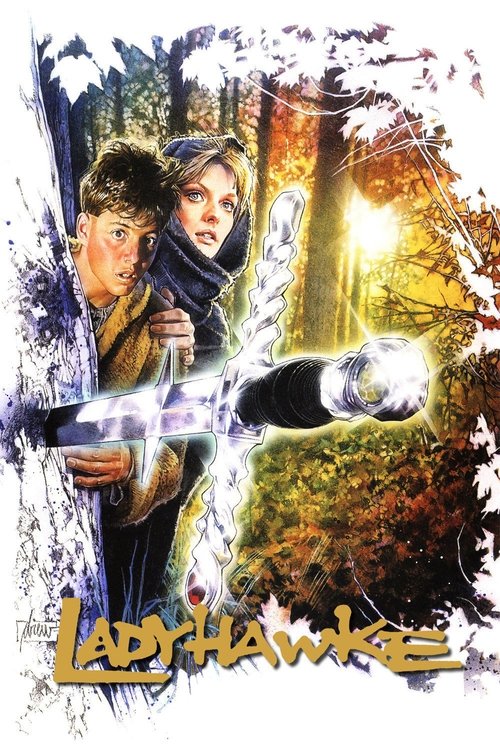
Ladyhawke
Ladyhawke Is a Portrait of Two Lovers Kept Alive Only by the Instant They Can Never Share
Directed by Richard Donner
A cursed knight is a wolf by night, his lady a hawk by day. They are always together and never once together. The curse is more precise than any monster.
Ladyhawke wears the costume of a medieval adventure, a bishop, a curse, a young thief who narrates to God as if to a business partner. The engine underneath is a single devastating image sustained for two hours. Etienne Navarre and Isabeau are lovers punished by a jealous bishop so that they share every moment of every day and can never meet in human form. He is a wolf in the dark hours; she is a hawk in the light. At dawn and at dusk, for a heartbeat, the transformation crosses over, and each glimpses the other's true shape vanishing as their own returns. The film is not really about breaking the curse. It is about what it does to two souls to be held permanently at the threshold, one breath from union, forever.
Alchemical Reading: The Wedding of Sun and Moon That the Curse Forbids
Alchemy's central image is the marriage of Sol and Luna, the sun and moon, the solar king and lunar queen whose union produces the reconciled whole. The curse on Navarre and Isabeau is that exact marriage held eternally apart. He belongs to the night, the moon's domain, in the shape of the wolf. She belongs to the day, the sun's domain, in the shape of the hawk. The alchemical wedding requires that the two opposites occupy the same vessel at the same moment, and the bishop's spell is engineered to guarantee they never can.
The film even names its own cure in alchemical terms. Navarre is told the curse breaks only on "a day without a night and a night without a day," a solar eclipse, the impossible moment when sun and moon share one sky. That is the coniunctio described precisely: the union of opposites at the point where the two great lights meet. When the eclipse comes and Navarre stands human before the bishop while Isabeau also stands human, the marriage of Sol and Luna completes in a single frame, and the spell that depended on keeping them apart simply dissolves.
Sufi Reading: The Lover and the Beloved Kept One Veil Apart
Sufi poetry returns endlessly to a single ache: the lover separated from the Beloved by the thinnest possible veil, close enough to sense, never close enough to hold. Ladyhawke is that poem made literal. Navarre and Isabeau are never apart in space. The wolf runs beneath the hawk's flight; the hawk circles the wolf's path. They are separated only by a form, only by the veil of time that keeps one of them animal whenever the other is human.
The film's cruelest and most Sufi image is the changeover. In the seconds of transformation, Navarre sometimes catches the last sight of Isabeau as woman before he becomes the wolf, or she glimpses him as man before she takes wing. It is longing distilled to its purest chemistry: the Beloved is always right there, always dissolving at the exact moment you could reach her. The Sufis would recognize the whole structure. The nearness is the torment, and the veil is thin precisely so that you never stop reaching through it.
Questions this film answers
What is the deeper meaning of Ladyhawke?
Ladyhawke wears the costume of a medieval adventure, a bishop, a curse, a young thief who narrates to God as if to a business partner. The engine underneath is a single devastating image sustained for two hours. Etienne Navarre and Isabeau are lovers punished by a jealous bishop so that they share every moment of every day and can never meet in human form. He is a wolf in the dark hours; she is a hawk in the light. At dawn and at dusk, for a heartbeat, the transformation crosses over, and each glimpses the other's true shape vanishing as their own returns. The film is not really about breaking the curse. It is about what it does to two souls to be held permanently at the threshold, one breath from union, forever.
What is the hidden symbolism in Ladyhawke?
Alchemy's central image is the marriage of Sol and Luna, the sun and moon, the solar king and lunar queen whose union produces the reconciled whole. The curse on Navarre and Isabeau is that exact marriage held eternally apart. He belongs to the night, the moon's domain, in the shape of the wolf. She belongs to the day, the sun's domain, in the shape of the hawk. The alchemical wedding requires that the two opposites occupy the same vessel at the same moment, and the bishop's spell is engineered to guarantee they never can.
What esoteric traditions appear in Ladyhawke?
Ladyhawke draws from Alchemy, Sufism traditions. A cursed knight is a wolf by night, his lady a hawk by day. They are always together and never once together. The curse is more precise than any monster.
Is Ladyhawke worth watching for spiritual seekers?
Ladyhawke (1985) directed by Richard Donner is essential viewing for those interested in Alchemy, Sufism. Ladyhawke Is a Portrait of Two Lovers Kept Alive Only by the Instant They Can Never Share. It rewards multiple viewings and contemplation.
Rewatch With New Eyes
Now that you've seen the architecture, experience it again. The same film becomes a different film when you know what to watch for.
This time, watch for:
- Track the stages: blackening, whitening, reddening — death before rebirth
- Feel the love that transforms: what the heart sees that the mind cannot
Links may include affiliate partnerships that support Media Revelations
The Descent Continues
Where this thread leads next.
King Kong 2005
Love Already Killed the Beast — the Bullets Only Released What Remained
Read the revelation →