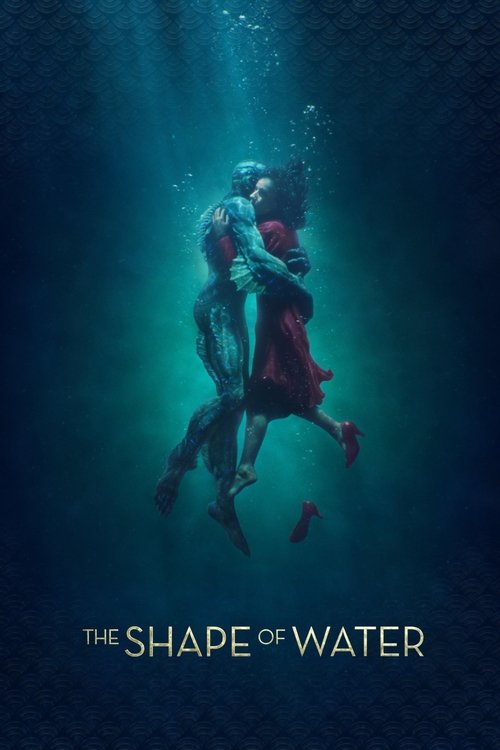
The Shape of Water
The Shape of Water Is a Fish-God's Resurrection Staged as a Love Story
Directed by Guillermo del Toro
Del Toro tells you at the start that this is a fairy tale about a princess without a voice. He does not tell you it is also a Gnostic gospel where the divine wears gills and the villain worships a God who looks like management.
A mute cleaning woman falls in love with an amphibian man held captive in a Cold War laboratory and breaks him out before the state can vivisect him. Elisa is voiceless, treated as furniture by everyone except the creature. The creature is worshipped as a god in the Amazon and studied as an asset in Baltimore. The surface reading is a beauty-and-the-beast romance with an Oscar-winning production design. What del Toro actually built is a theology. The film is explicit that the creature has healing power, that he regenerates wounds, that he is called a god by the people who knew him before the empire caught him. And it is equally explicit about who the empire's God is. Strickland, the antagonist, gives a speech about how man was made in God's image, and the God he means looks like him: white, dominant, holding a cattle prod. The film sets two divinities against each other. One heals the mute and the maimed. The other electrocutes what it does not understand.
Gnostic Reading: The Amphibian Is the Alien Spark, Strickland Is the Archon of a Dead Order
In Gnostic thought the true divine is foreign to this world, an exile from a higher fullness, trapped in matter ruled by lesser powers who mistake themselves for the ultimate God. The creature is this alien spark made literal. He does not belong to the sterile teal-and-green laboratory; he belongs to water, to the deep, to a realm the film codes as older and truer than the empire that cages him. Strickland is the archon. He reads a self-help book called The Power of Positive Thinking and worships a God of hierarchy who blesses the man at the top. His decaying, reattached fingers are the perfect Gnostic image: the ruler of the material world is himself rotting, held together by force, blind to his own corruption. The people the empire discards are the ones who recognize divinity. Elisa the mute, Giles the closeted gay artist, Zelda the black co-worker, Dmitri the defecting scientist. Gnostic salvation always arrives through the marginal, the ones the system does not count. They see the god because the system has already taught them they do not count as fully human, and so they have nothing invested in the system's lie about who God resembles.
Alchemical Reading: Water as the Solvent That Dissolves the Cage and the Wound
Alchemy begins in the solutio, the dissolving of the fixed form in water so that a new body can be composed. The film is saturated with the operation. Elisa's ritual is aquatic before she ever meets the creature: she draws her bath, times her longing to running water, is defined by the element she shares with him. Their union consummates in a bathroom she deliberately floods, sealing the door and filling the room until the whole space becomes the vessel. This is the alchemical bath rendered without metaphor. And the film pays out the alchemical promise in the final image. The creature's touch heals Strickland's throat wound on Elisa's neck, the scars on her throat opening into gills, the mark of her voicelessness transformed into the organ that lets her breathe in his world. The wound that made her mute becomes the aperture through which she lives. That is the coniunctio, the marriage of the two natures producing a third body that neither could reach alone.
Questions this film answers
What is the deeper meaning of The Shape of Water?
A mute cleaning woman falls in love with an amphibian man held captive in a Cold War laboratory and breaks him out before the state can vivisect him. Elisa is voiceless, treated as furniture by everyone except the creature. The creature is worshipped as a god in the Amazon and studied as an asset in Baltimore. The surface reading is a beauty-and-the-beast romance with an Oscar-winning production design. What del Toro actually built is a theology. The film is explicit that the creature has healing power, that he regenerates wounds, that he is called a god by the people who knew him before the empire caught him. And it is equally explicit about who the empire's God is. Strickland, the antagonist, gives a speech about how man was made in God's image, and the God he means looks like him: white, dominant, holding a cattle prod. The film sets two divinities against each other. One heals the mute and the maimed. The other electrocutes what it does not understand.
What is the hidden symbolism in The Shape of Water?
In Gnostic thought the true divine is foreign to this world, an exile from a higher fullness, trapped in matter ruled by lesser powers who mistake themselves for the ultimate God. The creature is this alien spark made literal. He does not belong to the sterile teal-and-green laboratory; he belongs to water, to the deep, to a realm the film codes as older and truer than the empire that cages him. Strickland is the archon. He reads a self-help book called The Power of Positive Thinking and worships a God of hierarchy who blesses the man at the top. His decaying, reattached fingers are the perfect Gnostic image: the ruler of the material world is himself rotting, held together by force, blind to his own corruption. The people the empire discards are the ones who recognize divinity. Elisa the mute, Giles the closeted gay artist, Zelda the black co-worker, Dmitri the defecting scientist. Gnostic salvation always arrives through the marginal, the ones the system does not count. They see the god because the system has already taught them they do not count as fully human, and so they have nothing invested in the system's lie about who God resembles.
What esoteric traditions appear in The Shape of Water?
The Shape of Water draws from Gnosticism, Alchemy traditions. Del Toro tells you at the start that this is a fairy tale about a princess without a voice. He does not tell you it is also a Gnostic gospel where the divine wears gills and the villain worships a God who looks like management.
Is The Shape of Water worth watching for spiritual seekers?
The Shape of Water (2017) directed by Guillermo del Toro is essential viewing for those interested in Gnosticism, Alchemy. The Shape of Water Is a Fish-God's Resurrection Staged as a Love Story. It rewards multiple viewings and contemplation.
Rewatch With New Eyes
Now that you've seen the architecture, experience it again. The same film becomes a different film when you know what to watch for.
This time, watch for:
- Watch for the false world vs. the real — who is asleep, who awakens
- Track the stages: blackening, whitening, reddening — death before rebirth
Links may include affiliate partnerships that support Media Revelations
The Descent Continues
Where this thread leads next.
King Kong 2005
Love Already Killed the Beast — the Bullets Only Released What Remained
Read the revelation →