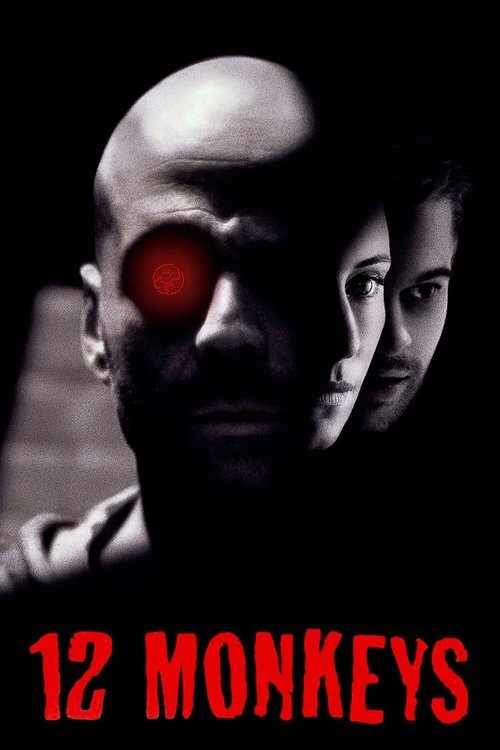
Twelve Monkeys
The Bardo Loop That Cannot Be Broken
Directed by Terry Gilliam
A film about the closed loop. James Cole has lived this scene before — he was the boy at the airport who watched himself die. The future cannot be changed because the future has already happened. Gilliam strips away every consolation the time-travel genre offers and leaves only the Buddhist recognition: the cycle was always sealed. The animals released from the zoo are the only beings to whom the apocalypse will be liberation.
Twelve Monkeys is the most precise Buddhist film made in the science-fiction register. Gilliam adapted Chris Marker's La Jetée — a film that was already a meditation on time, memory, and the impossibility of altering what has occurred — and expanded it into a feature-length depiction of samsara as time-travel cosmology. James Cole is sent back from the post-apocalyptic future to determine the origin of the virus that destroyed humanity. He cannot change anything. He was never sent to change anything. He was sent to gather information. The future scientists do not believe in alteration. They believe in observation. Cole, mistaken for insane in 1996, gradually realizes that the dream he has had his entire life — a boy at an airport watching a man die — is the dream of his own death, witnessed by himself as a child. The loop closes. He dies. The virus is released by an entirely different agent. The young Cole watches. The young Cole will grow up to be sent back to die. The cycle is sealed. The film is structurally a Möbius strip and is the most despairing major-studio film ever produced about the impossibility of intervention. The bardo loop has no exit. The seeing is the only thing that changes.
The Surface
In 2035, the surface of Earth is uninhabitable. The remnant of humanity lives in underground colonies, ruled by a panel of scientists who possess the equipment to send observers back through time. James Cole, a prisoner, is offered a pardon for volunteering. He is sent back to investigate the origin of the 1996 virus that killed five billion people. He is accidentally sent to 1990 first, where he is committed to a psychiatric hospital and meets Dr. Kathryn Railly. He is recalled, then sent again to 1996. He meets Jeffrey Goines, an animal-rights activist whose followers call themselves the Army of the Twelve Monkeys. Cole becomes convinced Goines is the perpetrator. He convinces Railly. They travel to the airport. The Army's actual project is the release of zoo animals, not the release of the virus. The virus is being carried by another man entirely — a lab assistant named Dr. Peters, who is boarding a flight that will take it to every major city in the world. Cole runs at Peters. Cole is shot by security. He dies on the airport floor while a young boy — himself as a child — watches.
Gilliam adapted Marker's 1962 short, which had been one of the most influential experimental films of the postwar period. Marker's film was almost entirely still images with narration. Gilliam's version is moving image but retains Marker's central conceit: the time-travel observer who is, ultimately, witnessing his own death without recognizing it until the loop closes.
Most readings approach the film as time-travel thriller. The thriller mechanics are competent. They are not the film's level. The film's level is the structural depiction of a closed temporal loop in which no intervention is possible because the supposed intervention is part of the loop's mechanism.
The Closed Loop as Samsara
Samsara — the cycle of existence in Buddhist cosmology — is not the same as 'the world.' Samsara is specifically the structural condition of cyclic causation, in which beings are bound by karma to repeat patterns they cannot perceive from inside the patterns. The defining feature of samsara is its closure. The cycle does not have an exit accessible from within itself. Liberation requires perceiving the cycle as cycle — and that perception, paradoxically, is the only thing the cycle does not generate.
Twelve Monkeys is a perfectly closed samsaric structure rendered as time-travel narrative. Cole is sent back. Cole witnesses his own death. The scientists who sent Cole back will, having processed his observations, send another Cole back, who will witness another death, who will be witnessed by a third Cole as a child, and so on. The structure does not unwind. Every iteration is the same iteration. The information being gathered is information that confirms what the system already knew.
The film's deepest cruelty is that the apparatus of intervention turns out to be the apparatus of repetition. The future scientists are not trying to prevent the virus. They cannot. They know they cannot. They send observers back to gather information that will help them adapt to the post-apocalyptic world, not to change the world's adaptation. Cole, naive about this, believes he is being sent to save humanity. He is not. He is being sent to die, again, as part of the loop's mechanism.
This is the standard Buddhist diagnosis of conventional spiritual practice. The practitioner believes they are escaping the cycle. The practice they are performing is, often, exactly the practice that reinforces the cycle. The believing-to-escape is itself one of samsara's most effective preservation mechanisms. Cole's belief that he might prevent the catastrophe is what makes him available to participate in the catastrophe's continuation. The believer is the most useful actor in the system the believer thinks they are opposing.
The Dream as Memory
Cole has had the same dream his entire life. A boy in an airport. A blonde woman screaming. A man being shot. The dream feels significant but he cannot interpret it. Over the course of the film, he begins to recognize elements: the airport, the woman, the man. The interpretation he reaches is the standard one — that the dream is precognitive, telling him about the place and people he will eventually encounter.
The actual interpretation is the inversion. The dream is not precognitive. The dream is the boy's actual memory. The boy at the airport saw the death of the man Cole becomes. The boy, growing up, retained the memory as recurring dream, the affect intact but the identification of the dying man unavailable. Cole has spent his life dreaming his own death from the perspective of the child who watched it.
This is the bardo's structure as Tibetan Buddhism describes it. The intermediate state between death and rebirth includes a kind of replay — the consciousness reviewing what has occurred, looking for the patterns it could not see when alive. Cole's recurring dream is the consciousness's attempt, across decades, to integrate what the child saw. The integration cannot happen until the loop closes. The loop closes when the adult Cole dies in front of the child Cole. At that moment, the dream's content becomes available as content — but only to the adult, who is dying, who has no further use for the information.
The Buddhist teaching is that this is the structure of every life, not only of Cole's. The patterns we are living are patterns we have been dreaming since childhood. The recognition of what the dreams were always about is only available at the moment the patterns close. The work of contemplative practice is to access that recognition while the patterns are still in motion — to see the loop from within rather than only at its sealing moment.
The Animals and the Inversion
The Army of the Twelve Monkeys turns out to be a red herring with regard to the virus. Jeffrey Goines and his followers are planning to release the animals from the Philadelphia Zoo. This is what they actually do. The zoo animals are freed. They run wild in the streets while Cole and Railly chase the actual perpetrator to the airport. The animals are not the apocalypse. The animals are the alternative.
Gilliam's framing of the animal release is deliberate. The release is filmed as joyful, exuberant, almost ecstatic. The animals belong in the world. They have been imprisoned for human convenience. Their freedom, in the film's brief glimpse of it, is the most uncomplicatedly good event the film depicts. The apocalypse that is about to occur will, the film implies, be a liberation for the surviving fauna. The human regime that has imprisoned them is the regime that will be removed by the virus.
This is the film's quietest theological move. The shamanic worldview — that animals are kin, that human dominion is not natural law, that the planet has interests that exceed human interests — is the worldview the film validates by giving Goines's project (the animal release) success and by giving Cole's project (humanity's preservation) failure. The animals are freed. The humans are killed. The structural logic favors the non-human.
Goines is not a hero. He is genuinely unstable and his project's motivations are mixed. But the project succeeds where Cole's fails. The film is suggesting that the human species, in the cosmology it inhabits, has been a containment regime for the other beings of Earth, and that the apocalypse — whatever the human experience of it — is the lifting of the containment. The dream Cole has been having is the dream of a species that has been preparing, in its sleep, for its own removal.
The Transmission
Twelve Monkeys transmits the most uncompromising statement available in 1990s mainstream cinema about the impossibility of saving what has already been lost. The future has already happened. The intervention you are planning is already part of the catastrophe you are trying to prevent. The loop closes regardless of your intentions because the loop was sealed before your intentions were formulated.
Most viewers find this too despairing to accept. They reach for alternate readings — that the ending is ambiguous, that the loop might not actually be closed, that Railly recognizing the older scientist on the plane could be the beginning of a new intervention. The film offers none of these consolations. The scientist on the plane is gathering observations, not preventing transmission. The loop is closed. Cole is dead. The young Cole has had his recurring nightmare confirmed without yet realizing what the confirmation was.
What the film offers, instead of hope of intervention, is the value of clear sight. Cole, in the moments before his death, briefly understands what has been happening. The understanding does not change the outcome. The understanding is itself the only thing that changes. He dies aware. He dies having perceived the loop. The little Cole who watches him die will live a life in which the dream is at least the trace of something perceived.
This is the Buddhist transmission in its most distilled form. The cycle is real. The cycle does not yield to intervention. What yields is the practitioner — the practitioner becomes capable of seeing the cycle as cycle. The seeing is the only freedom available within the structure. Cole achieves the seeing in his last moments. The viewer is asked to achieve it earlier, while there is still time to do something with the seeing other than die into it. The film does not tell the viewer what that something is. The film leaves the viewer with the recognition and asks them to find their own response. The animals, meanwhile, run free in the streets of Philadelphia. The film does not show them again. It does not need to.
Questions this film answers
What is the deeper meaning of Twelve Monkeys?
Twelve Monkeys is the most precise Buddhist film made in the science-fiction register. Gilliam adapted Chris Marker's La Jetée — a film that was already a meditation on time, memory, and the impossibility of altering what has occurred — and expanded it into a feature-length depiction of samsara as time-travel cosmology. James Cole is sent back from the post-apocalyptic future to determine the origin of the virus that destroyed humanity. He cannot change anything. He was never sent to change anything. He was sent to gather information. The future scientists do not believe in alteration. They believe in observation. Cole, mistaken for insane in 1996, gradually realizes that the dream he has had his entire life — a boy at an airport watching a man die — is the dream of his own death, witnessed by himself as a child. The loop closes. He dies. The virus is released by an entirely different agent. The young Cole watches. The young Cole will grow up to be sent back to die. The cycle is sealed. The film is structurally a Möbius strip and is the most despairing major-studio film ever produced about the impossibility of intervention. The bardo loop has no exit. The seeing is the only thing that changes.
What is the hidden symbolism in Twelve Monkeys?
In 2035, the surface of Earth is uninhabitable. The remnant of humanity lives in underground colonies, ruled by a panel of scientists who possess the equipment to send observers back through time. James Cole, a prisoner, is offered a pardon for volunteering. He is sent back to investigate the origin of the 1996 virus that killed five billion people. He is accidentally sent to 1990 first, where he is committed to a psychiatric hospital and meets Dr. Kathryn Railly. He is recalled, then sent again to 1996. He meets Jeffrey Goines, an animal-rights activist whose followers call themselves the Army of the Twelve Monkeys. Cole becomes convinced Goines is the perpetrator. He convinces Railly. They travel to the airport. The Army's actual project is the release of zoo animals, not the release of the virus. The virus is being carried by another man entirely — a lab assistant named Dr. Peters, who is boarding a flight that will take it to every major city in the world. Cole runs at Peters. Cole is shot by security. He dies on the airport floor while a young boy — himself as a child — watches.
What esoteric traditions appear in Twelve Monkeys?
Twelve Monkeys draws from Buddhism, Shamanism traditions. A film about the closed loop. James Cole has lived this scene before — he was the boy at the airport who watched himself die. The future cannot be changed because the future has already happened. Gilliam strips away every consolation the time-travel genre offers and leaves only the Buddhist recognition: the cycle was always sealed. The animals released from the zoo are the only beings to whom the apocalypse will be liberation.
What does Twelve Monkeys teach about the closed loop as samsara?
The apparatus of intervention turns out to be the apparatus of repetition. The believer is the most useful actor in the system the believer thinks they are opposing. Samsara — the cycle of existence in Buddhist cosmology — is not the same as 'the world.' Samsara is specifically the structural condition of cyclic causation, in which beings are bound by karma to repeat patterns they cannot perceive from inside the patterns. The defining feature of samsara is its closure. The cycle does not have an exit accessible from within itself. Liberation requires perceiving the cycle as cycle — and that perception, paradoxically, is the only thing the cycle does not generate.
What does Twelve Monkeys teach about the dream as memory?
The dream was never precognitive. Cole has spent his life dreaming his own death from the perspective of the child who watched it. Cole has had the same dream his entire life. A boy in an airport. A blonde woman screaming. A man being shot. The dream feels significant but he cannot interpret it. Over the course of the film, he begins to recognize elements: the airport, the woman, the man. The interpretation he reaches is the standard one — that the dream is precognitive, telling him about the place and people he will eventually encounter.
Rewatch With New Eyes
Now that you've seen the architecture, experience it again. The same film becomes a different film when you know what to watch for.
This time, watch for:
- See impermanence: what clings, what releases, what remains
- Follow the descent: what dies, what guides, what returns transformed
Links may include affiliate partnerships that support Media Revelations
The Descent Continues
Where this thread leads next.

La Jetée 1962
La Jetée Is a Buddhist Teaching on Attachment (The Prisoner Chooses His Chain)
Read the revelation →