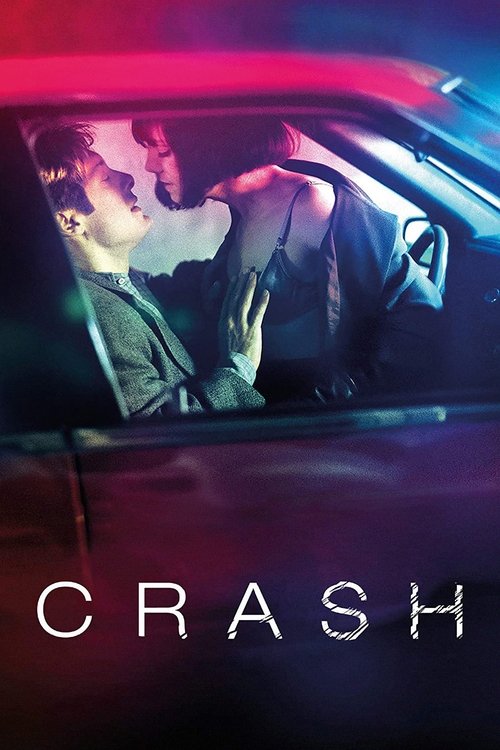
Crash
Crash Is About People Trying to Feel Something Through a Body That Has Gone Numb
Directed by David Cronenberg
Cronenberg shoots the collisions like sex and the sex like collisions, because to these characters they have become the same search: any impact hard enough to prove the nerves still work.
James and Catherine Ballard have an open marriage conducted at a strange emotional distance, reporting their affairs to each other in flat, post-orgasmic murmurs, neither of them able to reach anything through pleasure anymore. Then James is in a head-on crash that kills a man and puts him in a leg brace. In the hospital he meets Helen, the dead man's wife, and Vaughan, a scarred prophet who choreographs re-enactments of celebrity car deaths. Through them James discovers a subculture that has fused the automobile wound with erotic charge. The surface film reads as provocation, a cold catalog of perversion. The actual film is a study of anhedonia, the inability to feel, and the escalating violence required to breach it. These are not thrill-seekers. They are numb people, and the crash is the only stimulus strong enough to register on nerves that have stopped answering ordinary life. Cronenberg's camera stays calm and clinical throughout, because the characters themselves are calm, reaching for the one sensation that still lands.
Alchemical Reading: Seeking Transformation Through Wounding
Alchemy holds that transformation passes through the nigredo, the blackening, a stage of dissolution and wounding that must be undergone before anything new can form. The Crash subculture has intuited this and gotten it catastrophically wrong. They believe the wound itself is the transformation, that the scar is the gold. Cronenberg makes the misreading physical: Gabrielle's legs are caged in gleaming braces and her body opened by grafts of scar tissue that James treats as new erogenous sites, kissing the wound as if it were a mouth. They have mistaken the crucible's damage for the crucible's product. The alchemical operation is meant to break the material down in order to reconstitute it higher. These characters break themselves down and stop there, addicted to the breaking, endlessly repeating the nigredo because they never learned there was a stage beyond it. The final image, James rear-ending Catherine's car until it rolls into the grass, then reaching her and murmuring "maybe the next one," is the confession. The transformation never completes. There is only the next collision.
Buddhist Reading: Craving Escalating Toward the Body's Deadline
The Buddhist analysis of suffering begins with tanha, craving, and its cruel arithmetic: the object that satisfied yesterday no longer satisfies, so the dose must climb. Crash is tanha rendered as a demolition derby. Ordinary sex gave the Ballards nothing, so the craving escalated to sex plus danger, then sex plus injury, then sex plus proximity to death itself, each stage a larger wager to buy the same diminishing hit. Buddhism also teaches that craving fastens onto the body while the body is decaying toward death, and Cronenberg draws the line to its end. Vaughan does not merely court injury. He is driving toward his own death and knows it, and dies as he lived, in a highway crash. The subculture is a congregation organized around the one appetite that can only be fully satisfied by the death it keeps flirting with. The teaching underneath is austere and clear. Craving that seeks intensity instead of peace is a road with one destination, and everyone on it can feel the destination approaching, and that felt approach is exactly what they mistake for being alive.
Questions this film answers
What is the deeper meaning of Crash?
James and Catherine Ballard have an open marriage conducted at a strange emotional distance, reporting their affairs to each other in flat, post-orgasmic murmurs, neither of them able to reach anything through pleasure anymore. Then James is in a head-on crash that kills a man and puts him in a leg brace. In the hospital he meets Helen, the dead man's wife, and Vaughan, a scarred prophet who choreographs re-enactments of celebrity car deaths. Through them James discovers a subculture that has fused the automobile wound with erotic charge. The surface film reads as provocation, a cold catalog of perversion. The actual film is a study of anhedonia, the inability to feel, and the escalating violence required to breach it. These are not thrill-seekers. They are numb people, and the crash is the only stimulus strong enough to register on nerves that have stopped answering ordinary life. Cronenberg's camera stays calm and clinical throughout, because the characters themselves are calm, reaching for the one sensation that still lands.
What is the hidden symbolism in Crash?
Alchemy holds that transformation passes through the nigredo, the blackening, a stage of dissolution and wounding that must be undergone before anything new can form. The Crash subculture has intuited this and gotten it catastrophically wrong. They believe the wound itself is the transformation, that the scar is the gold. Cronenberg makes the misreading physical: Gabrielle's legs are caged in gleaming braces and her body opened by grafts of scar tissue that James treats as new erogenous sites, kissing the wound as if it were a mouth. They have mistaken the crucible's damage for the crucible's product. The alchemical operation is meant to break the material down in order to reconstitute it higher. These characters break themselves down and stop there, addicted to the breaking, endlessly repeating the nigredo because they never learned there was a stage beyond it. The final image, James rear-ending Catherine's car until it rolls into the grass, then reaching her and murmuring "maybe the next one," is the confession. The transformation never completes. There is only the next collision.
What esoteric traditions appear in Crash?
Crash draws from Alchemy, Buddhism traditions. Cronenberg shoots the collisions like sex and the sex like collisions, because to these characters they have become the same search: any impact hard enough to prove the nerves still work.
Is Crash worth watching for spiritual seekers?
Crash (1996) directed by David Cronenberg is essential viewing for those interested in Alchemy, Buddhism. Crash Is About People Trying to Feel Something Through a Body That Has Gone Numb. It rewards multiple viewings and contemplation.
Rewatch With New Eyes
Now that you've seen the architecture, experience it again. The same film becomes a different film when you know what to watch for.
This time, watch for:
- Track the stages: blackening, whitening, reddening — death before rebirth
- See impermanence: what clings, what releases, what remains
Links may include affiliate partnerships that support Media Revelations