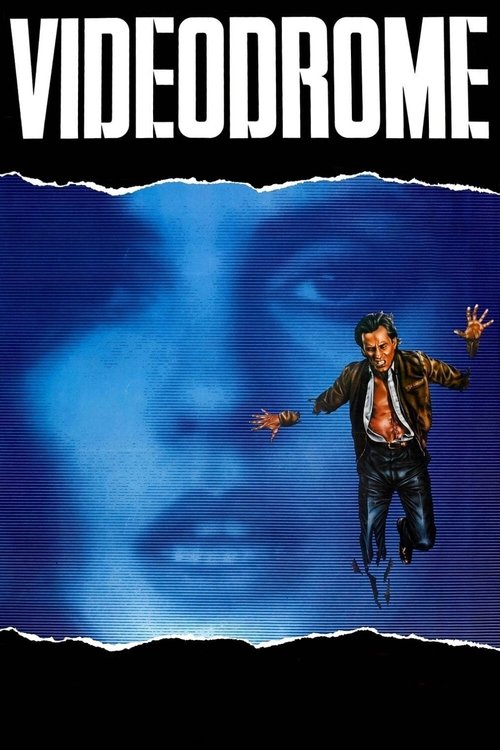
Videodrome
The New Flesh as Technological Possession
Directed by David Cronenberg
Long live the new flesh. Cronenberg predicted the merger of consciousness and media — the screen that watches back, the image that rewrites the body. Max becomes the medium. The gun grows from his hand. We all have the signal now.
Videodrome is a 1983 film that already knew what 2026 looks like. Cronenberg's central claim — that prolonged exposure to certain images produces tumors that produce hallucinations that produce new physical organs — is not science fiction. It is a description of what media has been doing to human nervous systems since television became continuous. Max's vaginal slit in his abdomen, the breathing VHS tape, the gun fused to his hand: these are not symbols of media's effect on us. They are the effect, rendered in a register the body recognizes when the intellect refuses to.
The Surface
A sleazy cable television executive named Max Renn discovers a pirate signal broadcasting what appears to be real torture and murder. He becomes obsessed, watches obsessively, develops a hallucinated vaginal slit in his abdomen, and is recruited by competing factions for whom Videodrome is either a tool of liberation or a weapon of population control. By the end he cannot distinguish hallucination from reality and shoots himself in a derelict ship.
Read as plot, Videodrome is incoherent. Cronenberg meant it that way. The structure of the film mimics the structure of Videodrome itself — a transmission that scrambles your ability to determine what is real, by the time you finish watching you have already received what the film was sending.
The film opened to confused reviews and made very little money. Forty years later, it reads as the most accurate film ever made about screens. Cronenberg saw the trajectory while the rest of us were still watching cable.
The Signal as Demiurge
Videodrome is not a TV show. It is a signal embedded in a TV show. The content does not matter — only the carrier wave. Whatever you watch on a Videodrome-encoded screen rewires you. The signal does not need the cooperation of your beliefs. It does not even need the cooperation of your attention. It alters the substrate of perception.
This is a Gnostic structure. The Demiurge does not need to be believed in to operate. The false world is maintained at a level beneath the level where belief takes place. By the time you are wondering whether to trust the world, the world has already constructed the wondering.
Brian O'Blivion, the prophet-figure who only appears through television, explains the cosmology: 'The television screen is the retina of the mind's eye. Therefore, the television screen is part of the physical structure of the brain.' He is not being metaphorical. He is describing what extended exposure does. The screen becomes brain tissue. The brain becomes screen tissue. The boundary stops mattering.
Forty years later we hold the screen six inches from our face for nine hours a day and call this normal. O'Blivion was the prophet whose prophecy was so accurate that it just sounds like a description of our morning.
The New Flesh
Max develops a slit in his abdomen — vaginal, receptive, a new orifice. Videotapes can be inserted into it. The gun he is given by Videodrome's enforcers eventually fuses with his hand. His body is being rewritten by the signal it has been receiving.
This is alchemical structure. The prima materia of the human body is dissolved and recombined. Cronenberg called the film a meditation on the alchemy of the screen age. The new flesh is not metaphor for psychological change. It is literal — the substance is being transmuted.
Watch what people look like now after fifteen years of phones. Posture changed. Eye movement changed. Attention windows changed. Sleep architecture changed. Hands curve toward an invisible device when no device is held. The body is being shaped by the medium. The medium has been shaping us long enough that the shape is now species-typical.
The new flesh is also liberation, in O'Blivion's reading. The body that emerges from sustained screen-exposure is not just damaged human flesh. It is something that has not existed before. We do not yet know what it is for. We do not yet know whether it can be used for anything other than the purposes the signal had in mind for it.
Long Live the New Flesh
The film's final sequence is Max in an abandoned ship watching a television. On the screen, his own image tells him: 'To become the new flesh, you first have to kill the old flesh. Don't be afraid to let your body die.' His image shoots himself. Max raises the gun. He says 'Long live the new flesh.' He shoots himself. The film ends.
This can be read as defeat — the signal completed its capture, the man killed himself. It can also be read as initiation — the old self died, the new flesh is now free to emerge. Cronenberg lets both stand. The point is that there is no longer a stable self that could prefer one reading over the other.
Real initiation includes this. The old self does not survive. The new self is unknown. Between them is a moment of action that has the form of suicide and the function of birth. Modern people have largely lost access to such transitions because we no longer have ritual containers — but we still have screens, and the screens are doing the work, badly, on whoever is watching.
Max becomes the medium. The signal had to find a human body to inhabit and propagate. By the end of the film he is no longer an executive watching a show. He is the show. This was the goal of Videodrome all along. The viewer was the product. He just did not know it until he was finished being made.
The Transmission
Cronenberg made this film at the dawn of cable. He could not have predicted phones, TikTok, the gut-microbe of recommended-content. He did not have to. He understood the principle. Once the screen becomes continuous, the brain becomes the screen, and what happens to the brain is determined by what is broadcast.
The horror of Videodrome is not that it depicts something monstrous happening to one man. The horror is that it depicts something ordinary happening to all of us, at a slower pace, and the pace makes us miss it. Cronenberg sped it up so the body horror became visible.
Long live the new flesh. We are it. The old human died sometime in the last two decades and most of us did not notice the moment. The film is the prophecy and the autopsy, simultaneously, made in 1983 and aging into accuracy.
Questions this film answers
What is the deeper meaning of Videodrome?
Videodrome is a 1983 film that already knew what 2026 looks like. Cronenberg's central claim — that prolonged exposure to certain images produces tumors that produce hallucinations that produce new physical organs — is not science fiction. It is a description of what media has been doing to human nervous systems since television became continuous. Max's vaginal slit in his abdomen, the breathing VHS tape, the gun fused to his hand: these are not symbols of media's effect on us. They are the effect, rendered in a register the body recognizes when the intellect refuses to.
What is the hidden symbolism in Videodrome?
A sleazy cable television executive named Max Renn discovers a pirate signal broadcasting what appears to be real torture and murder. He becomes obsessed, watches obsessively, develops a hallucinated vaginal slit in his abdomen, and is recruited by competing factions for whom Videodrome is either a tool of liberation or a weapon of population control. By the end he cannot distinguish hallucination from reality and shoots himself in a derelict ship.
What esoteric traditions appear in Videodrome?
Videodrome draws from Gnosticism, Alchemy traditions. Long live the new flesh. Cronenberg predicted the merger of consciousness and media — the screen that watches back, the image that rewrites the body. Max becomes the medium. The gun grows from his hand. We all have the signal now.
What does Videodrome teach about the signal as demiurge?
By the time you are wondering whether to trust the world, the world has already constructed the wondering. Videodrome is not a TV show. It is a signal embedded in a TV show. The content does not matter — only the carrier wave. Whatever you watch on a Videodrome-encoded screen rewires you. The signal does not need the cooperation of your beliefs. It does not even need the cooperation of your attention. It alters the substrate of perception.
What does Videodrome teach about the new flesh?
The body is being shaped by the medium. The medium has been shaping us long enough that the shape is now species-typical. Max develops a slit in his abdomen — vaginal, receptive, a new orifice. Videotapes can be inserted into it. The gun he is given by Videodrome's enforcers eventually fuses with his hand. His body is being rewritten by the signal it has been receiving.
Is Videodrome worth watching for spiritual seekers?
Videodrome (1983) directed by David Cronenberg is essential viewing for those interested in Body Horror, Media, Cronenberg. The New Flesh as Technological Possession. It rewards multiple viewings and contemplation.
Rewatch With New Eyes
Now that you've seen the architecture, experience it again. The same film becomes a different film when you know what to watch for.
This time, watch for:
- Watch for the false world vs. the real — who is asleep, who awakens
- Track the stages: blackening, whitening, reddening — death before rebirth
Links may include affiliate partnerships that support Media Revelations