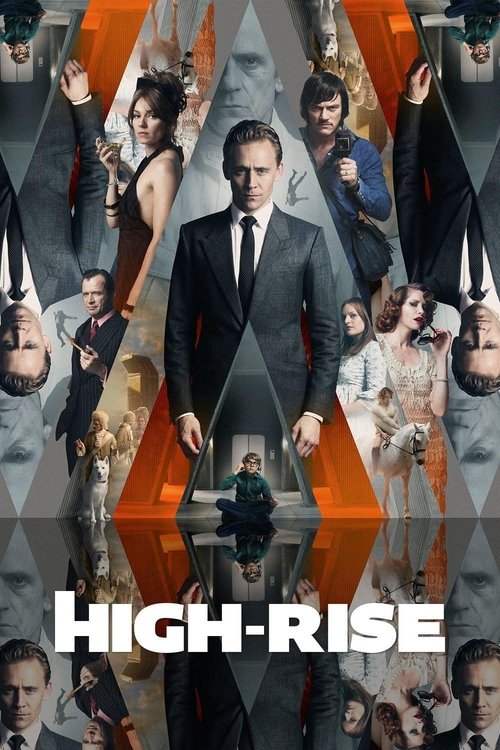
High-Rise
High-Rise Is a Vertical Body Rotting From the Head Down
Directed by Ben Wheatley
Ben Wheatley shot Ballard's tower as an organism eating itself. The building is not the setting. It is the patient.
Dr. Robert Laing moves into a brutalist tower where the poor live low and the rich live high, and within weeks the whole structure decomposes into tribal warfare, garbage-choked corridors, and rooftop rites. The easy reading is class allegory: the wealthy on top, the workers below, the elevator as the ladder nobody climbs. That reading is correct and also too small. What Wheatley films is a single body. Laing is a physiologist. He dissects a human head in the opening lecture, peeling back the scalp to show students what is underneath the face. The tower is that head, and the film is the dissection continued at architectural scale. Every floor is an organ. The power that keeps failing is the nervous system. And Laing, the man who studies bodies for a living, is the one cell that watches the organism die without ever leaving it.
Alchemical Reading: The Tower as a Failed Athanor
The athanor is the alchemist's furnace, the sealed vessel where base matter is cooked toward gold. Anthony Royal, the architect, lives at the summit in a rooftop garden with a white horse and calls the building his "crucible for change." He means it. He built a sealed vertical container and sealed the residents inside to see what they would become. This is the alchemical dream stated aloud: pressure and confinement transmute the prima materia into something higher.
It does not transmute. It putrefies. The nigredo, the blackening, is the necessary first death in the alchemical opus, and the tower reaches it and stops. The swimming pool fills with filth and a drowned body. The supermarket becomes a battlefield over the last cans of paint and food. Laing methodically paints his apartment grey, then repaints, tending one small square of order while the vessel around him rots. The furnace works perfectly. What it produces is simply what was already inside. Royal wanted gold and got the truth: seal civilized people in a pressure vessel and the heat does not refine them, it renders them down to the animal that was always the base material. The opus fails not because the container is flawed but because there was no gold in the lead to begin with.
Gnostic Reading: A Demiurge Who Believes His Own Design
In Gnostic cosmology the Demiurge is the false creator who builds a flawed material world and mistakes it for perfection, blind to how broken his own architecture is. Royal is that figure exactly. He designed the tower, he lives in its highest room, he surveys the floors below as his creation, and he genuinely believes the collapse is a feature. When the building descends into chaos he does not flee. He convenes with the other architects and speaks of the tower "finding its natural order," as if catastrophe were the plan maturing.
The residents are the trapped souls of the Gnostic world, sparks of consciousness caught in a material structure that was designed to fail them. They could leave. The doors work, the roads outside are intact, the ordinary world continues beyond the parking lot. They stay because the tower has become their entire cosmos and they can no longer imagine an outside. Laing alone keeps a flicker of the pneumatic in him, the one who half-sees the prison. But even he does not walk out. He rebuilds his life among the ruins and, in the final shot, listens to a child recite Thatcher on the free market. He has chosen the fallen world. He calls it home.
Questions this film answers
What is the deeper meaning of High-Rise?
Dr. Robert Laing moves into a brutalist tower where the poor live low and the rich live high, and within weeks the whole structure decomposes into tribal warfare, garbage-choked corridors, and rooftop rites. The easy reading is class allegory: the wealthy on top, the workers below, the elevator as the ladder nobody climbs. That reading is correct and also too small. What Wheatley films is a single body. Laing is a physiologist. He dissects a human head in the opening lecture, peeling back the scalp to show students what is underneath the face. The tower is that head, and the film is the dissection continued at architectural scale. Every floor is an organ. The power that keeps failing is the nervous system. And Laing, the man who studies bodies for a living, is the one cell that watches the organism die without ever leaving it.
What is the hidden symbolism in High-Rise?
The athanor is the alchemist's furnace, the sealed vessel where base matter is cooked toward gold. Anthony Royal, the architect, lives at the summit in a rooftop garden with a white horse and calls the building his "crucible for change." He means it. He built a sealed vertical container and sealed the residents inside to see what they would become. This is the alchemical dream stated aloud: pressure and confinement transmute the prima materia into something higher.
What esoteric traditions appear in High-Rise?
High-Rise draws from Alchemy, Gnosticism traditions. Ben Wheatley shot Ballard's tower as an organism eating itself. The building is not the setting. It is the patient.
Is High-Rise worth watching for spiritual seekers?
High-Rise (2015) directed by Ben Wheatley is essential viewing for those interested in Alchemy, Gnosticism. High-Rise Is a Vertical Body Rotting From the Head Down. It rewards multiple viewings and contemplation.
Rewatch With New Eyes
Now that you've seen the architecture, experience it again. The same film becomes a different film when you know what to watch for.
This time, watch for:
- Track the stages: blackening, whitening, reddening — death before rebirth
- Watch for the false world vs. the real — who is asleep, who awakens
Links may include affiliate partnerships that support Media Revelations
The Descent Continues
Where this thread leads next.

Snowpiercer 2013
Snowpiercer Is a Gnostic Escape Story Disguised as a Revolution
Read the revelation →