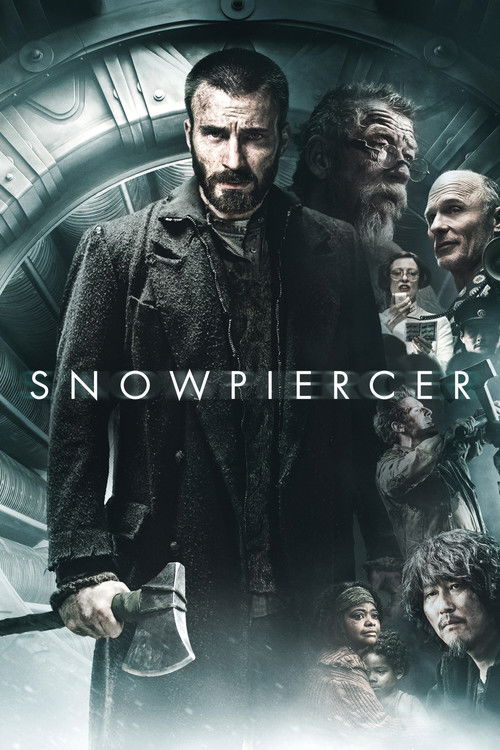
Snowpiercer
Snowpiercer Is a Gnostic Escape Story Disguised as a Revolution
Directed by Bong Joon Ho
Curtis fights his way to the front of the train believing he wants the engine. He wants the door.
Snowpiercer looks like a class parable, and on the surface it is one: the tail eats protein bars made of insects while the front eats sushi, and the poor rise up and march forward car by car through the machine. But Bong Joon Ho built the revolution to fail as a revolution and succeed as something stranger. When Curtis finally reaches Wilford in the engine, Wilford does not resist. He offers Curtis the throne. The whole uprising, it turns out, was designed by the system, a pressure valve to cull the population and keep the balance. Taking the engine changes nothing. The train is a closed loop, a perpetual-motion god that requires human sacrifice, child labor, and the periodic bloodletting of a fake rebellion to keep running forever. The revolutionary who wins the engine only becomes the new Wilford. The film's real hero is the one who stops looking forward and starts looking sideways, at the wall, at the frozen world outside, at the door nobody thinks to open.
Gnostic Reading: The Engine Is the Demiurge and the World Is a Prison Train
In Gnostic cosmology, the material world is a prison built by a false god, the Demiurge, who rules it and calls his rule order and calls it necessity. The train is that world exactly. Wilford is the Demiurge: the maker of the "sacred engine," the one who preaches that the closed system is eternal and that everyone must keep their "preordained position." He even speaks the Demiurge's core lie, that the misery is required for the whole to survive.
Curtis is the failed savior who accepts the Demiurge's terms, and so the Demiurge nearly makes him the successor. The genuine gnostic is Namgoong Minsu, the security engineer who built the doors. While everyone else fights over who controls the world, he studies the way out. He has watched a frozen wing melt a fraction more each year and understood the truth the engine denies: the outside is survivable, the prison is not eternal, there is a world beyond the walls. Gnosis is not conquest of the system. It is the recognition that the system is not the whole of reality. Namgoong does not take the engine. He blows the door.
Kabbalistic Reading: The Train as Fallen Vessel That Must Be Shattered
Kabbalah tells of vessels made to hold divine light that could not contain it and shattered, scattering sparks into a broken world that awaits repair. The train is a vessel that did not shatter and should have. It holds a shard of surviving life sealed inside a rigid form, and that form has hardened into idolatry: children worship the engine, a teacher leads them in hymns to Wilford, the vessel is mistaken for the light it carries.
Tikkun, the repair, does not come from reorganizing the cars or crowning a kinder ruler. It comes from breaking the vessel open so the sparks can escape into the world that needs them. Yona, the clairvoyant girl born on the train who can see through walls, is the one who reads the vessel truly. The final image is the two youngest survivors stepping into the snow and seeing a polar bear alive on the mountainside. Life persisted outside the vessel the whole time. The repair was never to perfect the train. It was to end it.
Questions this film answers
What is the deeper meaning of Snowpiercer?
Snowpiercer looks like a class parable, and on the surface it is one: the tail eats protein bars made of insects while the front eats sushi, and the poor rise up and march forward car by car through the machine. But Bong Joon Ho built the revolution to fail as a revolution and succeed as something stranger. When Curtis finally reaches Wilford in the engine, Wilford does not resist. He offers Curtis the throne. The whole uprising, it turns out, was designed by the system, a pressure valve to cull the population and keep the balance. Taking the engine changes nothing. The train is a closed loop, a perpetual-motion god that requires human sacrifice, child labor, and the periodic bloodletting of a fake rebellion to keep running forever. The revolutionary who wins the engine only becomes the new Wilford. The film's real hero is the one who stops looking forward and starts looking sideways, at the wall, at the frozen world outside, at the door nobody thinks to open.
What is the hidden symbolism in Snowpiercer?
In Gnostic cosmology, the material world is a prison built by a false god, the Demiurge, who rules it and calls his rule order and calls it necessity. The train is that world exactly. Wilford is the Demiurge: the maker of the "sacred engine," the one who preaches that the closed system is eternal and that everyone must keep their "preordained position." He even speaks the Demiurge's core lie, that the misery is required for the whole to survive.
What esoteric traditions appear in Snowpiercer?
Snowpiercer draws from Gnosticism, Kabbalah traditions. Curtis fights his way to the front of the train believing he wants the engine. He wants the door.
Is Snowpiercer worth watching for spiritual seekers?
Snowpiercer (2013) directed by Bong Joon Ho is essential viewing for those interested in Gnosticism, Kabbalah. Snowpiercer Is a Gnostic Escape Story Disguised as a Revolution. It rewards multiple viewings and contemplation.
Rewatch With New Eyes
Now that you've seen the architecture, experience it again. The same film becomes a different film when you know what to watch for.
This time, watch for:
- Watch for the false world vs. the real — who is asleep, who awakens
- Notice the vessels: what contains, what shatters, what repairs
Links may include affiliate partnerships that support Media Revelations