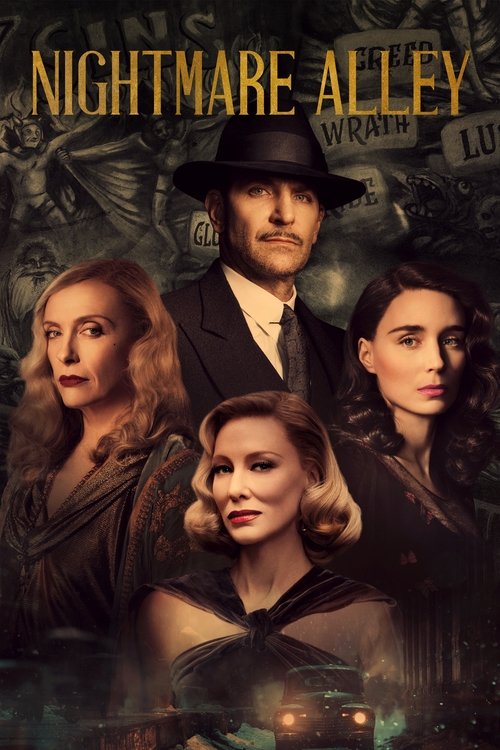
Nightmare Alley
Nightmare Alley Is the Story of a Man Who Ran From the Geek Straight Into Becoming Him
Directed by Guillermo del Toro
Del Toro opens on a man dragging a corpse to a hole in the floor and burning down the house. He is trying to bury the beginning. The film spends two hours proving the beginning was the end.
Stanton Carlisle arrives at the carnival with a burned house behind him and no name worth keeping. He watches the geek, the ruined man who bites the heads off chickens for a bottle a day, and he asks the question that damns him: how do you make a man do that? The barker explains. You find someone at the bottom, you give him the bottle, you tell him it is temporary, and temporary becomes forever. Stanton hears a warning. He treats it as a business model. He rises on stolen mentalism, ascends into tuxedos and marble hotel suites, and every rung up is built from a man he used and discarded. The film is not about a con artist who overreaches. It is about a soul that saw the pit clearly, understood exactly how one falls in, and walked the whole architecture on purpose while believing he was climbing.
Alchemical Reading: The Nigredo That Refuses to Become Anything Else
Alchemy begins with the nigredo, the blackening, the putrefaction where the old self is dissolved so that something can be born from the rot. Stanton is given the nigredo as his opening condition. The burned house, the buried body, the descent into the carnival's underworld of freaks and false spirits: this is the prima materia broken down, the beginning of the work. The whole promise of the operation is that dissolution leads somewhere. The blackness is supposed to yield the white, then the red, then the gold.
Stanton counterfeits every stage instead of undergoing it. He performs illumination for paying audiences, the fake spiritualist act where he pretends to channel the dead, gold-lit and glowing in the theater. It is the albedo staged as a con. He reaches for the reddening, the coniunctio, in his partnership with the psychologist Lilith Ritter, and she dissolves him instead, because the true agent of transformation always arrives from outside your control. The alchemists were explicit that the counterfeit gold, the sophic sulphur faked rather than achieved, poisons the operator. Stanton took the raw material of a real death and refused to let it transform him. The vessel cracks at the end, and what pours out is exactly what went in, unrefined.
Jungian Reading: The Shadow He Sold Tickets To
Jung held that the shadow is not evil but disowned, the part of the self we exile and then meet again in the world wearing a stranger's face. Stanton's shadow is the geek. He looks at the ruined man in the pit and feels only distance, only the cold arithmetic of how the trick is done. He never once suspects he is looking at himself.
Everything he does afterward is a campaign against that recognition. He drinks while insisting he does not drink like his father. He runs the ghost act on grieving people while telling himself he is different from the fraud who wrecked his family. The unintegrated shadow does not disappear. It waits, and it collects. When the final door opens and the carnival owner offers Stanton work, the job is the geek, and Stanton's own laughter breaks into weeping as he says the line that closes the circle: "Mister, I was born for it." He met his shadow in the world. He had already become it.
Questions this film answers
What is the deeper meaning of Nightmare Alley?
Stanton Carlisle arrives at the carnival with a burned house behind him and no name worth keeping. He watches the geek, the ruined man who bites the heads off chickens for a bottle a day, and he asks the question that damns him: how do you make a man do that? The barker explains. You find someone at the bottom, you give him the bottle, you tell him it is temporary, and temporary becomes forever. Stanton hears a warning. He treats it as a business model. He rises on stolen mentalism, ascends into tuxedos and marble hotel suites, and every rung up is built from a man he used and discarded. The film is not about a con artist who overreaches. It is about a soul that saw the pit clearly, understood exactly how one falls in, and walked the whole architecture on purpose while believing he was climbing.
What is the hidden symbolism in Nightmare Alley?
Alchemy begins with the nigredo, the blackening, the putrefaction where the old self is dissolved so that something can be born from the rot. Stanton is given the nigredo as his opening condition. The burned house, the buried body, the descent into the carnival's underworld of freaks and false spirits: this is the prima materia broken down, the beginning of the work. The whole promise of the operation is that dissolution leads somewhere. The blackness is supposed to yield the white, then the red, then the gold.
What esoteric traditions appear in Nightmare Alley?
Nightmare Alley draws from Alchemy, Jungian traditions. Del Toro opens on a man dragging a corpse to a hole in the floor and burning down the house. He is trying to bury the beginning. The film spends two hours proving the beginning was the end.
Is Nightmare Alley worth watching for spiritual seekers?
Nightmare Alley (2021) directed by Guillermo del Toro is essential viewing for those interested in Alchemy, Jungian. Nightmare Alley Is the Story of a Man Who Ran From the Geek Straight Into Becoming Him. It rewards multiple viewings and contemplation.
Rewatch With New Eyes
Now that you've seen the architecture, experience it again. The same film becomes a different film when you know what to watch for.
This time, watch for:
- Track the stages: blackening, whitening, reddening — death before rebirth
- Meet the shadow: what is rejected, projected, and finally integrated
Links may include affiliate partnerships that support Media Revelations
The Descent Continues
Where this thread leads next.
Angel Heart 1987
Harry Angel Is Already Damned When the Film Begins. The Investigation Is the Proof.
Read the revelation →