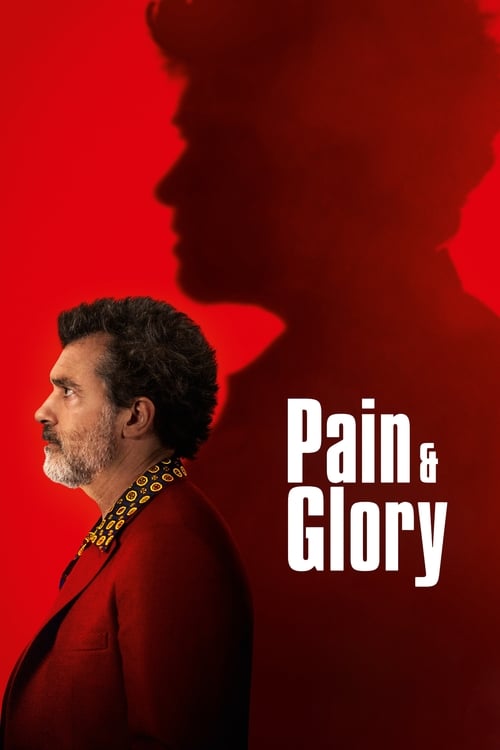
Pain and Glory
Pain and Glory Is What Happens When a Man Turns His Own Body Into the Studio
Directed by Pedro Almodóvar
Salvador cannot direct because he cannot move. Almodóvar's answer is to make the illness itself the film.
Salvador Mallo is a filmmaker who has stopped making films. His body has become a catalogue of failures: back pain, migraines, tinnitus, a throat that closes, a spine fused wrong. He recites the list to us over animated cutaway diagrams, as though pain were a filmography. The surface reading is that this is a late-career self-portrait, Almodóvar filming his own aches through a stand-in played by Antonio Banderas dressed and coiffed to look exactly like the director. But the film is doing something more precise than confession. It is an account of how a blocked man breaks his own seal. Salvador begins the film sealed inside his body and his apartment, refusing to work, chasing heroin from an old actor. He ends it walking, shooting a scene, alive. What moves him from one state to the other is not medicine. It is memory correctly handled, the past run through the vessel until it yields.
Alchemical Reading: Heroin Is the False Solvent, Memory Is the True One
Alchemy distinguishes between the false dissolution that only numbs and the true solutio that releases what is bound. Salvador tries the false one first. He smokes heroin with Alberto, the actor he estranged decades ago, and the drug does dissolve something: it opens the door to his childhood, to the village of Paterna, to his mother Jacinta washing sheets in the river and singing. The heroin is a solvent that works and poisons at once. It gives him the images but takes his capacity to use them. He nods off mid-memory. The prima materia surfaces and then sinks back undeveloped.
The true solvent arrives without the needle. Alberto finds an old confession Salvador wrote and performs it on stage, and the man Salvador loved in Madrid in the eighties, Federico, is in the audience and comes to the apartment that night. The material Salvador buried in a drawer walks back into the room as a living person. That is the difference between the drug and the work: the drug returned images he could only watch, the confession returned a wound he could finally close. He quits the heroin after this. He gets the surgery. The opus completes not when the pain leaves but when he stops using it as an excuse to stay sealed.
Jungian Reading: The Mother Is the First Frame and the Last
Jung held that the mother imago is the ground of every later image a psyche produces, the first form through which the world is received. Salvador's whole aesthetic is his mother's. The film shows us why. As a boy he decorates the cave-house they move into in Paterna, tiling the walls, making beauty from a hole in the ground, and Jacinta watches him with a mix of pride and unease at a son who is already an artist and already other than her. The last time we see her, old and dying, she tells him she does not like being played by an actress in his films, that he has failed her as a son by turning her into material.
The film's final shot answers her. The camera pulls back to reveal that the village memory we have been watching is a set, a scene Salvador is now shooting. He has become able to work again by placing his mother inside the frame at last, not to betray her but to keep her. The wound she named and the art she seeded turn out to be the same thing viewed from two ages of one life.
Other Almodóvar films where the mother is the hidden engine: All About My Mother (grief that generates a new family), Volver (the mother who returns from the dead to finish her work), Parallel Mothers (motherhood as buried history).
Questions this film answers
What is the deeper meaning of Pain and Glory?
Salvador Mallo is a filmmaker who has stopped making films. His body has become a catalogue of failures: back pain, migraines, tinnitus, a throat that closes, a spine fused wrong. He recites the list to us over animated cutaway diagrams, as though pain were a filmography. The surface reading is that this is a late-career self-portrait, Almodóvar filming his own aches through a stand-in played by Antonio Banderas dressed and coiffed to look exactly like the director. But the film is doing something more precise than confession. It is an account of how a blocked man breaks his own seal. Salvador begins the film sealed inside his body and his apartment, refusing to work, chasing heroin from an old actor. He ends it walking, shooting a scene, alive. What moves him from one state to the other is not medicine. It is memory correctly handled, the past run through the vessel until it yields.
What is the hidden symbolism in Pain and Glory?
Alchemy distinguishes between the false dissolution that only numbs and the true solutio that releases what is bound. Salvador tries the false one first. He smokes heroin with Alberto, the actor he estranged decades ago, and the drug does dissolve something: it opens the door to his childhood, to the village of Paterna, to his mother Jacinta washing sheets in the river and singing. The heroin is a solvent that works and poisons at once. It gives him the images but takes his capacity to use them. He nods off mid-memory. The prima materia surfaces and then sinks back undeveloped.
What esoteric traditions appear in Pain and Glory?
Pain and Glory draws from Alchemy, Jungian traditions. Salvador cannot direct because he cannot move. Almodóvar's answer is to make the illness itself the film.
Is Pain and Glory worth watching for spiritual seekers?
Pain and Glory (2019) directed by Pedro Almodóvar is essential viewing for those interested in Alchemy, Jungian. Pain and Glory Is What Happens When a Man Turns His Own Body Into the Studio. It rewards multiple viewings and contemplation.
Rewatch With New Eyes
Now that you've seen the architecture, experience it again. The same film becomes a different film when you know what to watch for.
This time, watch for:
- Track the stages: blackening, whitening, reddening — death before rebirth
- Meet the shadow: what is rejected, projected, and finally integrated
Links may include affiliate partnerships that support Media Revelations