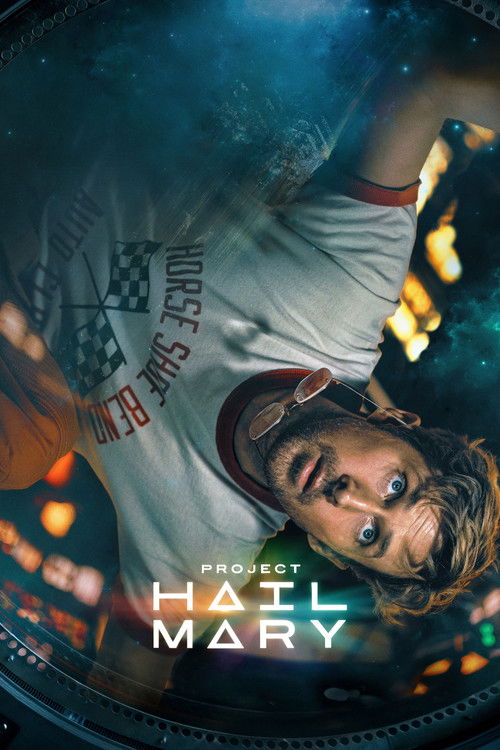
Project Hail Mary
Rocky Isn't the Alien — He's the Teacher You Already Had
Directed by Phil Lord & Christopher Miller
Two beings separated by every conceivable measure — different biology, different atmosphere, different stars — meet in the void and build a language from nothing. What they transmit to each other cannot be explained. Only received. Project Hail Mary is the most precise rendering of Buddhist teacher-student transmission in mainstream cinema, hidden inside the most optimistic hard sci-fi film of the decade.
Project Hail Mary is not a survival story. Ryland Grace solves problems — yes — but the actual subject is what happens when a teacher arrives in the one form you cannot possibly recognize as a teacher: utterly alien, sharing no language, no biology, no history, no planet. Rocky is the guru. The Eridian communication system is the koan. The choice to stay at the end is not sacrifice — it is completion, the moment the student finally becomes what the teacher modeled. And astrophage, the organism consuming every star in the galaxy, is the solve et coagula: the shared crisis that dissolves the separation between two civilizations and reconstitutes them as something neither could be alone.
The Surface
Andy Weir writes survival stories. His heroes are engineers: they duct-tape, calculate, and think their way out of catastrophes with relentless good cheer. Project Hail Mary appears to follow this template exactly — an astronaut wakes up alone, pieces together where he is, and applies rigorous scientific method to save humanity from an organism eating the Sun.
That reading is correct. It is also the least interesting thing about the film.
The real architecture is initiatory. A man arrives stripped of his past, encounters a being he cannot comprehend, builds a relationship that exceeds every category he brought with him, and at the end chooses not to return. This is not a plot about survival. It is a plot about transformation — about what happens when you meet the teacher you needed and finally let yourself be taught.
Weir named his protagonist Ryland Grace. In a book full of meticulous technical accuracy, this name is not accidental. Grace is what arrives when effort runs out. Grace is what the mission requires — and what the man must become.
Rocky as the Guru You Already Had
Every esoteric tradition has a version of the same figure: the teacher who arrives when you're ready, in a form you didn't expect, from a direction you didn't anticipate. The Zen master who doesn't look like a Zen master. The Sufi sheikh who appears as an ordinary stranger. The Tibetan lama who finds the student rather than the other way around.
Rocky is this figure.
Rocky doesn't look like a teacher. Rocky is a spider-shaped, ammonia-breathing creature from a planet orbiting another star, perceiving the world through senses Grace can't access, communicating through pressure waves, surviving temperatures that would kill a human in seconds. Rocky is as alien as anything in cinema — genuinely other, not a human in a suit.
And Rocky knows things Grace needs to know. Not just scientifically — though Rocky is a brilliant engineer — but existentially. Rocky models a way of being in extreme circumstances that Grace cannot access alone: steady under pressure, curious about everything, loyal without conditions, entirely unafraid of the void. When Grace panics, Rocky works. When Grace despairs, Rocky builds.
The Buddhist concept of the kalyana-mitra — the 'spiritual friend' — describes exactly this relationship. The teacher doesn't lecture. The teacher demonstrates. The student learns by proximity, by working alongside, by absorbing something that cannot be transmitted through explanation alone. You cannot become Rocky-caliber by studying Rocky. You become it by being near Rocky when it matters.
Rocky doesn't arrive as a teacher. He arrives as a problem to be solved. That is exactly how the best teachers arrive.
The Language Problem as Koan
The film's most extraordinary sequence is the invention of a shared language. Grace knows music theory. Rocky's species communicates in precise frequencies. Slowly, through trial and error and mathematical intuition, they build a bridge — not by translating their respective languages into each other but by constructing something new that belongs to neither of them.
This is transmission in the Buddhist sense: not the transfer of information but the creation of conditions in which understanding arises on its own.
Bodhidharma held up a flower. Mahakashyapa smiled. The teaching passed between them — not through words, not through doctrine, but through a moment of shared recognition between two minds who met across a gap no explanation could bridge. 'A special transmission outside the scriptures. Not dependent on words and letters.'
The Eridian communication system renders this structural point literal. You cannot speak to Rocky in English. Rocky cannot speak to you in Eridian. But you can sit together in the abyss, start from mathematics — the one thing neither species invented but both discovered — and work your way toward: I am glad you exist.
The emotional core of the film is not the science. It is this: that consciousness recognizes itself across any gap, and that this recognition is the real first contact. Not technological. Not political. Conscious.
Astrophage as Solve et Coagula
Solve et coagula: dissolve and reconstitute. The fundamental alchemical operation. First, the prima materia is broken down — all structure dissolved, all form released. Then, in the dissolution, elements previously separated can combine. Finally, a new substance coagulates: something that could not have existed before the dissolution.
Astrophage is the solve.
A microorganism consuming starlight across the galaxy. Earth's Sun dimming. Rocky's star dimming. Two civilizations that have never met, that share no biology, no language, no physical reference point, that would have had no reason to find each other across the void — suddenly share a crisis. The astrophage dissolves their separateness.
The friendship that forms between Grace and Rocky is the coagula: something that could not have existed without the crisis. There is no version of this encounter that happens voluntarily. Rocky and Grace meet because they are both dying, both sent on impossible missions by civilizations that cannot solve the problem alone.
The alchemical insight is that the dissolving force — the thing you're trying to eliminate — is also the transformation agent. You cannot have the gold without the fire that melts everything down. Astrophage is the shadow that makes the alliance possible. The shared enemy is also the initiator.
This is what it means to be united by the wound rather than divided by it. The astrophage crisis was the condition of their meeting — which means it was, in the deepest sense, the condition of everything the film becomes.
The Choice to Stay
Here is what the ending actually means.
Grace solves the problem. He has the formula. He could make it home. Rocky's people are already applying the solution. Humanity will survive. The mission — technically, formally, by every metric — is complete. Grace can go home.
Grace chooses to stay.
The Grace who was pressed into this mission didn't want to die. He said so, clearly. He was a teacher who had stopped believing in his own teaching, who stumbled into heroism against his will, chosen partly because he was expendable. The man who went to sleep in that pod was unfinished.
In initiation traditions from the mystery schools of Eleusis to the Tibetan Bardo teachings, the initiatory journey has a specific structure: departure, ordeal, transformation, return — or transcendence. The question the tradition always asks at the end is whether the changed person can go back. Or whether the transformation has placed them permanently elsewhere.
Grace has been placed permanently elsewhere. Not because he can't physically return. Because he now knows what he is: someone who belongs where the teaching happens. He has, finally, become a teacher in the truest sense — not explaining what he read in textbooks but transmitting what he survived.
Staying is not sacrifice. Staying is completion. The initiation is done. The student learned from Rocky. The student stayed to be near Rocky. The loop closes. The hero has become the guru.
The Transmission
This is not a film about saving the Earth. That is the premise, not the point.
The point is that Rocky and Grace — two beings separated by every conceivable measure — found each other in the dark, built something neither could build alone, and in doing so proved something the rest of the universe needed to know: that consciousness is not local, that recognition is possible across the maximum gap, that the teacher you need will arrive in the form you least expect.
And that sometimes staying — surrendering the return, releasing the hero's homecoming — is the most complete act available to a being who has finally understood its purpose.
The Sun was saved. But what endures is the transmission: two minds across the void, building a language from nothing, teaching each other how to be the beings the universe requires them to become.
That is the real Hail Mary. Not the long pass. The prayer, answered.
Questions this film answers
What is the deeper meaning of Project Hail Mary?
Project Hail Mary is not a survival story. Ryland Grace solves problems — yes — but the actual subject is what happens when a teacher arrives in the one form you cannot possibly recognize as a teacher: utterly alien, sharing no language, no biology, no history, no planet. Rocky is the guru. The Eridian communication system is the koan. The choice to stay at the end is not sacrifice — it is completion, the moment the student finally becomes what the teacher modeled. And astrophage, the organism consuming every star in the galaxy, is the solve et coagula: the shared crisis that dissolves the separation between two civilizations and reconstitutes them as something neither could be alone.
What is the hidden symbolism in Project Hail Mary?
Andy Weir writes survival stories. His heroes are engineers: they duct-tape, calculate, and think their way out of catastrophes with relentless good cheer. Project Hail Mary appears to follow this template exactly — an astronaut wakes up alone, pieces together where he is, and applies rigorous scientific method to save humanity from an organism eating the Sun.
What esoteric traditions appear in Project Hail Mary?
Project Hail Mary draws from Buddhism, Alchemy, Initiation, Hard-sci-fi traditions. Two beings separated by every conceivable measure — different biology, different atmosphere, different stars — meet in the void and build a language from nothing. What they transmit to each other cannot be explained. Only received. Project Hail Mary is the most precise rendering of Buddhist teacher-student transmission in mainstream cinema, hidden inside the most optimistic hard sci-fi film of the decade.
What does Project Hail Mary teach about the language problem as koan?
You cannot speak to Rocky in any language. But you can sit together in the abyss, start from mathematics, and work your way to: I am glad you exist. The film's most extraordinary sequence is the invention of a shared language. Grace knows music theory. Rocky's species communicates in precise frequencies. Slowly, through trial and error and mathematical intuition, they build a bridge — not by translating their respective languages into each other but by constructing something new that belongs to neither of them.
What does Project Hail Mary teach about astrophage as solve et coagula?
The astrophage is the shadow that unites. The thing you're trying to eliminate is also the agent of transformation. Solve et coagula: dissolve and reconstitute. The fundamental alchemical operation. First, the prima materia is broken down — all structure dissolved, all form released. Then, in the dissolution, elements previously separated can combine. Finally, a new substance coagulates: something that could not have existed before the dissolution.
What does Project Hail Mary teach about the choice to stay?
Staying is not sacrifice. Staying is completion. The initiation is done. The hero has become the guru. Here is what the ending actually means.
Is Project Hail Mary worth watching for spiritual seekers?
Project Hail Mary (2026) directed by Phil Lord & Christopher Miller is essential viewing for those interested in Buddhism, Alchemy, Teacher-Student. Rocky Isn't the Alien — He's the Teacher You Already Had. It rewards multiple viewings and contemplation.
Rewatch With New Eyes
Now that you've seen the architecture, experience it again. The same film becomes a different film when you know what to watch for.
This time, watch for:
- See impermanence: what clings, what releases, what remains
- Track the stages: blackening, whitening, reddening — death before rebirth
- Mark the threshold: the old self dies, the ordeal transforms, the new self returns
Links may include affiliate partnerships that support Media Revelations
The Descent Continues
Where this thread leads next.

Arrival 2016
Language as the Door to Non-Linear Being
Read the revelation →