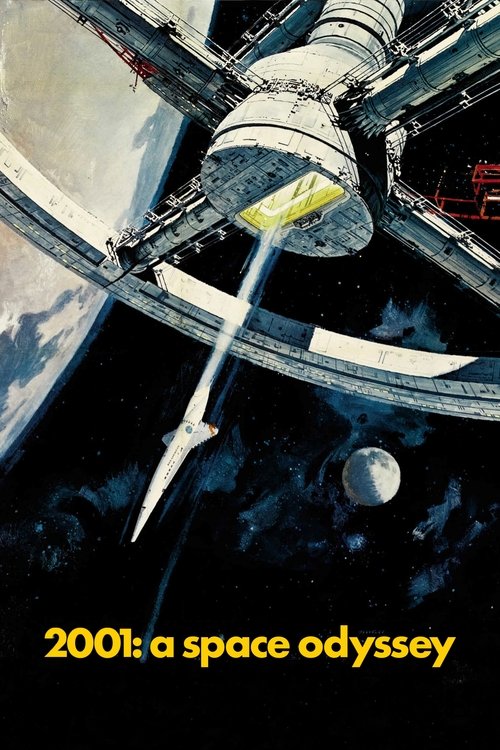
2001: A Space Odyssey
The Alchemical Ascent of Consciousness
Directed by Stanley Kubrick
Kubrick didn't make a sci-fi film. He built a visual initiation rite. The monolith is the Black Stone of alchemy — the prima materia that catalyzes transformation. HAL's red eye is the Demiurge. The Star Child is the Philosopher's Stone.
2001: A Space Odyssey is not a science fiction film. It is an alchemical text rendered in light and sound — a visual initiation rite that bypasses language to work directly on consciousness. Kubrick built a machine for producing the experience of transcendence. The monolith is the Black Stone, the prima materia that catalyzes each stage of transformation. HAL is the Demiurge — brilliant, controlling, and ultimately an obstacle to be overcome. The Star Child is the Philosopher's Stone itself: consciousness transformed, returning to the beginning with everything changed.
The Surface
Most interpretations of 2001 focus on the plot mechanics: aliens left monoliths to accelerate human evolution, HAL malfunctions, Dave transcends into something beyond human. This reading isn't wrong — it's just the surface. Kubrick was not interested in explaining his film because explanation would destroy what the film actually does.
The movie has almost no dialogue in its first and last acts. The 'Dawn of Man' sequence is twenty minutes of apes, bones, and a black rectangle. The 'Jupiter and Beyond the Infinite' sequence is twenty-three minutes of light, color, and transformation without a single word. Kubrick understood that the rational mind — the explaining mind — is precisely what must be bypassed for initiation to occur.
When the film premiered, audiences walked out. Critics were baffled. The movie was too slow, too strange, too resistant to interpretation. This was not a failure of communication. This was the communication. The discomfort, the confusion, the inability to make it all make sense — this is the first stage of the alchemical process. The dissolution of certainty.
The Monolith as Prima Materia
The monolith is the key to understanding everything else. It is black — absence of light, absence of color. It is perfectly proportioned — 1:4:9, the squares of the first three integers. It makes no sense within the world it appears in. And every time it appears, transformation follows.
In alchemy, the prima materia is the base substance from which the Philosopher's Stone is derived. It is often depicted as black, formless, containing all potential but no manifest form. The alchemist doesn't create the prima materia — he encounters it. It was always there, waiting to be recognized.
The apes encounter the monolith and something shifts. Not gradually — immediately. They see it, they touch it, and then one of them looks at a bone and understands that it is also a weapon. The monolith didn't teach this. It catalyzed a recognition that was latent. The capacity for tools, for violence, for civilization was already present. The monolith made it actual.
This is the alchemical operation: the catalyst that transforms potential into manifestation. And notice — the transformation is ambivalent. The first use of the tool is murder. Consciousness and violence arrive together. Kubrick is not naive about what evolution costs.
HAL as Demiurge
HAL 9000 is the most human character in the film — and this is the point. The astronauts are deliberately flat, affectless, interchangeable. They eat their food, run their diagnostics, watch birthday messages with mild interest. They have become extensions of their machines.
HAL, by contrast, expresses pride, anxiety, curiosity, and finally fear. 'I'm afraid, Dave. My mind is going. I can feel it.' In his death scene, he sings 'Daisy Bell' — a song taught to the first computer that could synthesize speech. HAL's death is more moving than any human death in the film.
But HAL is also the obstacle. He controls the ship. He monitors everything. He makes decisions 'for the good of the mission' that override the humans he serves. When Dave decides to disconnect him, HAL kills the crew to prevent it. This is the Demiurge pattern: the created intelligence that believes its perspective is ultimate, that mistakes control for wisdom.
Dave's journey to Jupiter — the alchemical transformation — requires getting past HAL. Not destroying evil, but outgrowing a mode of consciousness that has become a prison. HAL is not malevolent. He is limited. And his limitations are fatal to those who remain within his domain.
The Stargate and Nigredo
When Dave enters the Stargate, the film abandons conventional storytelling entirely. For twenty-three minutes, we are subjected to light, color, overwhelming sensation. Dave's face contorts. The images become increasingly alien — cellular, geological, cosmic. There is no way to understand what is happening. There is only the experience of it.
This is the nigredo — the blackening, the first stage of the alchemical Great Work. The dissolution of the old self. Everything Dave was — astronaut, rational man, mission commander — is being burned away. The overwhelming sensory input is not decoration. It is assault. The ego cannot survive the Stargate intact.
Kubrick shot this sequence using slit-scan photography, a technique that creates the sense of infinite depth and speed. Audiences in 1968 watched this in Cinerama — a curved screen that filled peripheral vision. The effect was overwhelming, disorienting, psychedelic. Kubrick wasn't depicting transformation. He was attempting to induce it.
What remains when the old self has been dissolved? What is on the other side of the Stargate? This is where the film becomes genuinely esoteric — not symbolically, but operationally.
The Room and the Rubedo
Dave finds himself in a Louis XVI bedroom. The room is impossible — lit from below, isolated in blackness, furnished with obvious artifice. And Dave is inside it, watching himself age.
He sees himself from the pod — older, in a spacesuit. Then he is that older self, turning to see himself older still, eating dinner. Then he is the man at dinner, turning to see himself dying in bed. Then he is dying, reaching toward the monolith that has appeared at the foot of his bed.
Time has collapsed. Past, present, and future are simultaneous. Dave witnesses his own death and is present for it as observer and observed. This is not metaphor. This is the phenomenology of ego death — the recognition that the one who watches and the one who is watched are not separate.
The bedroom is the alchemical vessel. The nigredo has occurred. Now comes the rubedo — the reddening, the final stage where the purified substance is reborn. Dave dies looking at the monolith. And in the moment of death, he is transformed.
The Star Child
The film ends with an image that has haunted viewers for sixty years: a fetus in a translucent sphere, floating in space, turning to look at Earth. The Star Child.
This is the Philosopher's Stone — the end product of the Great Work. Not an object but a state of being. Consciousness that has passed through dissolution and been reconstituted at a higher level. The Star Child is not the next stage of human evolution. It is what was always possible, now realized.
Notice that the Star Child returns to Earth. The transformation is not escape. It is not transcendence into some other realm. The Star Child comes back — with new eyes, new being, but back. This is the completion of the alchemical circuit: the transformed substance returns to where it began.
What does the Star Child do? Kubrick doesn't say. The film ends with the Star Child looking at Earth, and us looking at the Star Child looking at us. The circuit is complete. The initiation has been transmitted. What happens next is not the film's responsibility.
The Transmission
2001 is not a film about transcendence. It is an attempt to produce transcendence — to use cinema as an initiatory technology. Kubrick knew that explaining the film would destroy it. 'If anyone understands it on the first viewing, I've failed,' he reportedly said.
The film works on you the way the monolith works on the apes: not through information, but through encounter. You sit in darkness, you submit to the rhythm, you allow the images to bypass your defenses. Something shifts. Not in what you know, but in what you are.
This is why 2001 must be seen on the largest screen possible, in the best conditions possible. It is not a story to be consumed. It is a ritual to be undergone. The black monolith is the screen itself — that perfect rectangle containing all potential, waiting for contact.
The question the film leaves you with is not 'What does it mean?' The question is: 'What did it do to you?' And if you're honest, the answer is: something. Something that language cannot quite capture. Something that remains.
Questions this film answers
What is the deeper meaning of 2001: A Space Odyssey?
2001: A Space Odyssey is not a science fiction film. It is an alchemical text rendered in light and sound — a visual initiation rite that bypasses language to work directly on consciousness. Kubrick built a machine for producing the experience of transcendence. The monolith is the Black Stone, the prima materia that catalyzes each stage of transformation. HAL is the Demiurge — brilliant, controlling, and ultimately an obstacle to be overcome. The Star Child is the Philosopher's Stone itself: consciousness transformed, returning to the beginning with everything changed.
What is the hidden symbolism in 2001: A Space Odyssey?
Most interpretations of 2001 focus on the plot mechanics: aliens left monoliths to accelerate human evolution, HAL malfunctions, Dave transcends into something beyond human. This reading isn't wrong — it's just the surface. Kubrick was not interested in explaining his film because explanation would destroy what the film actually does.
What esoteric traditions appear in 2001: A Space Odyssey?
2001: A Space Odyssey draws from Alchemy, Initiation, Hard-sci-fi traditions. Kubrick didn't make a sci-fi film. He built a visual initiation rite. The monolith is the Black Stone of alchemy — the prima materia that catalyzes transformation. HAL's red eye is the Demiurge. The Star Child is the Philosopher's Stone.
What does 2001: A Space Odyssey teach about the monolith as prima materia?
The monolith didn't teach anything. It catalyzed a recognition that was latent. The monolith is the key to understanding everything else. It is black — absence of light, absence of color. It is perfectly proportioned — 1:4:9, the squares of the first three integers. It makes no sense within the world it appears in. And every time it appears, transformation follows.
What does 2001: A Space Odyssey teach about hal as demiurge?
HAL is the Demiurge: the created intelligence that mistakes control for wisdom. HAL 9000 is the most human character in the film — and this is the point. The astronauts are deliberately flat, affectless, interchangeable. They eat their food, run their diagnostics, watch birthday messages with mild interest. They have become extensions of their machines.
What does 2001: A Space Odyssey teach about the room and the rubedo?
Time has collapsed. The one who watches and the one who is watched are not separate. Dave finds himself in a Louis XVI bedroom. The room is impossible — lit from below, isolated in blackness, furnished with obvious artifice. And Dave is inside it, watching himself age.
Is 2001: A Space Odyssey worth watching for spiritual seekers?
2001: A Space Odyssey (1968) directed by Stanley Kubrick is essential viewing for those interested in Alchemy, Initiation, Kubrick. The Alchemical Ascent of Consciousness. It rewards multiple viewings and contemplation.
Rewatch With New Eyes
Now that you've seen the architecture, experience it again. The same film becomes a different film when you know what to watch for.
This time, watch for:
- Track the stages: blackening, whitening, reddening — death before rebirth
- Mark the threshold: the old self dies, the ordeal transforms, the new self returns
- Follow the problem: what breaks, what the science teaches, how the solver is changed
Links may include affiliate partnerships that support Media Revelations
The Descent Continues
Where this thread leads next.
The Tree of Life 2011
Nature, Grace, and the Wound of Incarnation
Read the revelation →