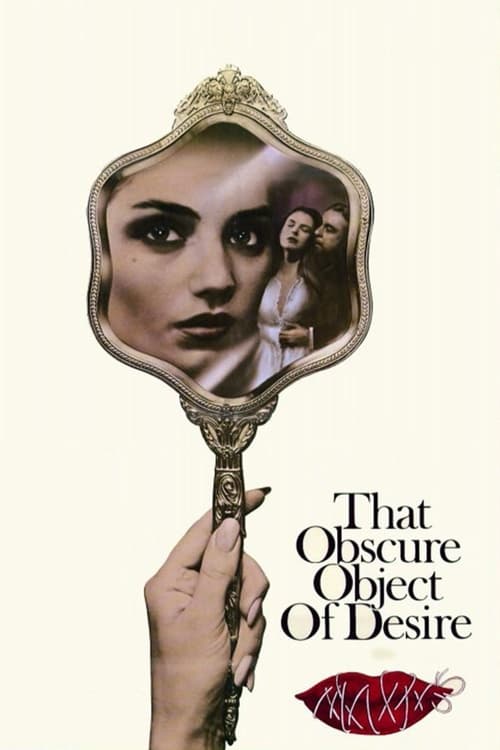
That Obscure Object of Desire
That Obscure Object of Desire Casts Two Actresses as One Woman Because the Woman Was Never Real
Directed by Luis Buñuel
Buñuel's last film. Conchita is played by two different actresses, switched without warning mid-scene, and almost no one notices the first time through. That is the whole teaching.
A wealthy older man, Mathieu, tells the story of his ruin by a young flamenco dancer named Conchita to the strangers in his train compartment. She promises herself to him and withholds herself endlessly. She takes his money and keeps her virginity as a weapon. She dances naked for tourists, marries a young lover in front of him, and returns each time he swears he is finished. And Conchita is played by two women, Carole Bouquet and Ángela Molina, who alternate between and sometimes within scenes. The surface reading treats this as a cruel comedy about male obsession, and it is one. But the double casting is not a stunt. It is the film's actual argument, made in the grammar of cinema: the woman Mathieu is obsessed with does not exist. He is chasing a projection, and Buñuel proves it by never letting the projection hold a stable face.
Jungian Reading: The Anima Has No Single Face Because She Is Not a Person
Jung named the anima the man's inner image of the feminine, an unconscious figure he mistakes for the real women in front of him. The undeveloped man does not relate to a woman. He relates to his own anima, painted over her, and he is baffled when she will not behave the way the image says she should. Buñuel filmed this projection directly. Conchita is two actresses because she is not a woman at all. She is Mathieu's anima, and the anima wears whatever face the unconscious supplies from moment to moment.
Notice that Mathieu never registers the switch. He treats both women as one continuous Conchita, exactly as a man possessed by his anima treats every incompatible signal from the beloved as coming from a single coherent person he simply cannot decode. He pours money and pleading into a figure who cannot be satisfied because she is a mirror. What he wants from Conchita is not Conchita. It is completion, and no external woman can deliver it, so the projection recedes forever, obscure by definition. The final image of the two of them walking past a shop window where a woman mends a bloodstained garment says it plainly: the wound is never closed and the object is always just ahead.
Alchemical Reading: The Prima Materia That Will Not Enter the Vessel
Alchemy begins with the prima materia, the raw chaotic substance that must be sealed in the vessel and cooked until it transforms. The Work fails if the substance refuses containment. Mathieu treats Conchita as prima materia he can purchase and process into the gold of possession. He offers a house, money, a settled life, every apparatus of the sealed vessel. She will not enter it. She takes the gold and stays raw.
The terrorist bombings that punctuate the film, exploding without explanation in the background of his obsession, are the alchemist's fire escaping the vessel and detonating in the world. Mathieu's frustrated desire cannot be contained, so it becomes the violence loose in the streets. The Work he attempts is a coniunctio with a substance that was never his to fix. In the last shot, an explosion consumes them both. The vessel that would not seal finally shatters, and the gold is ash.
Questions this film answers
What is the deeper meaning of That Obscure Object of Desire?
A wealthy older man, Mathieu, tells the story of his ruin by a young flamenco dancer named Conchita to the strangers in his train compartment. She promises herself to him and withholds herself endlessly. She takes his money and keeps her virginity as a weapon. She dances naked for tourists, marries a young lover in front of him, and returns each time he swears he is finished. And Conchita is played by two women, Carole Bouquet and Ángela Molina, who alternate between and sometimes within scenes. The surface reading treats this as a cruel comedy about male obsession, and it is one. But the double casting is not a stunt. It is the film's actual argument, made in the grammar of cinema: the woman Mathieu is obsessed with does not exist. He is chasing a projection, and Buñuel proves it by never letting the projection hold a stable face.
What is the hidden symbolism in That Obscure Object of Desire?
Jung named the anima the man's inner image of the feminine, an unconscious figure he mistakes for the real women in front of him. The undeveloped man does not relate to a woman. He relates to his own anima, painted over her, and he is baffled when she will not behave the way the image says she should. Buñuel filmed this projection directly. Conchita is two actresses because she is not a woman at all. She is Mathieu's anima, and the anima wears whatever face the unconscious supplies from moment to moment.
What esoteric traditions appear in That Obscure Object of Desire?
That Obscure Object of Desire draws from Alchemy, Jungian traditions. Buñuel's last film. Conchita is played by two different actresses, switched without warning mid-scene, and almost no one notices the first time through. That is the whole teaching.
Is That Obscure Object of Desire worth watching for spiritual seekers?
That Obscure Object of Desire (1977) directed by Luis Buñuel is essential viewing for those interested in Alchemy, Jungian. That Obscure Object of Desire Casts Two Actresses as One Woman Because the Woman Was Never Real. It rewards multiple viewings and contemplation.
Rewatch With New Eyes
Now that you've seen the architecture, experience it again. The same film becomes a different film when you know what to watch for.
This time, watch for:
- Track the stages: blackening, whitening, reddening — death before rebirth
- Meet the shadow: what is rejected, projected, and finally integrated
Links may include affiliate partnerships that support Media Revelations