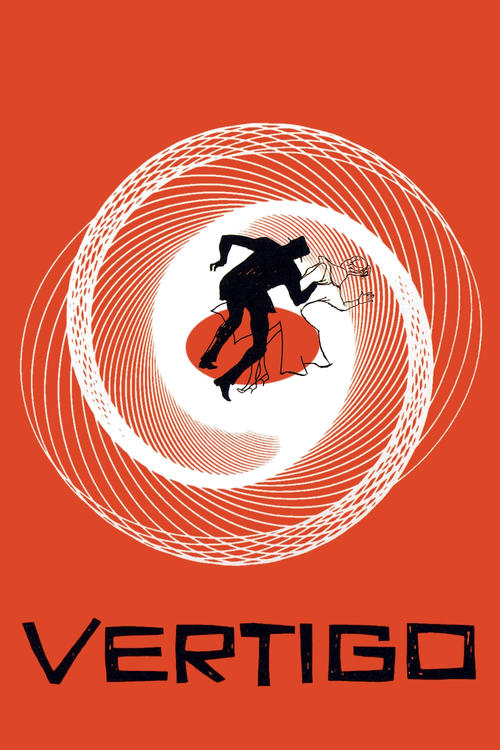
Vertigo
The Anima Forced Twice Through the Tower
Directed by Alfred Hitchcock
Hitchcock made the most pitiless film ever made about anima possession. Scottie does not love Madeleine. He loves the projection. When the projection turns out to be Judy, he forces Judy to become the projection again — clothes, hair, voice — and the film stages, in real time, the violence of refusing to recognize the woman behind the figure. He drags her up the tower a second time because the dream cannot be allowed to live.
Vertigo is the most precise and most cruel anima film ever made. Hitchcock did not make a thriller about acrophobia. He made a sustained, fifty-year-ahead-of-its-time case study of what happens when a man's interior feminine is projected onto a real woman who is herself complicit in carrying the projection — and what happens to both of them when the projection is exposed and the man, instead of withdrawing it, doubles down. Scottie is the man who would rather kill the woman a second time than admit she was never the figure he loved. Judy is the woman who has performed the role twice and dies inside the costume the second time because performing it has become more important to her than living. The dress shop scene where Scottie reconstructs Madeleine on Judy's body is the most disturbing sequence in classical Hollywood, and almost nobody at the time saw what it was.
The Surface
A retired San Francisco detective with vertigo is hired to follow the wife of an old friend, Madeleine, who appears to be possessed by the spirit of a dead ancestor. He falls in love with her. She apparently kills herself by jumping from a mission tower he cannot climb to stop her. Months later he meets a woman named Judy who resembles Madeleine. He reshapes her into Madeleine's image. He discovers Judy was Madeleine — hired to play the role for the husband's murder of his actual wife. He drags Judy back to the tower. She falls from it accidentally. He stands on the ledge alone, vertigo cured by repetition.
On release Vertigo was a critical failure. The audience could not accept the structure. Hitchcock had built a film that punished its lead character without offering catharsis and that turned its romance into a crime scene. Reappraised in the 1980s and 1990s, the film is now widely considered the greatest American film of its era and one of the greatest of any era. The reappraisal is correct.
What Hitchcock built is a psychological autopsy of the projection mechanism as it operates in romantic love. He did this in 1958, using cinema's most popular leading man, in glorious color, with one of the most accessible scores ever written. The popular surface concealed a teaching most viewers were not ready to receive.
Madeleine as Anima
The Madeleine that Scottie first sees is a perfect anima figure. Pale blonde, gray suit, walking through art galleries in slow motion, gazing at a portrait of a long-dead woman she may or may not be possessed by. She is haunted, ethereal, doomed. She floats. She speaks in fragments. She drives in circles around the city and ends up in the same places Scottie is. She is, in other words, designed.
She is designed by the husband and by Judy together as a trap for Scottie. But the design works because the design is exactly what Scottie's interior would have produced if his interior had been given materials. The anima projection cannot land on just anyone — it requires a surface tuned to the projector. The conspirators have, by accident or careful study, tuned this surface precisely.
Jung wrote about the anima as the bridge to the unconscious. Properly related to, she leads the man into wholeness. Improperly related to — projected onto a woman who is identified with the figure — she becomes possession, infatuation, and finally tragedy. Scottie cannot relate to Madeleine. He can only adore her. The film documents this distinction with unusual precision. He follows her in his car. He saves her from the bay without speaking. He watches her sleep. He never quite has a conversation. The figure does not survive conversation. The figure survives gaze.
When she dies from the tower, what Scottie has lost is not a person. He has lost the figure that organized his interior. The breakdown that follows is the appropriate response to anima dispossession. He has been emptied of what was projected. He cannot bear what is left.
Judy and the Costume of the Dead
When Scottie meets Judy, he sees both the resemblance and the difference. Judy is the woman behind the figure. She is a brunette. She has a Kansas accent. She has lived a small life. She is plain in the way Madeleine was perfect because Madeleine was the costume Judy wore to perform a role for which she was paid.
Scottie does not want Judy. He wants the costume back on the body. The dress shop scene is one of the most psychologically violent scenes in classical Hollywood. He picks out the gray suit. He picks out the shoes. He insists on the exact dye for the hair. Judy resists, then complies, because she has fallen in love with him and believes that becoming Madeleine again is the only way to keep him. She agrees to be erased.
This is the anima trap from the woman's side. Judy is not innocent — she helped commit a murder. But the film does not let Scottie's pursuit of her be a moral correction. His pursuit is its own crime. He is, in the most literal sense, willing to overwrite a real person to restore his projection. The crime of the conspirators was the original murder. Scottie's crime is the second, slower murder of the woman he is allegedly in love with.
When Judy emerges from the bathroom in full Madeleine costume — green light, soft focus, the camera trembling — the scene is filmed as ecstatic reunion. It is also revealed by the structure of the film to be necromancy. Scottie has reanimated a corpse. The corpse has Judy inside it, suffering, and Scottie does not know or care.
The Tower the Second Time
When Scottie discovers Judy was Madeleine — sees the necklace, makes the connection — he does not break down. He does something more frightening. He becomes calm. He drives her back to the mission. He drags her up the tower he could not climb the first time. He is cured of his vertigo because the new pursuit is more important than the old fear.
This is the film's darkest claim. Sufficient obsession overrides phobia. Scottie's acrophobia, which has defined him since the prologue, dissolves under the pressure of the rage he is finally able to access. He has come to make the woman who took Madeleine from him pay. He does not seem to recognize that the woman who took Madeleine from him is the woman who was Madeleine. The projection cannot accommodate that level of integration. The two figures remain split inside him even as he holds Judy by the wrist on the staircase.
Judy falls from the tower at the same height Madeleine fell from. She is killed by Scottie indirectly — he startled her, she stepped back, the nun arrived. But Hitchcock is unambiguous about responsibility. Scottie killed her. The two killings — the conspirators' first murder of the real Madeleine, Scottie's symbolic second murder of Judy-as-Madeleine — are revealed to be the same crime in different costumes.
The final image, Scottie on the ledge, arms outstretched, looking down, is the most devastating closing shot of any classical Hollywood film. He has cured his vertigo. He has lost both versions of the woman. He has not learned anything. The film ends because there is nothing further to show. The mechanism has completed its full revolution.
The Transmission
Vertigo is a film many people have to watch three times to register. The first viewing is the mystery. The second is the romance. The third — once the structure is visible — is the horror. Hitchcock built it to operate in layers because the people he was making it about would not have understood it if it had been delivered directly.
What it transmits is permanent. After Vertigo, you cannot watch a love story without watching for the projection. You cannot listen to a man describe a woman without listening for whether he is describing her or the figure he has placed over her. You cannot listen to yourself, doing this, without hearing it for what it is.
Hitchcock made the film at the end of a decade of obsessive casting of blondes who resembled the figure he had been chasing since adolescence. The film is the most honest confession in his work. He did not just understand the mechanism. He had spent his life inside it. He gave it back to the audience as a film, and the audience initially refused it because it indicted them too. The reappraisal happened when the culture finally caught up. The film was waiting.
Questions this film answers
What is the deeper meaning of Vertigo?
Vertigo is the most precise and most cruel anima film ever made. Hitchcock did not make a thriller about acrophobia. He made a sustained, fifty-year-ahead-of-its-time case study of what happens when a man's interior feminine is projected onto a real woman who is herself complicit in carrying the projection — and what happens to both of them when the projection is exposed and the man, instead of withdrawing it, doubles down. Scottie is the man who would rather kill the woman a second time than admit she was never the figure he loved. Judy is the woman who has performed the role twice and dies inside the costume the second time because performing it has become more important to her than living. The dress shop scene where Scottie reconstructs Madeleine on Judy's body is the most disturbing sequence in classical Hollywood, and almost nobody at the time saw what it was.
What is the hidden symbolism in Vertigo?
A retired San Francisco detective with vertigo is hired to follow the wife of an old friend, Madeleine, who appears to be possessed by the spirit of a dead ancestor. He falls in love with her. She apparently kills herself by jumping from a mission tower he cannot climb to stop her. Months later he meets a woman named Judy who resembles Madeleine. He reshapes her into Madeleine's image. He discovers Judy was Madeleine — hired to play the role for the husband's murder of his actual wife. He drags Judy back to the tower. She falls from it accidentally. He stands on the ledge alone, vertigo cured by repetition.
What esoteric traditions appear in Vertigo?
Vertigo draws from Jungian, Initiation traditions. Hitchcock made the most pitiless film ever made about anima possession. Scottie does not love Madeleine. He loves the projection. When the projection turns out to be Judy, he forces Judy to become the projection again — clothes, hair, voice — and the film stages, in real time, the violence of refusing to recognize the woman behind the figure. He drags her up the tower a second time because the dream cannot be allowed to live.
What does Vertigo teach about madeleine as anima?
The figure does not survive conversation. The figure survives gaze. The anima projection requires a surface tuned to the projector. The Madeleine that Scottie first sees is a perfect anima figure. Pale blonde, gray suit, walking through art galleries in slow motion, gazing at a portrait of a long-dead woman she may or may not be possessed by. She is haunted, ethereal, doomed. She floats. She speaks in fragments. She drives in circles around the city and ends up in the same places Scottie is. She is, in other words, designed.
Is Vertigo worth watching for spiritual seekers?
Vertigo (1958) directed by Alfred Hitchcock is essential viewing for those interested in Jungian, Anima, Hitchcock. The Anima Forced Twice Through the Tower. It rewards multiple viewings and contemplation.
Rewatch With New Eyes
Now that you've seen the architecture, experience it again. The same film becomes a different film when you know what to watch for.
This time, watch for:
- Meet the shadow: what is rejected, projected, and finally integrated
- Mark the threshold: the old self dies, the ordeal transforms, the new self returns
Links may include affiliate partnerships that support Media Revelations
The Descent Continues
Where this thread leads next.
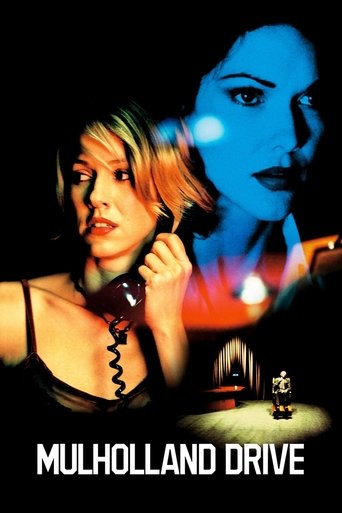
Mulholland Drive 2001
The Blue Key and the Dissolution of Identity
Read the revelation →