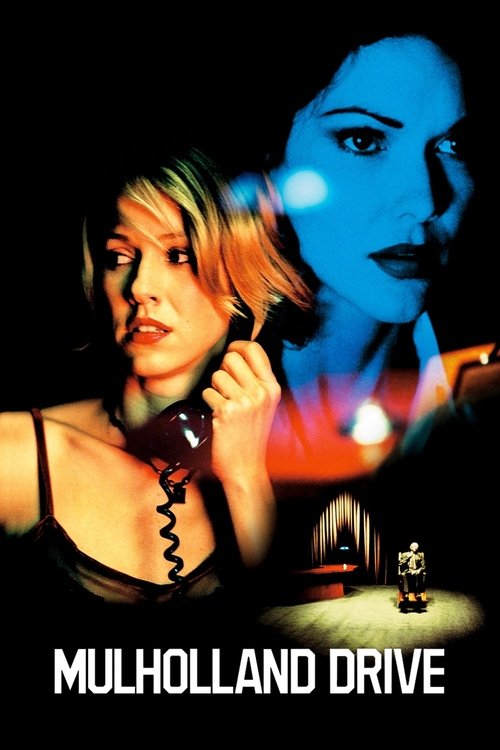
Mulholland Drive
The Blue Key and the Dissolution of Identity
Directed by David Lynch
Lynch creates experiences of what it feels like when identity dissolves. The blue box is ego death. Club Silencio is the revelation: there is no band. There is no self performing.
Mulholland Drive is not a puzzle to be solved. It is an experience of identity dissolution — what it feels like from inside when the self fragments. Lynch does not depict madness from the outside. He puts you inside it. The blue box is the moment of ego death. Club Silencio is the revelation that everything performing is illusion. Hollywood is the realm of glamour — not the fashion kind, but the occult kind: a spell that makes things appear other than they are. And the woman who goes by two names is not two characters. She is one self, shattered.
The Surface
A woman survives a car crash on Mulholland Drive and stumbles into a Hollywood apartment with no memory of who she is. A fresh-faced aspiring actress named Betty arrives to stay in the same apartment and helps the amnesiac — now calling herself 'Rita' — discover her identity. They fall in love. Then a blue key opens a blue box, and everything changes.
Critics spent years constructing elaborate timelines: the first two-thirds are a dream, the last third is 'reality,' or vice versa. They mapped which characters corresponded to which in the 'other' timeline. They felt satisfied when the puzzle clicked into place.
Lynch has never confirmed any interpretation. He famously provided '10 clues to unlocking this thriller' that explain nothing. The film resists reduction to a single coherent narrative because reduction to a single coherent narrative is precisely what it's about. The desperate need to make things make sense is itself part of what the film investigates.
The Dream Factory
Hollywood in Mulholland Drive is not just a setting. It is an occult zone — a place where glamour, in the old magical sense, is manufactured and sold. Glamour was originally a spell that made things appear differently than they were. Hollywood is the industrial production of glamour: faces made more beautiful than any face, stories more coherent than any life, selves that exist only as long as the camera runs.
The directors in the film are controlled by invisible powers. A sinister figure lives behind Winkie's Diner and seems to hold the keys to reality. Auditions require approval from forces that never show themselves. This is not conspiracy theory. This is the phenomenology of working in an industry where your identity depends on whether you are chosen.
Betty's audition scene is crucial. She rehearses lines that sound flat, clichéd. Then she performs them with an older actor, and something terrifying happens: she becomes someone else entirely. The scene crackles with genuine sexual menace. Betty is not acting. She is channeling. For a moment, she is not herself, and what comes through is more alive than she is.
This is what Lynch understands about performance: the actor's self must dissolve for the character to emerge. The self is the obstacle. And if you make this dissolution your profession, what happens to the self that remains when the camera stops?
Club Silencio
The film's hinge point is Club Silencio — an underground theater where Betty and Rita watch a performance that is explicitly, brazenly fake. The emcee announces: 'No hay banda. There is no band.' A woman sings Roy Orbison's 'Crying' in Spanish. Her voice is overwhelming, heartbreaking. Then she collapses — and the voice continues. It was recorded. There is no singer.
This scene is the key to everything. The voice that moves us is not coming from the body that appears to produce it. The emotion is real. The person producing it is an illusion. Lynch literalizes what the whole film is about: the self that we believe is generating our experience may not exist at all.
Betty and Rita weep uncontrollably. They have witnessed the revelation that undoes all identities: what feels most real, most ours, most immediate — the voice, the self, the one experiencing — is already a recording played through a temporary body. There is no band. There is no singer. There is no self that owns the experience.
After Club Silencio, Betty opens the blue box. This is the ego death moment. The identity she believed herself to be dissolves, and what remains is the other story — darker, more fragmented, irreconcilable.
Diane and Betty
The common interpretation: Betty is Diane's dream, a fantasy of how she wishes things had gone. Diane is the 'real' person — a failed actress who had a relationship with Camilla (Rita's 'real' identity), got discarded for a man, and arranged Camilla's murder. The blue key is proof the hit was completed.
This interpretation is not wrong, but it is insufficient. It treats the film as a mystery with a solution, when the film is actually demonstrating something about the nature of identity itself. Betty and Diane are not separate people, one of whom is 'real.' They are facets of a self that cannot integrate.
Diane cannot be the idealized Betty without denying her failure and jealousy. Betty cannot maintain her radiance without denying the darkness that fuels her talent. The split is not dream versus reality. The split is the impossibility of being a whole self when the forces that compose you are irreconcilable.
The cowboy who appears to Adam the director says: 'If you do good, you'll see me one more time. If you do bad, you'll see me two more times.' He appears twice. Something has been done badly. But the crime is not the contract killing. The crime is the splitting itself — the refusal to integrate what cannot be faced.
The Blue Box
The blue box is the film's central mystery object. It appears in 'Rita's' purse with no explanation. The blue key opens it. When it opens, the self that was Betty dissolves and the self that is Diane is all that remains.
In one sense, this is simple: the box is the threshold between the dream and the dreamer, and opening it means waking up into a reality worse than the fantasy. But the box is more than a plot device. It is a symbol of the container that holds identity together — and what happens when that container fails.
Betty's aunt's apartment — where the whole fantasy takes place — becomes a trap once the box opens. The same rooms that were warm, full of possibility, are now cold, littered with evidence of a disintegrated life. The space hasn't changed. The one perceiving it has.
This is Lynch's phenomenological precision: reality is not independent of the self that perceives it. When the self dissolves, reality dissolves with it. The blue box is not a portal to another place. It is the revelation that there was only ever one place, seen from inside a collapsing perspective.
The Transmission
Mulholland Drive is not an enjoyable film. It is disturbing in ways that linger — not because of its violence (which is minimal) or its darkness (which is pervasive) but because of what it does to the viewer's sense of stable identity.
Lynch's method is to create experiences rather than meanings. You do not watch Mulholland Drive and 'understand' what happened. You watch it and feel your own assumptions about selfhood become unstable. The film does not represent fragmentation. It induces it.
This is why Lynch refuses to explain. Explanation would reassert the rational self that categorizes and masters experience. The film is designed to slip past that self, to work in the space where categories fail. If you reduce it to a timeline, you've defended yourself against what it's actually offering.
What it's offering is a direct experience of what the mystics describe: the self you believe yourself to be is a construction, held together by narrative and repetition, and it can dissolve. This is terrifying. It is also, for those who can bear it, the doorway through which something else becomes possible.
Questions this film answers
What is the deeper meaning of Mulholland Drive?
Mulholland Drive is not a puzzle to be solved. It is an experience of identity dissolution — what it feels like from inside when the self fragments. Lynch does not depict madness from the outside. He puts you inside it. The blue box is the moment of ego death. Club Silencio is the revelation that everything performing is illusion. Hollywood is the realm of glamour — not the fashion kind, but the occult kind: a spell that makes things appear other than they are. And the woman who goes by two names is not two characters. She is one self, shattered.
What is the hidden symbolism in Mulholland Drive?
A woman survives a car crash on Mulholland Drive and stumbles into a Hollywood apartment with no memory of who she is. A fresh-faced aspiring actress named Betty arrives to stay in the same apartment and helps the amnesiac — now calling herself 'Rita' — discover her identity. They fall in love. Then a blue key opens a blue box, and everything changes.
What esoteric traditions appear in Mulholland Drive?
Mulholland Drive draws from Jungian traditions. Lynch creates experiences of what it feels like when identity dissolves. The blue box is ego death. Club Silencio is the revelation: there is no band. There is no self performing.
What does Mulholland Drive teach about the dream factory?
The self must dissolve for the character to emerge. The self is the obstacle. Hollywood in Mulholland Drive is not just a setting. It is an occult zone — a place where glamour, in the old magical sense, is manufactured and sold. Glamour was originally a spell that made things appear differently than they were. Hollywood is the industrial production of glamour: faces made more beautiful than any face, stories more coherent than any life, selves that exist only as long as the camera runs.
What does Mulholland Drive teach about club silencio?
There is no band. There is no singer. There is no self that owns the experience. The film's hinge point is Club Silencio — an underground theater where Betty and Rita watch a performance that is explicitly, brazenly fake. The emcee announces: 'No hay banda. There is no band.' A woman sings Roy Orbison's 'Crying' in Spanish. Her voice is overwhelming, heartbreaking. Then she collapses — and the voice continues. It was recorded. There is no singer.
Is Mulholland Drive worth watching for spiritual seekers?
Mulholland Drive (2001) directed by David Lynch is essential viewing for those interested in Ego Dissolution, Lynch, Identity. The Blue Key and the Dissolution of Identity. It rewards multiple viewings and contemplation.
Rewatch With New Eyes
Now that you've seen the architecture, experience it again. The same film becomes a different film when you know what to watch for.
This time, watch for:
- Meet the shadow: what is rejected, projected, and finally integrated
Links may include affiliate partnerships that support Media Revelations