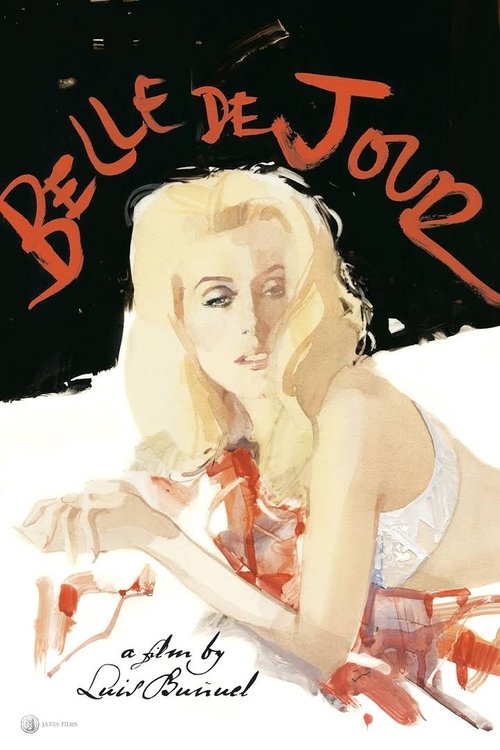
Belle de Jour
Belle de Jour Is a Woman Splitting Herself in Two So the Buried Half Can Finally Be Touched
Directed by Luis Buñuel
Buñuel refuses to mark the fantasies. You are never told which scenes are real, because to Séverine the question has stopped mattering.
Séverine is a young bourgeois wife who cannot let her devoted husband touch her, and who is aroused only in daydreams of humiliation, mud, whips, and being handled by strangers. She learns of a discreet brothel and begins working afternoons there, two to five, under the name Belle de Jour. Buñuel films her fantasies in the same flat daylight as her marriage, cuts between them without warning, and drops in images with no explanation: a coffin, a herd of bulls named after sins, a small box a client opens that makes one prostitute recoil and Séverine consent. The film is the record of a woman who has walled off her own desire so completely that the only way back to it is to become a second person. She does not have a double life. She is a double, and the film is the operation of the two halves finding each other.
Jungian Reading: Belle de Jour Is the Shadow Séverine Has to Live In Before She Can Live at All
Jung called the shadow everything the conscious personality disowns, the material pushed into the dark because it does not fit the mask we present. Séverine's mask is the frigid, faithful, immaculate wife. Her shadow is Belle de Jour, and Buñuel plants its origin precisely: two flashbacks, a workman touching her as a child, a girl refusing communion, the wound and the refusal that split desire from acceptability at the root. She did not choose the division. It was done to her, and she has spent adult life obeying it.
The brothel is where she goes to inhabit the shadow deliberately, and Jung is clear that this is not indulgence but integration, the disowned self must be met and lived, not merely confessed. Watch how she changes. The woman who flinched from her husband's kiss begins, through Belle de Jour, to actually love him. The buried half is not her sickness. It is the route back to her. By the afternoons of two to five she reclaims the desire her marriage had no room for, and only then can the wife feel anything at all. The shadow is not the enemy of the marriage. It is its resurrection.
Alchemical Reading: The Coitus of Opposites in a Woman Who Contains Both
The alchemical goal is the coniunctio, the marriage of opposites, sun and moon, king and queen, the pure and the base fused into something whole. Séverine holds both poles in one body: the white bride and the mud-spattered woman dragged behind the carriage, the immaculate and the defiled. Buñuel's persistent images of dirt, whips, and stained cloth against her pale clothes are the blackening, the necessary corruption of the too-pure material before it can be joined. Purity that has never been touched is not gold. It is unworked ore.
The film's dislocated ending is the coniunctio attempted. Her husband is shot, paralyzed, silent in a wheelchair, and then, in the final scene, he rises, healed, and asks what she is thinking while the sound of the fantasy carriage bells returns. The real and the imagined fuse in the last shot, the two Séverines finally occupying one frame. Buñuel does not tell you it succeeded. He shows you the vessel sealed and the opposites inside it, and leaves the transmutation as the question the whole film was asking.
Questions this film answers
What is the deeper meaning of Belle de Jour?
Séverine is a young bourgeois wife who cannot let her devoted husband touch her, and who is aroused only in daydreams of humiliation, mud, whips, and being handled by strangers. She learns of a discreet brothel and begins working afternoons there, two to five, under the name Belle de Jour. Buñuel films her fantasies in the same flat daylight as her marriage, cuts between them without warning, and drops in images with no explanation: a coffin, a herd of bulls named after sins, a small box a client opens that makes one prostitute recoil and Séverine consent. The film is the record of a woman who has walled off her own desire so completely that the only way back to it is to become a second person. She does not have a double life. She is a double, and the film is the operation of the two halves finding each other.
What is the hidden symbolism in Belle de Jour?
Jung called the shadow everything the conscious personality disowns, the material pushed into the dark because it does not fit the mask we present. Séverine's mask is the frigid, faithful, immaculate wife. Her shadow is Belle de Jour, and Buñuel plants its origin precisely: two flashbacks, a workman touching her as a child, a girl refusing communion, the wound and the refusal that split desire from acceptability at the root. She did not choose the division. It was done to her, and she has spent adult life obeying it.
What esoteric traditions appear in Belle de Jour?
Belle de Jour draws from Jungian, Alchemy traditions. Buñuel refuses to mark the fantasies. You are never told which scenes are real, because to Séverine the question has stopped mattering.
Is Belle de Jour worth watching for spiritual seekers?
Belle de Jour (1967) directed by Luis Buñuel is essential viewing for those interested in Jungian, Alchemy. Belle de Jour Is a Woman Splitting Herself in Two So the Buried Half Can Finally Be Touched. It rewards multiple viewings and contemplation.
Rewatch With New Eyes
Now that you've seen the architecture, experience it again. The same film becomes a different film when you know what to watch for.
This time, watch for:
- Meet the shadow: what is rejected, projected, and finally integrated
- Track the stages: blackening, whitening, reddening — death before rebirth
Links may include affiliate partnerships that support Media Revelations