Timecrimes
Timecrimes Reveals That the Monster Chasing You Is the Version of You Covering Its Tracks
Directed by Nacho Vigalondo
Vigalondo built a time-loop out of one man, a bandaged stalker, and an hour. The horror is that every crime in it is committed to keep the story consistent.
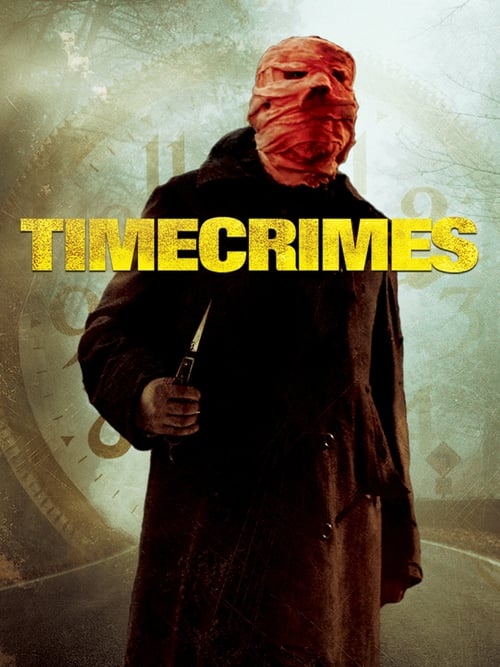
Héctor is relaxing in his garden when he spots, through binoculars, a woman undressing in the woods. He goes to investigate and is attacked by a man whose face is wrapped in pink bandages. Fleeing, he hides in a building at a nearby facility, is coaxed into a strange tank by a scientist, and emerges an hour in the past, now able to watch his earlier self through the same binoculars. From here Timecrimes tightens into a single mechanism: to make the timeline resolve the way he has already lived it, Héctor must become the bandaged man, must force the woman to undress, must engineer each event he originally suffered. The surface reading is a clever low-budget puzzle. The actual film is a demonstration that the enemy was never external, and that self-preservation, followed to its end, requires you to victimize everyone including yourself.
Hard-Sci-Fi Reading: The Single-Timeline Trap
Timecrimes obeys one iron law: there is only one timeline, and it is already whole. Nothing can be changed, only completed. The film is a masterpiece of this deterministic model because Héctor's every attempt to fix his situation turns out to be the exact cause of it. He wraps his own head in bandages because he saw a bandaged man. He pushes the woman into the woods because he saw her there. The loop is not a trap he stumbles into; it is a shape he is condemned to trace with perfect fidelity.
Vigalondo refuses the escape hatch most time-travel films grant. There is no branching, no do-over, no clever exploit. There are three versions of Héctor active at the film's climax, and consistency demands that two of them be sacrificed so the survivor's memory matches the record. The physics is airtight, and the airtightness is the dread.
Jungian Reading: The Shadow You Must Become
The bandaged stalker is the perfect image of the disowned self. Héctor first meets him as pure threat, a faceless attacker in the woods, and spends the film terrified of him. Then he learns he is him. The thing hunting him is a future self doing exactly what a future self must do, and Héctor's education is the slow, sickening realization that he will have to put on the bandages himself.
This is shadow-integration rendered as literal plot. What you flee, you become. The woman in the woods, terrorized twice, is collateral to Héctor's need to keep his own timeline intact, and his final act is to let a duplicate of himself die so that he can go home to his wife as if nothing happened. He integrates the shadow not by growing wise but by doing its work, and the film ends with him seated calmly, monstrous acts hidden inside a preserved ordinary evening.
Questions this film answers
What is the deeper meaning of Timecrimes?
Héctor is relaxing in his garden when he spots, through binoculars, a woman undressing in the woods. He goes to investigate and is attacked by a man whose face is wrapped in pink bandages. Fleeing, he hides in a building at a nearby facility, is coaxed into a strange tank by a scientist, and emerges an hour in the past, now able to watch his earlier self through the same binoculars. From here Timecrimes tightens into a single mechanism: to make the timeline resolve the way he has already lived it, Héctor must become the bandaged man, must force the woman to undress, must engineer each event he originally suffered. The surface reading is a clever low-budget puzzle. The actual film is a demonstration that the enemy was never external, and that self-preservation, followed to its end, requires you to victimize everyone including yourself.
What is the hidden symbolism in Timecrimes?
Timecrimes obeys one iron law: there is only one timeline, and it is already whole. Nothing can be changed, only completed. The film is a masterpiece of this deterministic model because Héctor's every attempt to fix his situation turns out to be the exact cause of it. He wraps his own head in bandages because he saw a bandaged man. He pushes the woman into the woods because he saw her there. The loop is not a trap he stumbles into; it is a shape he is condemned to trace with perfect fidelity.
What esoteric traditions appear in Timecrimes?
Timecrimes draws from Hard-sci-fi, Jungian traditions. Vigalondo built a time-loop out of one man, a bandaged stalker, and an hour. The horror is that every crime in it is committed to keep the story consistent.
Is Timecrimes worth watching for spiritual seekers?
Timecrimes (2007) directed by Nacho Vigalondo is essential viewing for those interested in Hard Sci-Fi, Jungian. Timecrimes Reveals That the Monster Chasing You Is the Version of You Covering Its Tracks. It rewards multiple viewings and contemplation.
Rewatch With New Eyes
Now that you've seen the architecture, experience it again. The same film becomes a different film when you know what to watch for.
This time, watch for:
- Follow the problem: what breaks, what the science teaches, how the solver is changed
- Meet the shadow: what is rejected, projected, and finally integrated
Links may include affiliate partnerships that support Media Revelations
The Descent Continues
Where this thread leads next.

Primer 2004
Aaron Becomes His Own Archon (That's the Real Trap)
Read the revelation →