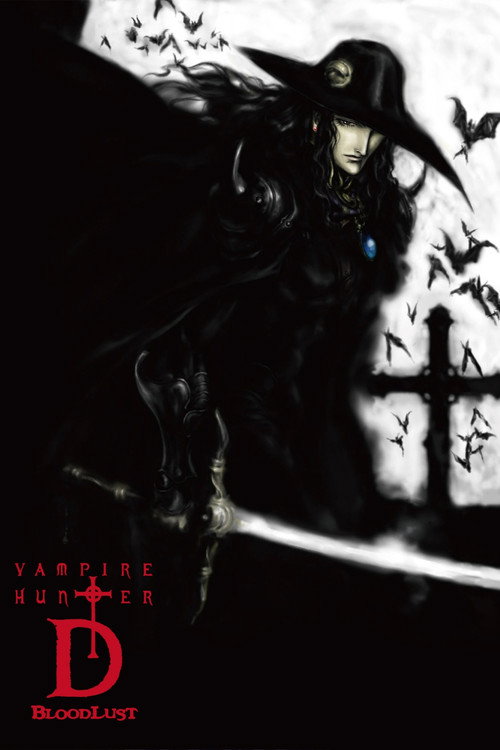
Vampire Hunter D: Bloodlust
Vampire Hunter D: Bloodlust Is About Two Immortals Who Would Rather Burn Than Live Without Love
Directed by Yoshiaki Kawajiri
Kawajiri drew a gothic future where a vampire noble and a human woman flee toward a place called Carmilla, and the half-breed sent to kill them is the only one who understands why they run.
D is a dhampir, half human and half vampire, hired to retrieve Charlotte Elbourne, a young woman taken by the vampire lord Meier Link. Everyone assumes an abduction. It is not. Charlotte left willingly, in love with Meier, and the two are racing toward the City of the Night where a woman called Carmilla promises to make Charlotte immortal so the lovers can never be parted. D pursues them across a ruined, beautiful world, and the closer he gets the clearer it becomes that he is not hunting a monster. He is watching a love that both the human world and the vampire world have declared impossible, and he carries the same wound in his own blood. Kawajiri's film is not a chase. It is a meditation on whether love across an unbridgeable divide is salvation or annihilation, and it refuses to pretend those are different things.
Sufi Reading: The Lover Who Burns Toward the Beloved and Calls the Fire Home
Sufi poetry returns endlessly to the moth and the flame: the lover so consumed by longing for the Beloved that union means being burned to nothing. Meier and Charlotte are that moth in two bodies. Their love cannot survive in either world, so they fly toward the only place that might hold it, knowing the journey is likely to kill them both.
The film honors this rather than mocking it. In the final act, cornered, Meier and Charlotte choose to leave together aboard a ship bound for a distant star, a destination that is really a beautiful way of choosing death over separation. They do not want safety. They want union at any cost, which in Sufi terms is the highest love there is, the love that would rather be annihilated in the Beloved than persist alone. D lets them go. The hunter recognizes the lover's fire because it burns in him too, inherited from a father who was the greatest vampire of all. He does not kill what he was sent to kill because he sees it is holy.
Alchemical Reading: The Dhampir Is the Coniunctio That Cannot Rest
Alchemy prizes the coniunctio, the marriage of opposites, sun and moon, king and queen, the union that produces the philosopher's stone. D is that union already made flesh: human and vampire fused in one body, day and night in a single self. He should be the completed work, the reconciled opposites walking around.
But Kawajiri shows the coniunctio as torment rather than triumph. D never rests, never belongs, is refused by both the world that made him and the world that hunts alongside him. The parasite in his left hand, a wisecracking face that speaks with its own voice, is the unintegrated remnant of the opus, the two natures still arguing inside the vessel. Meier and Charlotte reach for the same union D embodies, and the film's ache is that D already knows what awaits them: the marriage of opposites does not grant peace, it grants a life spent between worlds with no home in either. He completes their story by letting them attempt the union he himself could never resolve, riding away alone at dawn, the finished stone that the world still has no use for.
Other stories where love crosses an impossible divide and chooses the fire.
Questions this film answers
What is the deeper meaning of Vampire Hunter D: Bloodlust?
D is a dhampir, half human and half vampire, hired to retrieve Charlotte Elbourne, a young woman taken by the vampire lord Meier Link. Everyone assumes an abduction. It is not. Charlotte left willingly, in love with Meier, and the two are racing toward the City of the Night where a woman called Carmilla promises to make Charlotte immortal so the lovers can never be parted. D pursues them across a ruined, beautiful world, and the closer he gets the clearer it becomes that he is not hunting a monster. He is watching a love that both the human world and the vampire world have declared impossible, and he carries the same wound in his own blood. Kawajiri's film is not a chase. It is a meditation on whether love across an unbridgeable divide is salvation or annihilation, and it refuses to pretend those are different things.
What is the hidden symbolism in Vampire Hunter D: Bloodlust?
Sufi poetry returns endlessly to the moth and the flame: the lover so consumed by longing for the Beloved that union means being burned to nothing. Meier and Charlotte are that moth in two bodies. Their love cannot survive in either world, so they fly toward the only place that might hold it, knowing the journey is likely to kill them both.
What esoteric traditions appear in Vampire Hunter D: Bloodlust?
Vampire Hunter D: Bloodlust draws from Alchemy, Sufism traditions. Kawajiri drew a gothic future where a vampire noble and a human woman flee toward a place called Carmilla, and the half-breed sent to kill them is the only one who understands why they run.
Is Vampire Hunter D: Bloodlust worth watching for spiritual seekers?
Vampire Hunter D: Bloodlust (2001) directed by Yoshiaki Kawajiri is essential viewing for those interested in Alchemy, Sufism. Vampire Hunter D: Bloodlust Is About Two Immortals Who Would Rather Burn Than Live Without Love. It rewards multiple viewings and contemplation.
Rewatch With New Eyes
Now that you've seen the architecture, experience it again. The same film becomes a different film when you know what to watch for.
This time, watch for:
- Track the stages: blackening, whitening, reddening — death before rebirth
- Feel the love that transforms: what the heart sees that the mind cannot
Links may include affiliate partnerships that support Media Revelations