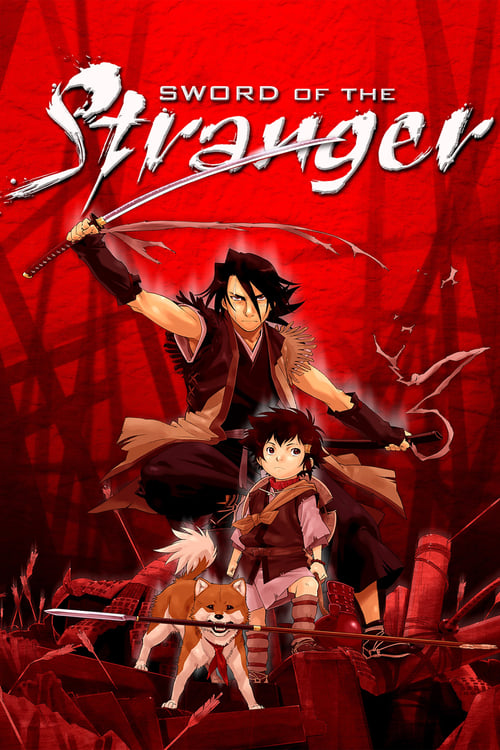
Sword of the Stranger
Sword of the Stranger Is About a Man Who Sealed His Blade and a Boy Who Needs Him to Draw It
Directed by Masahiro Ando
Masahiro Ando made the most beautifully choreographed swordfight in anime, then hid a Buddhist teaching about renunciation underneath it.
A wandering ronin called No Name saves a boy, Kotaro, and his dog from Ming assassins, then agrees to escort them for money. No Name carries his katana tied into its scabbard with a cord. He has bound his own weapon shut. The surface reading is a gorgeous, blood-soaked chase film about a stranger protecting a hunted child. What Ando actually made is a study of a man in retreat from his own capacity for violence, who has renounced the sword not out of peace but out of guilt, and the whole film is the pressure that will force him to choose between the vow and the child. The cord on the blade is the entire movie. Everything drives toward the moment it is cut.
Buddhist Reading: The Bound Sword as the Renounced Self
Buddhism draws a hard line between suppression and liberation. To seal a thing away by force never makes you free of it. You live instead in permanent tension with what you have merely locked in the dark, and that tension is its own suffering.
No Name has tied his sword shut because he once killed on command and cannot forgive it. The bound blade is his attempt to renounce, but he has renounced through repression, not release. He still wears the sword. He still carries the war inside the cord. A vow taken from shame is only violence pointed inward, and it holds exactly until the moment the world asks more of you than the vow can bear. Kotaro is that moment. When the child is taken to be sacrificed by the Ming, No Name must decide whether the vow or the boy is the higher truth. He cuts the cord. The drawing of the blade is not a failure of his renunciation. It is its completion, because true renunciation was never about never acting. It was about acting without the poison of the old guilt. He kills to save a life rather than to obey a lord, and in that single distinction the whole karmic weight he carried is finally set down. The sword comes free and so does he.
Initiatory Reading: The Guide Who Dies Teaching the Boy to Live
The initiatory pattern demands a guide who transforms the initiate and cannot follow him home. Ando gives Kotaro two fathers in miniature, and only the false one survives.
Kotaro begins the film alone, distrustful, using people and expecting betrayal because betrayal is all he has known. No Name meets that armor not with force but with a stubborn, wordless reliability, showing up, protecting, refusing to abandon the boy even when abandonment would be easier and safer. This is the initiation: the child learns, for the first time, what it is to be genuinely fought for. The final duel against Luo-Lang, the blond Western swordsman who fights only for the pleasure of finding an equal, is the guide's last teaching. No Name wins and is mortally wounded doing it. He dies in the snow having given Kotaro the one thing a guide can give, proof that a person will spend their life for you and ask nothing. The boy walks out of the mountains changed. The guide stays behind in the red snow. The price of the transmission is paid in full.
Questions this film answers
What is the deeper meaning of Sword of the Stranger?
A wandering ronin called No Name saves a boy, Kotaro, and his dog from Ming assassins, then agrees to escort them for money. No Name carries his katana tied into its scabbard with a cord. He has bound his own weapon shut. The surface reading is a gorgeous, blood-soaked chase film about a stranger protecting a hunted child. What Ando actually made is a study of a man in retreat from his own capacity for violence, who has renounced the sword not out of peace but out of guilt, and the whole film is the pressure that will force him to choose between the vow and the child. The cord on the blade is the entire movie. Everything drives toward the moment it is cut.
What is the hidden symbolism in Sword of the Stranger?
Buddhism draws a hard line between suppression and liberation. To seal a thing away by force never makes you free of it. You live instead in permanent tension with what you have merely locked in the dark, and that tension is its own suffering.
What esoteric traditions appear in Sword of the Stranger?
Sword of the Stranger draws from Buddhism, Initiation traditions. Masahiro Ando made the most beautifully choreographed swordfight in anime, then hid a Buddhist teaching about renunciation underneath it.
Is Sword of the Stranger worth watching for spiritual seekers?
Sword of the Stranger (2007) directed by Masahiro Ando is essential viewing for those interested in Buddhism, Initiation. Sword of the Stranger Is About a Man Who Sealed His Blade and a Boy Who Needs Him to Draw It. It rewards multiple viewings and contemplation.
Rewatch With New Eyes
Now that you've seen the architecture, experience it again. The same film becomes a different film when you know what to watch for.
This time, watch for:
- See impermanence: what clings, what releases, what remains
- Mark the threshold: the old self dies, the ordeal transforms, the new self returns
Links may include affiliate partnerships that support Media Revelations
The Descent Continues
Where this thread leads next.

Ninja Scroll 1993
Ninja Scroll Is an Alchemical Poisoning: Jubei Must Drink the Toxin to Become the Cure
Read the revelation →