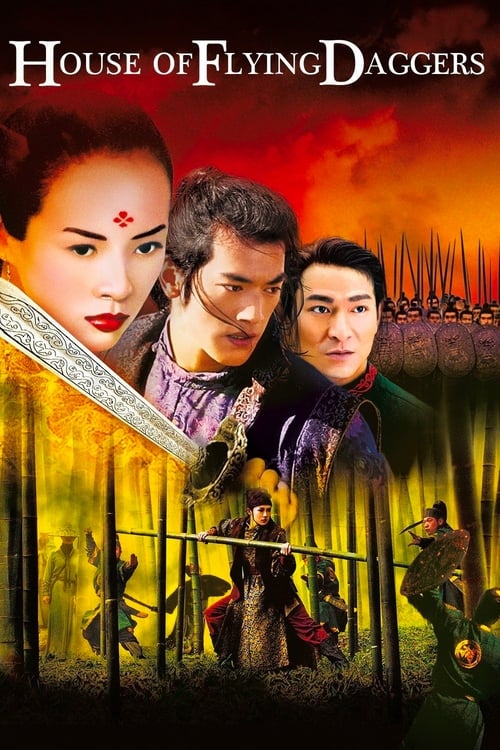
House of Flying Daggers
House of Flying Daggers Is About the Blindness Everyone Keeps Even After Their Eyes Open
Directed by Zhang Yimou
Zhang Yimou dressed a Sufi teaching in silk and blood. Every character can see. None of them will.
The plot is a nesting doll of deceptions: a policeman pretends to free a rebel who pretends to be blind, so that the deception can lead the government to the rebel headquarters, except the policeman falls in love, and the rebel was never the person anyone thought. Read as a spy thriller, it is elegant and cruel. But the film keeps returning to a single image that has nothing to do with espionage: Mei, the dancer, plays blind. She is not blind. She sees perfectly. She only performs sightlessness to survive a world that would use her sight against her. And by the end, every character is doing the same thing. Jin sees that he loves her and pretends it is a mission. Leo sees that she has left him and pretends it is duty. The government sees rebels everywhere and cannot see the one standing in front of it. This is a film about people with working eyes who choose, again and again, not to look at the one thing that would save them.
Sufi Reading: The Echo Game and the Beloved Who Is Already Present
The Echo Game is the film's first great set piece and its whole theology in miniature. Mei, blindfolded, must repeat a drum pattern by striking the drums that ring the room, using only the long sleeves that unspool from her wrists. She cannot see the target. She locates it by sound, by memory, by an attention that does not depend on the eyes. In Sufi practice this is exactly the discipline: the Beloved is not found by looking outward but by a listening so complete that the seeker moves without sight toward what is already calling. Mei succeeds because she has stopped trusting the eyes.
Then watch what breaks the spell. When Jin and Mei finally lie together in the tall grass, she says she has been alone a long time, and for one moment neither is performing. The tragedy of the film is that this presence, this dropping of the blindfold, arrives and is immediately taken back up. Jin returns to the mission. Mei returns to the cause. The Sufi teaching is that union is available in every instant and is refused in almost every instant. Zhang stages that refusal as a love story, but the ache underneath it is spiritual: the Beloved was in the grass, and both of them stood up and walked away from it.
Jungian Reading: The Duel That Cannot End Because Neither Man Will Withdraw His Projection
The final fight happens in a field that changes from autumn gold to deep snow while the two men swing at each other, the seasons collapsing because the duel has left ordinary time. Leo and Jin are not really fighting over Mei. They are fighting over an image of her that each has installed inside himself: Leo's Mei is the loyalty he sacrificed three years for, Jin's Mei is the freedom he glimpsed for a week. Neither man is looking at the actual woman bleeding in the snow between them.
This is the anima at its most destructive: two men so possessed by the inner figure they have projected that they will kill each other and let her die rather than see her plainly. Mei's last act is to throw the dagger anyway, wounded, to stop the fight, because she is the only one who ever saw the others as they were.
Questions this film answers
What is the deeper meaning of House of Flying Daggers?
The plot is a nesting doll of deceptions: a policeman pretends to free a rebel who pretends to be blind, so that the deception can lead the government to the rebel headquarters, except the policeman falls in love, and the rebel was never the person anyone thought. Read as a spy thriller, it is elegant and cruel. But the film keeps returning to a single image that has nothing to do with espionage: Mei, the dancer, plays blind. She is not blind. She sees perfectly. She only performs sightlessness to survive a world that would use her sight against her. And by the end, every character is doing the same thing. Jin sees that he loves her and pretends it is a mission. Leo sees that she has left him and pretends it is duty. The government sees rebels everywhere and cannot see the one standing in front of it. This is a film about people with working eyes who choose, again and again, not to look at the one thing that would save them.
What is the hidden symbolism in House of Flying Daggers?
The Echo Game is the film's first great set piece and its whole theology in miniature. Mei, blindfolded, must repeat a drum pattern by striking the drums that ring the room, using only the long sleeves that unspool from her wrists. She cannot see the target. She locates it by sound, by memory, by an attention that does not depend on the eyes. In Sufi practice this is exactly the discipline: the Beloved is not found by looking outward but by a listening so complete that the seeker moves without sight toward what is already calling. Mei succeeds because she has stopped trusting the eyes.
What esoteric traditions appear in House of Flying Daggers?
House of Flying Daggers draws from Sufism, Jungian traditions. Zhang Yimou dressed a Sufi teaching in silk and blood. Every character can see. None of them will.
Is House of Flying Daggers worth watching for spiritual seekers?
House of Flying Daggers (2004) directed by Zhang Yimou is essential viewing for those interested in Sufism, Jungian. House of Flying Daggers Is About the Blindness Everyone Keeps Even After Their Eyes Open. It rewards multiple viewings and contemplation.
Rewatch With New Eyes
Now that you've seen the architecture, experience it again. The same film becomes a different film when you know what to watch for.
This time, watch for:
- Feel the love that transforms: what the heart sees that the mind cannot
- Meet the shadow: what is rejected, projected, and finally integrated
Links may include affiliate partnerships that support Media Revelations
The Descent Continues
Where this thread leads next.
Hero 2002
Hero Is a Film About an Assassin Who Chooses Not to Kill and Calls It Enlightenment
Read the revelation →