Hero
Hero Is a Film About an Assassin Who Chooses Not to Kill and Calls It Enlightenment
Directed by Zhang Yimou
Zhang Yimou tells the same murder four times in four colors, and each retelling erodes a different illusion until only surrender remains.
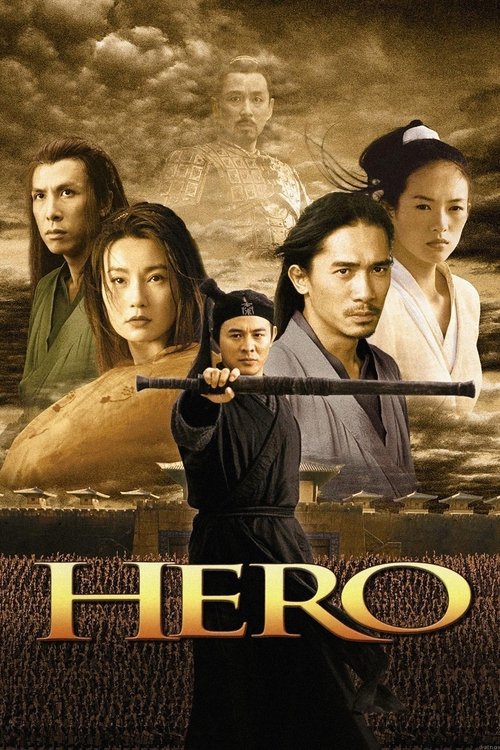
A nameless warrior arrives at the palace of the King of Qin, permitted to sit within ten paces of the throne because he claims to have slain the three assassins the king most feared: Broken Sword, Flying Snow, and Sky. He recounts how he did it. The king, unconvinced, tells a different version. Nameless tells another. The story of the killings is retold in staged colors, red, blue, white, and the truth that surfaces is not who killed whom but why Nameless, who could kill the king with a single thrust, chooses to lower his sword. The film looks like nationalist spectacle, a defense of the tyrant who unified China through blood. Underneath the color it is a Buddhist argument about the sword that refuses itself, told through a calligraphy character that means, simultaneously, killing and its opposite.
Buddhism Reading: The Character That Contains Its Own Renunciation
The film's spiritual engine is a single written character, jian, sword, that Broken Sword spends years perfecting in his calligraphy. When the king finally reads the largest scroll, he understands the swordsman's highest realization: that the ultimate meaning of the sword is to have no sword, that the supreme warrior does not kill at all. This is the ahimsa buried inside the martial code, the recognition that the perfected weapon is one laid down.
Nameless carries this understanding into the throne room. He has the king's life in his hand. And Broken Sword, in the white retelling, has already refused an identical opportunity, sparing the king because he saw that another cycle of vengeance would only feed the wheel. Nameless completes the same renunciation. This is the Buddhist reading of violence itself: every killing is bound to the wheel of retribution, samsara turning through blade after blade, and the only exit is the warrior who breaks the chain by absorbing the blow rather than returning it. Nameless dies for the choice. Executed by the king's own archers, he becomes the sword that would not strike, which is the film's most disturbing beauty and its most honest one.
Jungian Reading: Four Colors as the Descent Through the Psyche's Own Lies
The four color-coded retellings are not a stylistic flourish. They are a map of how a psyche approaches its own truth by first passing through its distortions. The red version is the story as fantasy and jealousy, all passion and betrayal, Flying Snow killing Broken Sword out of wounded love. This is the shadow projected outward, the assumption that others act from the darkest possible motive.
The blue version is the king's cooler correction, more strategic, less lurid. The white version, which the film presents as truest, strips the jealousy away entirely and reveals the assassins as far nobler than either prior account allowed, capable of sacrifice, restraint, and a love that does not curdle. Jung called this movement the withdrawal of projection, the slow work by which the psyche stops mistaking its own contents for the world and finally sees what is actually there. The color literally cools from the fever-red of the ego's fear to the white of clarified sight. By the final telling, Nameless is no longer looking at enemies. He is looking at what he himself must become. The seeing changes him, and the changed man cannot complete the murder he came to commit.
Questions this film answers
What is the deeper meaning of Hero?
A nameless warrior arrives at the palace of the King of Qin, permitted to sit within ten paces of the throne because he claims to have slain the three assassins the king most feared: Broken Sword, Flying Snow, and Sky. He recounts how he did it. The king, unconvinced, tells a different version. Nameless tells another. The story of the killings is retold in staged colors, red, blue, white, and the truth that surfaces is not who killed whom but why Nameless, who could kill the king with a single thrust, chooses to lower his sword. The film looks like nationalist spectacle, a defense of the tyrant who unified China through blood. Underneath the color it is a Buddhist argument about the sword that refuses itself, told through a calligraphy character that means, simultaneously, killing and its opposite.
What is the hidden symbolism in Hero?
The film's spiritual engine is a single written character, jian, sword, that Broken Sword spends years perfecting in his calligraphy. When the king finally reads the largest scroll, he understands the swordsman's highest realization: that the ultimate meaning of the sword is to have no sword, that the supreme warrior does not kill at all. This is the ahimsa buried inside the martial code, the recognition that the perfected weapon is one laid down.
What esoteric traditions appear in Hero?
Hero draws from Buddhism, Jungian traditions. Zhang Yimou tells the same murder four times in four colors, and each retelling erodes a different illusion until only surrender remains.
Is Hero worth watching for spiritual seekers?
Hero (2002) directed by Zhang Yimou is essential viewing for those interested in Buddhism, Jungian. Hero Is a Film About an Assassin Who Chooses Not to Kill and Calls It Enlightenment. It rewards multiple viewings and contemplation.
Rewatch With New Eyes
Now that you've seen the architecture, experience it again. The same film becomes a different film when you know what to watch for.
This time, watch for:
- See impermanence: what clings, what releases, what remains
- Meet the shadow: what is rejected, projected, and finally integrated
Links may include affiliate partnerships that support Media Revelations
The Descent Continues
Where this thread leads next.
Crouching Tiger, Hidden Dragon 2000
The Martial Artist Who Could Not Surrender
Read the revelation →