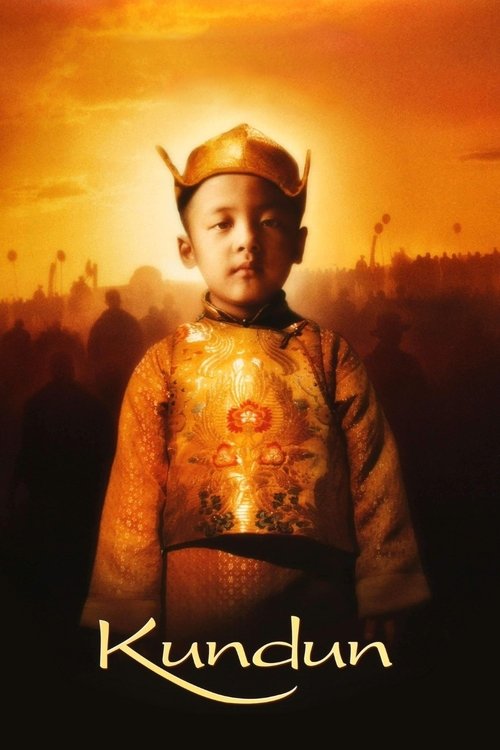
Kundun
Kundun Is Scorsese's Film About Losing Everything Without Losing Yourself
Directed by Martin Scorsese
The director of Raging Bull and Goodfellas made a film with almost no violence and almost no plot. It is his most radical film precisely because nothing in it can be gripped.
Kundun follows the fourteenth Dalai Lama from his identification as a toddler through his flight into exile in 1959. There is no arc in the Western sense. The child does not learn to fight, does not defeat the invader, does not save his country. China takes Tibet. He walks away over the mountains, having lost the throne, the palace, the nation, and every material thing his position promised. The astonishing choice Scorsese makes is to film this total defeat as a spiritual completion rather than a tragedy. Tibet is not the thing to be saved. Tibet is the last attachment to be released. The film is a training in non-grasping, and the plot is engineered so that the audience must undergo the release alongside the man. Everything is taken, and the film insists that nothing essential was lost.
Buddhist Reading: Impermanence Filmed as the Sand Mandala Is Filmed
The film's structural key is the sand mandala, shown twice. Monks spend days pouring colored sand grain by grain into an image of unbearable intricacy, a whole cosmos rendered in dust. Then they sweep it into a pile and pour it into the river. This is the entire teaching of Kundun in a single ritual: what is built with total devotion is surrendered without protest, because the devotion was never for the sake of keeping.
Scorsese films the invasion of Tibet the way he films the mandala. The palaces, the ceremonies, the ten-thousand-year monastic order, all of it is intricate, all of it is holy, and all of it is swept away. The young Dalai Lama's initiation is not learning to hold. It is learning to let a nation dissolve like sand and remain whole. Watch his face at the border crossing as a guard asks, "Are you the Lord Buddha?" and he answers, "I think I am a reflection, like the moon on water." That answer is the fruit of the training. The self that could be conquered was never the real one. What China invaded was the reflection. The moon was already gone over the mountains.
Initiatory Reading: A Child Enthroned Is a Child Being Buried Alive
Every genuine initiation begins with a death, and Kundun opens with one disguised as an honor. A toddler is identified, removed from his mother, seated on a throne, and told he is the reincarnation of a line of god-kings. The film does not sentimentalize this. It shows the loneliness of it, the small boy dwarfed by the Potala Palace, the child who must be taught that he belongs to everyone and therefore to no one. The enthronement is the descent into the underworld. The palace is the sealed chamber where the ordinary self is dissolved.
The initiatory pattern demands a return, and here the return inverts the myth. The initiate does not come back to his people transformed and triumphant. He is driven out. But the exile is the graduation. He has been prepared his entire life to lose the throne without losing the presence the throne only pointed at. Kundun means "The Presence," and the film's argument is that the presence was never located in Lhasa. The palace was the guardian at the threshold. The mountains were the door. The man who crosses into India carries out the only thing that could not be taken, which is the one thing the whole brutal initiation existed to reveal.
Questions this film answers
What is the deeper meaning of Kundun?
Kundun follows the fourteenth Dalai Lama from his identification as a toddler through his flight into exile in 1959. There is no arc in the Western sense. The child does not learn to fight, does not defeat the invader, does not save his country. China takes Tibet. He walks away over the mountains, having lost the throne, the palace, the nation, and every material thing his position promised. The astonishing choice Scorsese makes is to film this total defeat as a spiritual completion rather than a tragedy. Tibet is not the thing to be saved. Tibet is the last attachment to be released. The film is a training in non-grasping, and the plot is engineered so that the audience must undergo the release alongside the man. Everything is taken, and the film insists that nothing essential was lost.
What is the hidden symbolism in Kundun?
The film's structural key is the sand mandala, shown twice. Monks spend days pouring colored sand grain by grain into an image of unbearable intricacy, a whole cosmos rendered in dust. Then they sweep it into a pile and pour it into the river. This is the entire teaching of Kundun in a single ritual: what is built with total devotion is surrendered without protest, because the devotion was never for the sake of keeping.
What esoteric traditions appear in Kundun?
Kundun draws from Buddhism, Initiation traditions. The director of Raging Bull and Goodfellas made a film with almost no violence and almost no plot. It is his most radical film precisely because nothing in it can be gripped.
Is Kundun worth watching for spiritual seekers?
Kundun (1997) directed by Martin Scorsese is essential viewing for those interested in Buddhism, Initiation. Kundun Is Scorsese's Film About Losing Everything Without Losing Yourself. It rewards multiple viewings and contemplation.
Rewatch With New Eyes
Now that you've seen the architecture, experience it again. The same film becomes a different film when you know what to watch for.
This time, watch for:
- See impermanence: what clings, what releases, what remains
- Mark the threshold: the old self dies, the ordeal transforms, the new self returns
Links may include affiliate partnerships that support Media Revelations
The Descent Continues
Where this thread leads next.
King Kong 2005
Love Already Killed the Beast — the Bullets Only Released What Remained
Read the revelation →