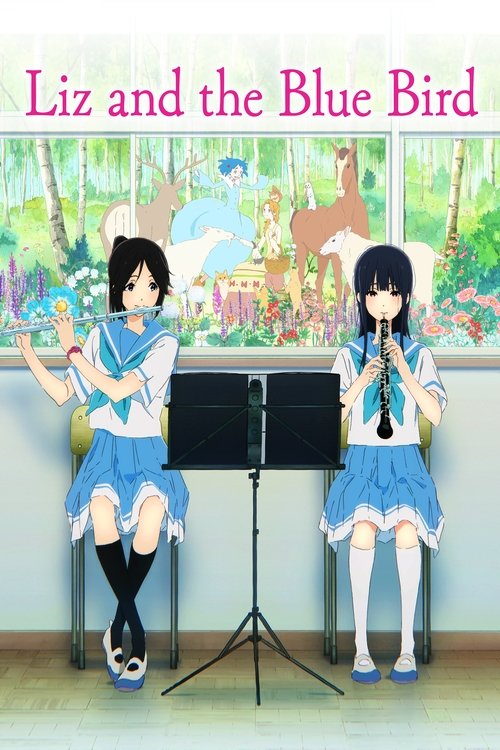
Liz and the Blue Bird
Liz and the Blue Bird Is About the Terrible Love That Wants to Keep the Thing It Should Set Free
Directed by Naoko Yamada
Two girls play a fairy tale in a school orchestra, each convinced she is the one who must be let go. Yamada made a film about the exact frequency at which love becomes a cage.
Mizore and Nozomi are two high-school girls in the brass band, preparing a piece based on a fairy tale about a lonely woman named Liz and a girl who is secretly a blue bird. In the tale, Liz takes in the girl, loves her, and finally realizes she must release her back to the sky. The film's whole architecture is the two students trying to work out which of them is Liz and which is the bird. Mizore, quiet and dependent, assumes she is the bird kept by radiant, outgoing Nozomi. She is wrong. Yamada tells this almost without dialogue, through the space between two bodies in a corridor, the precise number of centimeters they leave, the way a shoulder turns. This is not a gentle film about friendship. It is a forensic study of asymmetrical love, of the moment you discover the person you thought was holding you is the one clinging, and that you are the one who has to open your hand.
Alchemical Reading: The Conjunction That Only Completes Through Separation
Alchemy names its climactic union coniunctio, the marriage of opposed elements. But there is a stricter truth the process insists on: a true union cannot form between two things that have never been separate. What has not been distinguished cannot be joined. Mizore and Nozomi have fused into a single dependency that neither can see as a problem, and the film's alchemy is the painful work of separatio that must precede any real bond. The turning point is a played duet. Mizore, whose oboe solo the piece is built around, finally performs it with the full force of a talent she had suppressed to stay small beside her friend, and Nozomi, the confident one, realizes in real time that she is the lesser musician, the one who needs the other. The vessel cracks. Their elements finally stand apart as distinct substances. Only after that separation can they say the tale's true line to each other, disjoint the fused thing, and choose one another as two rather than one.
Initiatory Reading: Discovering You Are the Keeper, Not the Kept
Initiation frequently turns on a reversal of role, the initiate discovering their assumed position in the story was backwards. Mizore's entire self-image rests on being the beloved dependent, the bird Nozomi generously houses. Her ordeal is the slow, unbearable recognition that the fairy tale runs the other way. She is Liz. She is the one who has been keeping Nozomi small by needing her so completely, and love now requires that she release her friend toward a future, a music school, a life, that Mizore's dependence would clip. The initiatory threshold is a science-lab conversation where Mizore admits she loves everything about Nozomi, and Nozomi, wounded, confesses she envies Mizore's gift. Each learns she has misread her own role in the myth they were living. The passage completes not in staying bound but in the courage to want the other's flight more than one's own comfort, which is the exact lesson Liz learns when she opens the window.
Questions this film answers
What is the deeper meaning of Liz and the Blue Bird?
Mizore and Nozomi are two high-school girls in the brass band, preparing a piece based on a fairy tale about a lonely woman named Liz and a girl who is secretly a blue bird. In the tale, Liz takes in the girl, loves her, and finally realizes she must release her back to the sky. The film's whole architecture is the two students trying to work out which of them is Liz and which is the bird. Mizore, quiet and dependent, assumes she is the bird kept by radiant, outgoing Nozomi. She is wrong. Yamada tells this almost without dialogue, through the space between two bodies in a corridor, the precise number of centimeters they leave, the way a shoulder turns. This is not a gentle film about friendship. It is a forensic study of asymmetrical love, of the moment you discover the person you thought was holding you is the one clinging, and that you are the one who has to open your hand.
What is the hidden symbolism in Liz and the Blue Bird?
Alchemy names its climactic union coniunctio, the marriage of opposed elements. But there is a stricter truth the process insists on: a true union cannot form between two things that have never been separate. What has not been distinguished cannot be joined. Mizore and Nozomi have fused into a single dependency that neither can see as a problem, and the film's alchemy is the painful work of separatio that must precede any real bond. The turning point is a played duet. Mizore, whose oboe solo the piece is built around, finally performs it with the full force of a talent she had suppressed to stay small beside her friend, and Nozomi, the confident one, realizes in real time that she is the lesser musician, the one who needs the other. The vessel cracks. Their elements finally stand apart as distinct substances. Only after that separation can they say the tale's true line to each other, disjoint the fused thing, and choose one another as two rather than one.
What esoteric traditions appear in Liz and the Blue Bird?
Liz and the Blue Bird draws from Alchemy, Initiation traditions. Two girls play a fairy tale in a school orchestra, each convinced she is the one who must be let go. Yamada made a film about the exact frequency at which love becomes a cage.
Is Liz and the Blue Bird worth watching for spiritual seekers?
Liz and the Blue Bird (2018) directed by Naoko Yamada is essential viewing for those interested in Alchemy, Initiation. Liz and the Blue Bird Is About the Terrible Love That Wants to Keep the Thing It Should Set Free. It rewards multiple viewings and contemplation.
Rewatch With New Eyes
Now that you've seen the architecture, experience it again. The same film becomes a different film when you know what to watch for.
This time, watch for:
- Track the stages: blackening, whitening, reddening — death before rebirth
- Mark the threshold: the old self dies, the ordeal transforms, the new self returns
Links may include affiliate partnerships that support Media Revelations
The Descent Continues
Where this thread leads next.
A Silent Voice: The Movie 2016
A Silent Voice Is the Story of a Boy Who Bullied a Deaf Girl and Then Had to Learn to Hear at All
Read the revelation →