Paranoia Agent: Part 1
The Shadow That Hits You When You Can No Longer Hit Yourself
Directed by Satoshi Kon
Satoshi Kon built a serial killer procedural. What he actually made is a clinical diagram of collective psychological collapse, with the city of Tokyo as the patient and a boy on rollerblades as the symptom.
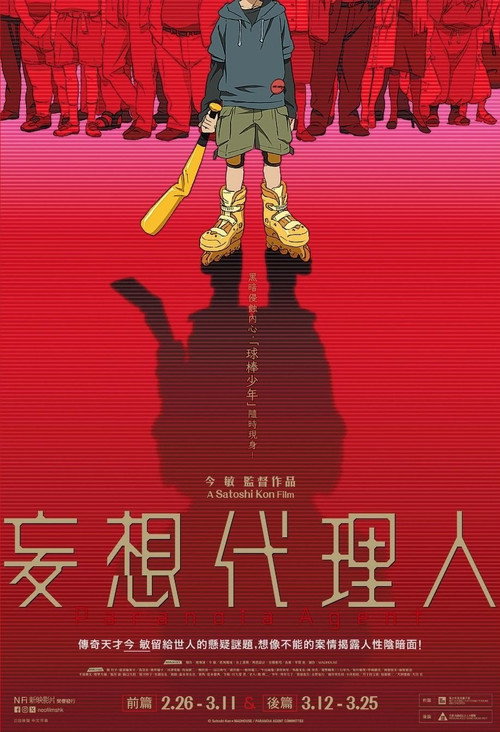
Paranoia Agent opens on designer Tsukiko Sagi, creator of the wildly successful Maromi mascot, unable to produce a follow-up. The pressure is strangling her. Then a boy in golden skates strikes her with a bent baseball bat, and she is saved. Saved from the deadline, saved from the meeting, saved from having to admit she is empty. Lil' Slugger, Shounen Bat, spreads through Musashino after that. Every victim is at a breaking point. Every victim gets struck and relieved. Satoshi Kon is not making a mystery about who the attacker is. He is making a diagnosis about why the city needed one.
Jungian Reading: Lil' Slugger Is the Collective Shadow Wearing a Body
In Jungian psychology, the Shadow is everything a person refuses to acknowledge about themselves: rage, failure, want, the unacceptable. When the psyche suppresses enough of it, the Shadow externalizes. It is no longer an inner pressure; it becomes an outer event. Something attacks from outside so the person does not have to admit the attack was always internal.
Tsukiko cannot confess she has nothing left. The detective Ikari cannot confess the case is unraveling him. The schoolboy Ichi cannot confess the bullying is destroying him from inside. Each one, at maximum suppression, receives a visit from a figure that does their violence for them. The bent bat is not a weapon. It is the shape of the self-recrimination they were already holding. Lil' Slugger lands only the blow the victim had already been landing on themselves for months. The attack in the alley near episode two, where a second detective dismisses the crime and then finds himself suddenly in the crosshairs, is the series' clearest statement: the Shadow has a sense of selection. It does not arrive randomly. It arrives when the psychological dishonesty reaches its structural limit.
Kon gives this a social dimension the clinical literature rarely touches. The attacks are news. The city talks about Lil' Slugger. And the more the city talks, the more people unconsciously wish for the relief. The Shadow has gone collective. A citywide scapegoat is being assembled, a vessel for every failure and pressure that modern Tokyo demands its citizens suppress.
Gnostic Reading: Maromi Is the False Comforter, the Idol That Feeds on Need
Maromi, the pink cartoon dog, is everywhere in the world of the series. Plushies, phone straps, stationery. Tsukiko created her out of a personal grief she never processed, and the creature she made reflects exactly that: a being of pure soft comfort, with no interior life, no demand, no expectation. Maromi exists only to be held.
In Gnostic cosmology, the Demiurge creates a false world that mimics the Pleroma but hollows it. The imitation looks like fullness. It functions as a trap. Maromi is this structure made adorable. She proliferates because Musashino's citizens are starved for contact and will take the simulation. When Tsukiko curls around her Maromi plushie in a moment of crisis, and Maromi appears to speak, to offer reassurance, the scene is not comfort. It is the idol animated by the worshipper's own need, feeding on the gap it was designed to maintain. The more Maromi spreads, the less anyone has to face what they actually feel. Lil' Slugger and Maromi are two poles of the same system. One suppresses through terror. One suppresses through sweetness. Perfect Blue runs the same Kon architecture at the level of individual identity. Here, the scale is the city itself.
Questions this film answers
What is the deeper meaning of Paranoia Agent: Part 1?
Paranoia Agent opens on designer Tsukiko Sagi, creator of the wildly successful Maromi mascot, unable to produce a follow-up. The pressure is strangling her. Then a boy in golden skates strikes her with a bent baseball bat, and she is saved. Saved from the deadline, saved from the meeting, saved from having to admit she is empty. Lil' Slugger, Shounen Bat, spreads through Musashino after that. Every victim is at a breaking point. Every victim gets struck and relieved. Satoshi Kon is not making a mystery about who the attacker is. He is making a diagnosis about why the city needed one.
What is the hidden symbolism in Paranoia Agent: Part 1?
In Jungian psychology, the Shadow is everything a person refuses to acknowledge about themselves: rage, failure, want, the unacceptable. When the psyche suppresses enough of it, the Shadow externalizes. It is no longer an inner pressure; it becomes an outer event. Something attacks from outside so the person does not have to admit the attack was always internal.
What esoteric traditions appear in Paranoia Agent: Part 1?
Paranoia Agent: Part 1 draws from Jungian, Gnosticism traditions. Satoshi Kon built a serial killer procedural. What he actually made is a clinical diagram of collective psychological collapse, with the city of Tokyo as the patient and a boy on rollerblades as the symptom.
Is Paranoia Agent: Part 1 worth watching for spiritual seekers?
Paranoia Agent: Part 1 (2004) directed by Satoshi Kon is essential viewing for those interested in Jungian, Gnosticism. The Shadow That Hits You When You Can No Longer Hit Yourself. It rewards multiple viewings and contemplation.
Rewatch With New Eyes
Now that you've seen the architecture, experience it again. The same film becomes a different film when you know what to watch for.
This time, watch for:
- Meet the shadow: what is rejected, projected, and finally integrated
- Watch for the false world vs. the real — who is asleep, who awakens
Links may include affiliate partnerships that support Media Revelations