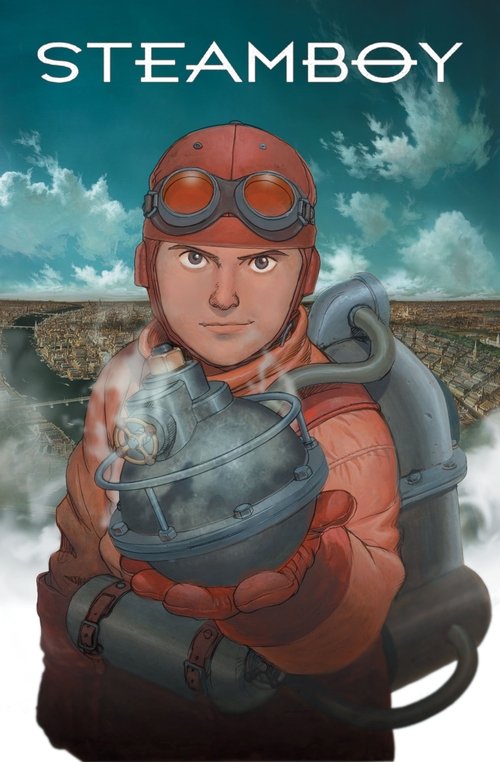
Steamboy
Steamboy Is Three Generations Fighting Over Whether Fire From Heaven Should Be Given to Men
Directed by Katsuhiro Otomo
Otomo spent a decade animating steam and pistons to stage the oldest argument in Western myth: what happens when a mortal seizes the power of the gods.
Ray Steam, a boy inventor in Victorian Manchester, receives a metal sphere from his grandfather Lloyd and is immediately hunted for it. The Steam Ball is condensed, pressurized power, a compact source that can drive a machine or level a city. Around it stand three generations of one family, each with a verdict. Grandfather Lloyd wants the power hidden, convinced humanity is not ready. Father Eddie, half-fused to his own machinery after an accident, wants it used, worshipping science as pure progress regardless of cost. Ray, the boy, is caught between them and must decide for himself. This is not a chase film about a gadget. It is a Promethean myth in Victorian dress, an argument about stolen fire conducted across a family, and the boy stands where the myth always places the mortal: holding a power meant for gods and forced to judge whether he has the right.
Alchemical Reading: The Steam Ball as False Philosopher's Stone
The Steam Ball is a perfect dark mirror of the philosopher's stone. Both are small, dense objects said to contain limitless power, the aim of a lifetime of secret labor, capable of transmuting the ordinary into the extraordinary. But real alchemy insists the work is inward: the stone is made by transforming the alchemist. Eddie Steam has inverted this completely. He seeks the outer power while remaining spiritually unchanged, and the film marks his failure on his body, his flesh half-replaced by steam-driven prosthetics, a man who tried to become the stone by machinery instead of transformation.
Grandfather Lloyd is the alchemist who understood the danger and chose to bury the work. His warning, that the power must serve life or it becomes a weapon, is the exact ethical seal the old alchemists placed on their art, the reason they wrote in cipher. The climactic Steam Castle rising over London is the false opus made visible, a vast glittering apparatus that produces nothing but destruction. It is transmutation without transformation, gold that turns everything it touches to ruin.
Initiatory Reading: The Boy Who Must Refuse Both Fathers
Ray's true trial is never really the machines. It is that both of his elders offer him a completed philosophy and demand he simply adopt it. Grandfather says suppress the power. Father says unleash it. The initiatory task, the thing that actually makes him a man rather than an heir, is that he must refuse to be the vessel for either inherited certainty and forge a third answer himself.
He does. In the end Ray uses the very power both men fought over, not to hide it and not to conquer with it, but to contain the catastrophe they created, riding the Steam Ball to minimize the destruction of the castle they built. That is the initiate's graduation. He takes the fire, accepts that it cannot be uninvented, and assumes responsibility for it in the same motion. He does not resolve the argument between his fathers. He outgrows the need to pick a side, which is what every real coming of age requires.
Questions this film answers
What is the deeper meaning of Steamboy?
Ray Steam, a boy inventor in Victorian Manchester, receives a metal sphere from his grandfather Lloyd and is immediately hunted for it. The Steam Ball is condensed, pressurized power, a compact source that can drive a machine or level a city. Around it stand three generations of one family, each with a verdict. Grandfather Lloyd wants the power hidden, convinced humanity is not ready. Father Eddie, half-fused to his own machinery after an accident, wants it used, worshipping science as pure progress regardless of cost. Ray, the boy, is caught between them and must decide for himself. This is not a chase film about a gadget. It is a Promethean myth in Victorian dress, an argument about stolen fire conducted across a family, and the boy stands where the myth always places the mortal: holding a power meant for gods and forced to judge whether he has the right.
What is the hidden symbolism in Steamboy?
The Steam Ball is a perfect dark mirror of the philosopher's stone. Both are small, dense objects said to contain limitless power, the aim of a lifetime of secret labor, capable of transmuting the ordinary into the extraordinary. But real alchemy insists the work is inward: the stone is made by transforming the alchemist. Eddie Steam has inverted this completely. He seeks the outer power while remaining spiritually unchanged, and the film marks his failure on his body, his flesh half-replaced by steam-driven prosthetics, a man who tried to become the stone by machinery instead of transformation.
What esoteric traditions appear in Steamboy?
Steamboy draws from Alchemy, Initiation traditions. Otomo spent a decade animating steam and pistons to stage the oldest argument in Western myth: what happens when a mortal seizes the power of the gods.
Is Steamboy worth watching for spiritual seekers?
Steamboy (2004) directed by Katsuhiro Otomo is essential viewing for those interested in Alchemy, Initiation. Steamboy Is Three Generations Fighting Over Whether Fire From Heaven Should Be Given to Men. It rewards multiple viewings and contemplation.
Rewatch With New Eyes
Now that you've seen the architecture, experience it again. The same film becomes a different film when you know what to watch for.
This time, watch for:
- Track the stages: blackening, whitening, reddening — death before rebirth
- Mark the threshold: the old self dies, the ordeal transforms, the new self returns
Links may include affiliate partnerships that support Media Revelations