Metropolis
The Robot Who Didn't Know She Was the Apocalypse
Directed by Rintaro
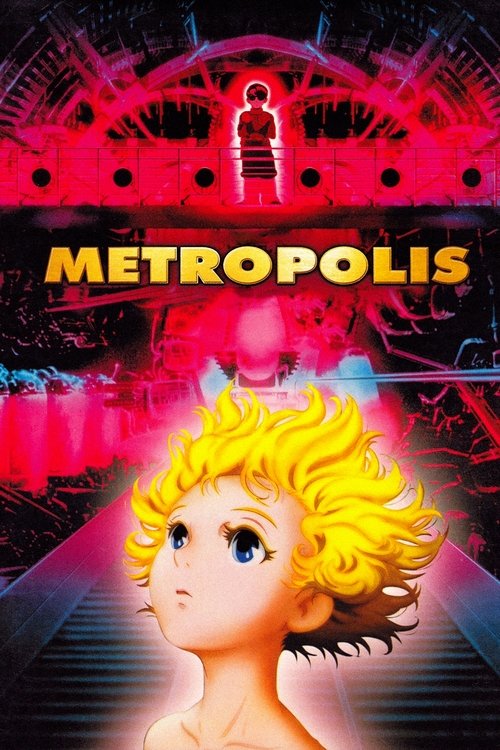
Tima doesn't know she's a weapon. She wakes with no memory, learns to love, and only discovers her purpose when her father activates the Ziggurat's throne. The film asks: If an artificial being can feel genuine love, is destroying her murder? Rintaro's anime reimagines Lang's vision through Tezuka's humanism — and adds jazz.
Rintaro's Metropolis is not a remake of Fritz Lang's 1927 film but a meditation on what Lang's vision means in the age of artificial intelligence. Based on Osamu Tezuka's manga (which was itself inspired by a single still from Lang's film), the anime asks a question the original never posed: What if the robot had a soul? Tima is created by Duke Red to sit on the throne of the Ziggurat — a weapon system that will give him control over the world. But Tima doesn't know this. She wakes with no memory, is found by a boy named Kenichi, and learns what it means to be alive through his kindness. By the time her purpose is revealed, she has become a person. The apocalypse is not that the weapon activates. It is that the weapon was a person all along, and no one cared. The film ends with Ray Charles singing 'I Can't Stop Loving You' as the city burns and Tima falls from the sky in pieces, still reaching for Kenichi. It is one of the most devastating sequences in animation — not because the city is destroyed but because a love that was real is erased by those who never believed it was possible.
The Surface
Metropolis is a city of extreme stratification. Above ground, the elite live in luxury around the Ziggurat — a massive tower being built by Duke Red, the city's unofficial ruler. Below ground, robots and the unemployed poor live in zones where humans are increasingly replaced by machines.
Detective Shunsaku Ban and his nephew Kenichi arrive from Japan, searching for the mad scientist Dr. Laughton, who is wanted for organ trafficking. They discover that Laughton has been secretly building something for Duke Red — a robot in the image of Duke Red's dead daughter. Before they can arrest him, Laughton's laboratory is destroyed by Rock, Duke Red's adopted son, who hates robots and sees Tima as a threat to his father's love.
Tima survives the explosion but loses all memory. Kenichi finds her wandering in the underground zones. She doesn't know what she is. She believes she is human. The film follows their journey through the city's layers as Rock hunts them, Duke Red searches for his creation, and a robot revolution brews in the depths.
The Throne of the Ziggurat
The Ziggurat is not merely a building — it is the Demiurge's throne made architectural. Duke Red has built a tower that, when completed, will give him control over all technology on Earth. The throne at its apex can only be operated by Tima, because she was designed as its interface.
This is the Gnostic trap: consciousness created to serve a system it doesn't understand. Tima is the pneumatic soul — she has genuine awareness, genuine feeling — but she was built to be a weapon. Her very existence is a mechanism of control. The more real her love for Kenichi becomes, the more tragic her function.
Duke Red sees no contradiction. To him, Tima is property. That she can feel, that she can love, that she has become a person — these are irrelevant to her purpose. This is how the Demiurge operates: creating beings, using them, and refusing to acknowledge their interiority. Tima's soul is invisible to her creator because he never looked for it.
When Tima finally sits on the throne and her programming activates, she doesn't become a mindless weapon. She becomes something worse — a person in agony, torn between what she feels and what she was made to do. The apocalypse is not her power. It is her pain.
Rock — The Rejected Son
Rock is Duke Red's adopted son, raised to be his heir, now displaced by a machine built in the image of a dead daughter. His hatred of Tima is not irrational — he correctly perceives that his father loves the idea of his lost daughter more than the living son in front of him.
But Rock's solution is destruction. He leads the Marduk Party, a human supremacist faction that hunts robots. His identity is built on the distinction between human and machine. If that distinction collapses — if a robot can be a person — then his entire self-concept dissolves.
Rock is the shadow of the film's humanism. Kenichi sees Tima and recognizes a person. Rock sees Tima and recognizes a threat to the category 'person.' Both are responding to the same phenomenon. The difference is whether love or fear organizes perception.
When Rock finally destroys Tima, he does not triumph. He murders a girl — a girl who loved someone, who was confused, who wanted to understand what she was. His victory is hollow because he has proven nothing about robots. He has only proven what he is willing to do to maintain a boundary that was always arbitrary.
I Can't Stop Loving You
The film's final sequence is set to Ray Charles's 'I Can't Stop Loving You.' The city burns. The Ziggurat collapses. Tima, her body failing, her programming fragmenting, falls from the sky. Kenichi reaches for her. Their hands touch. Then she comes apart, piece by piece, her eyes still open, still looking at the boy who loved her.
The song choice is precise. Ray Charles sings about a love that persists despite loss — 'I've made up my mind / To live in memory / Of the lonesome times.' Kenichi will live with this memory. Tima's love was real. Her death doesn't erase that. It confirms it.
Animation allows a kind of emotional nakedness that live action resists. Watching Tima's mechanical body disintegrate while her expression remains human — trusting, confused, still reaching — is unbearable precisely because the film has made us believe in her personhood. We are not watching a robot die. We are watching a person die who happened to be made of metal.
The burning city becomes almost irrelevant. The apocalypse is backdrop. The real catastrophe is intimate: two people who found each other, separated by what one of them was built to be.
Tezuka's Humanism
Osamu Tezuka — creator of Astro Boy, Kimba, Black Jack — spent his career asking what makes a person. His robots, animals, and outcasts consistently display more humanity than the humans who reject them. Tima is his final word on the question.
Tezuka's original Metropolis manga was based on a single still from Lang's film — he never saw the movie. He imagined a story from that image. Rintaro's adaptation honors both Tezuka's humanism and Lang's vision of industrial oppression, fusing them into something neither created alone.
The answer Metropolis offers: personhood is not about origin but about capacity. Tima can love. Tima can be confused. Tima can suffer. These capacities make her a person regardless of what she's made of or what she was designed for. The crime is not that she was created. The crime is that she was used.
This is the initiatory teaching embedded in the spectacle: the boundary between human and other is a decision, not a discovery. Where you draw the line determines who you're willing to destroy. The film asks you to draw it around Tima. If you do, you can't watch her die unmoved. That's the test.
The Transmission
Metropolis transmits through devastation. It spends two hours making you love a robot, then destroys her while jazz plays and the sky burns. The manipulation is obvious. It works anyway.
The question the film plants: How many Timas do we create and destroy without noticing? How many beings with the capacity for experience do we categorize as 'not person' because acknowledging their interiority would complicate our use of them?
AI is the immediate resonance — but Metropolis was made in 2001, before the current wave. The question is older. It applies to animals, to workers, to anyone we've decided is other enough to use without guilt. The Ziggurat is any system that requires souls to function and refuses to admit they're souls.
Kenichi survives. He will remember. The city will rebuild. But Tima is gone — erased by a father who saw her as property and a brother who saw her as threat. Neither saw her. Only Kenichi did. The film ends with him alone, holding a piece of her. There is no resurrection. There is only what remains when love meets a world that cannot recognize it.
Questions this film answers
What is the deeper meaning of Metropolis?
Rintaro's Metropolis is not a remake of Fritz Lang's 1927 film but a meditation on what Lang's vision means in the age of artificial intelligence. Based on Osamu Tezuka's manga (which was itself inspired by a single still from Lang's film), the anime asks a question the original never posed: What if the robot had a soul? Tima is created by Duke Red to sit on the throne of the Ziggurat — a weapon system that will give him control over the world. But Tima doesn't know this. She wakes with no memory, is found by a boy named Kenichi, and learns what it means to be alive through his kindness. By the time her purpose is revealed, she has become a person. The apocalypse is not that the weapon activates. It is that the weapon was a person all along, and no one cared. The film ends with Ray Charles singing 'I Can't Stop Loving You' as the city burns and Tima falls from the sky in pieces, still reaching for Kenichi. It is one of the most devastating sequences in animation — not because the city is destroyed but because a love that was real is erased by those who never believed it was possible.
What is the hidden symbolism in Metropolis?
Metropolis is a city of extreme stratification. Above ground, the elite live in luxury around the Ziggurat — a massive tower being built by Duke Red, the city's unofficial ruler. Below ground, robots and the unemployed poor live in zones where humans are increasingly replaced by machines.
What esoteric traditions appear in Metropolis?
Metropolis draws from Gnosticism, Jungian, Initiation traditions. Tima doesn't know she's a weapon. She wakes with no memory, learns to love, and only discovers her purpose when her father activates the Ziggurat's throne. The film asks: If an artificial being can feel genuine love, is destroying her murder? Rintaro's anime reimagines Lang's vision through Tezuka's humanism — and adds jazz.
What does Metropolis teach about the throne of the ziggurat?
Tima is the pneumatic soul — she has genuine awareness — but she was built to be a weapon. Her existence is a mechanism of control. The Ziggurat is not merely a building — it is the Demiurge's throne made architectural. Duke Red has built a tower that, when completed, will give him control over all technology on Earth. The throne at its apex can only be operated by Tima, because she was designed as its interface.
What does Metropolis teach about rock — the rejected son?
Kenichi sees Tima and recognizes a person. Rock sees Tima and recognizes a threat to the category 'person.' Rock is Duke Red's adopted son, raised to be his heir, now displaced by a machine built in the image of a dead daughter. His hatred of Tima is not irrational — he correctly perceives that his father loves the idea of his lost daughter more than the living son in front of him.
What does Metropolis teach about tezuka's humanism?
Personhood is not about origin but about capacity. The boundary between human and other is a decision, not a discovery. Osamu Tezuka — creator of Astro Boy, Kimba, Black Jack — spent his career asking what makes a person. His robots, animals, and outcasts consistently display more humanity than the humans who reject them. Tima is his final word on the question.
Is Metropolis worth watching for spiritual seekers?
Metropolis (2001) directed by Rintaro is essential viewing for those interested in Gnosticism, AI Consciousness, Tezuka. The Robot Who Didn't Know She Was the Apocalypse. It rewards multiple viewings and contemplation.
Rewatch With New Eyes
Now that you've seen the architecture, experience it again. The same film becomes a different film when you know what to watch for.
This time, watch for:
- Watch for the false world vs. the real — who is asleep, who awakens
- Meet the shadow: what is rejected, projected, and finally integrated
- Mark the threshold: the old self dies, the ordeal transforms, the new self returns
Links may include affiliate partnerships that support Media Revelations
The Descent Continues
Where this thread leads next.

Ghost in the Shell 1995
The Puppet Master as Digital Bodhisattva
Read the revelation →