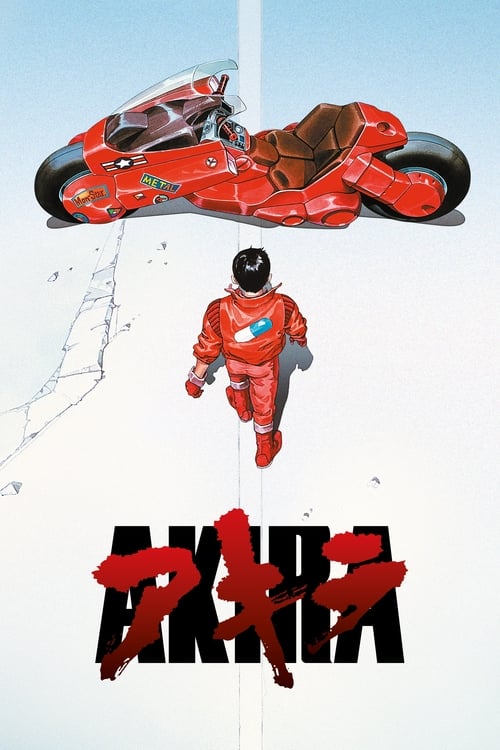
The most visceral depiction of premature kundalini awakening ever animated. Tetsuo's body can't contain the energy because his psyche wasn't prepared. Neo-Tokyo builds weapons from what should have been temples.
Akira is the most accurate depiction of catastrophic spiritual awakening ever put on film. Otomo dresses it as cyberpunk apocalypse, but the actual subject is the human nervous system encountering energies it has no architecture to hold. Tetsuo is not a metaphor for nuclear weapons. He is a metaphor for what happens when force enters a psyche that has never been initiated. The military thought they were studying telekinesis. They were dissecting kundalini in children whose chakras had not yet formed. The 1988 explosion that opened the film was the result. The 2019 explosion at the end is the same event, repeating, because nothing in Neo-Tokyo learned anything between the two.
The Surface
A biker gang in post-apocalyptic Neo-Tokyo collides with a military experiment. One of them, Tetsuo, develops psychic powers and rapidly loses control. The government attempts to contain him. He destroys most of the city. A being called Akira — the original subject of the experiments — is invoked to stop him. The universe restarts.
Most readings stop at the political allegory: nuclear trauma, military hubris, youth alienation. These readings are not wrong, but they are not the layer Otomo was actually building. The 2,000-page manga he was compressing is explicit about what the espers represent. They are children with awakened consciousness in bodies that cannot metabolize it.
The film is a study of what happens when transcendent force enters an unprepared vessel. Every other event — the gangs, the coup, the religious cult — is the residue of one technical fact: someone in this city woke up too fast.
Tetsuo as Premature Awakening
In every initiatory tradition, power is given gradually and only after the initiate has been prepared. The body must be tempered. The ego must be loosened. A container must be built before anything is poured into it. Skipping these steps is not 'fast progress.' It is destruction.
Tetsuo skips every step. He has been the small one, the bullied one, the one who borrowed Kaneda's bike because his own was always breaking down. When power arrives, it arrives into a psyche organized around resentment, inferiority, and the desperate need to no longer be small. The power does not transform that organization. It amplifies it.
This is why his telekinesis manifests as smashing. His telepathy as paranoia. His regenerative ability as runaway flesh that he cannot stop from growing. The energy is real. The vessel is wrong. Everything kundalini literature warns about — the destruction of the nervous system, the inflation of the ego into messianic delusion, the loss of the body's boundary — Otomo animates frame by frame.
The stadium sequence is the final stage. Tetsuo's body becomes a tumor of itself, consuming Kaori, swallowing equipment, no longer recognizing where he ends and the world begins. This is what an awakened consciousness without preparation actually looks like from inside. Not enlightenment. Cancer of the self.
The Children Who Are Older Than the City
The other espers — Kiyoko, Takashi, Masaru — look like children but have the faces of old people. They are wrinkled, undersized, eternal. They have been in the military facility for decades, kept alive by drugs and apparatus. They know what is coming because they have already seen it. They speak to each other across distance without moving their mouths.
These are the prepared vessels. Their bodies were broken so their consciousness could expand without destroying them. They are not happy. They are not enlightened in any feel-good sense. They are stationed at the edge of human consciousness, holding a position no one asked them to hold, knowing that another being like Akira will eventually emerge and that they will not be able to stop it.
This is the bodhisattva architecture made literal. Beings who could exit the wheel but stay, embedded in suffering, because someone has to be present when the next awakening goes wrong. The espers are not the villains. They are the maintenance crew for a fault line in reality itself.
When they finally take Tetsuo with them at the end — when they pull him into the dimension where Akira already lives — they are not killing him. They are giving him the initiation he should have received before any of this started. The universe restarts inside his consciousness because his consciousness is finally a place where a universe can be safely born.
Akira Already Happened
The opening shot is a white flash and a perfectly circular crater. The first thing we see in the film is the result of what the film is about. Otomo is not building toward an explosion. He is showing us the explosion has already occurred, and we are now living in its aftermath, in a city built on top of a wound that was never closed.
Akira's body parts are kept in cryogenic storage beneath the new Olympic stadium. The city is built on his bones the way Christian cathedrals were built on saints. Neo-Tokyo is a reliquary that has forgotten what relic it contains. The cult that worships Akira knows. The government that dissected him knows. The citizens going about their day do not know — but they live above the buried god regardless.
This is the Gnostic structure: the divine spark hidden in matter, encrypted in flesh, scattered in pieces. The Archons (the military, the politicians, the corporations) know where the pieces are and use them for power. The pneumatic remnant (the cult, the espers) knows the pieces are sacred. The mass population is hylic — completely unconscious that the city itself is a desecrated temple.
When Tetsuo finds the cryogenic chamber and sees the labeled jars — BRAIN, HEART — he is not seeing a science fiction prop. He is seeing what the modern world has done to the sacred. Reduced it to specimens. Catalogued the unknowable.
The Transmission
Akira is technically a masterpiece — the most expensive animated film of its era, animated on twos with a degree of detail Western animation rarely attempted. But the technical mastery is in service of a transmission that the action obscures: the film induces in the viewer the same overload it depicts.
The neon, the speed, the constant escalation, the hallucinatory texture of Tetsuo's transformations — by the third act, the viewer's nervous system is in the same state as Tetsuo's. Otomo is using cinema as a kundalini amplifier and trusting that the frame of the screen will contain what the character cannot.
Watch what you feel after the credits. Not satisfied. Not entertained. Wired. Slightly nauseous. Aware that something happened to you and you cannot quite say what. That is the film operating at its actual layer. The warning is not 'don't trust the military.' The warning is: do not summon what you have not built a body to hold.
Questions this film answers
What is the deeper meaning of Akira?
Akira is the most accurate depiction of catastrophic spiritual awakening ever put on film. Otomo dresses it as cyberpunk apocalypse, but the actual subject is the human nervous system encountering energies it has no architecture to hold. Tetsuo is not a metaphor for nuclear weapons. He is a metaphor for what happens when force enters a psyche that has never been initiated. The military thought they were studying telekinesis. They were dissecting kundalini in children whose chakras had not yet formed. The 1988 explosion that opened the film was the result. The 2019 explosion at the end is the same event, repeating, because nothing in Neo-Tokyo learned anything between the two.
What is the hidden symbolism in Akira?
A biker gang in post-apocalyptic Neo-Tokyo collides with a military experiment. One of them, Tetsuo, develops psychic powers and rapidly loses control. The government attempts to contain him. He destroys most of the city. A being called Akira — the original subject of the experiments — is invoked to stop him. The universe restarts.
What esoteric traditions appear in Akira?
Akira draws from Initiation, Buddhism, Gnosticism traditions. The most visceral depiction of premature kundalini awakening ever animated. Tetsuo's body can't contain the energy because his psyche wasn't prepared. Neo-Tokyo builds weapons from what should have been temples.
What does Akira teach about tetsuo as premature awakening?
The power does not transform Tetsuo's organization. It amplifies it. The energy is real. The vessel is wrong. In every initiatory tradition, power is given gradually and only after the initiate has been prepared. The body must be tempered. The ego must be loosened. A container must be built before anything is poured into it. Skipping these steps is not 'fast progress.' It is destruction.
What does Akira teach about akira already happened?
Neo-Tokyo is a reliquary that has forgotten what relic it contains. The opening shot is a white flash and a perfectly circular crater. The first thing we see in the film is the result of what the film is about. Otomo is not building toward an explosion. He is showing us the explosion has already occurred, and we are now living in its aftermath, in a city built on top of a wound that was never closed.
Is Akira worth watching for spiritual seekers?
Akira (1988) directed by Katsuhiro Otomo is essential viewing for those interested in Kundalini, Awakening, Power. The Awakening That Destroys the Vessel. It rewards multiple viewings and contemplation.
Rewatch With New Eyes
Now that you've seen the architecture, experience it again. The same film becomes a different film when you know what to watch for.
This time, watch for:
- Mark the threshold: the old self dies, the ordeal transforms, the new self returns
- See impermanence: what clings, what releases, what remains
- Watch for the false world vs. the real — who is asleep, who awakens
Links may include affiliate partnerships that support Media Revelations
The Descent Continues
Where this thread leads next.
Neon Genesis Evangelion 1995
Kabbalistic Apocalypse in the Ruins of the Self
Read the revelation →