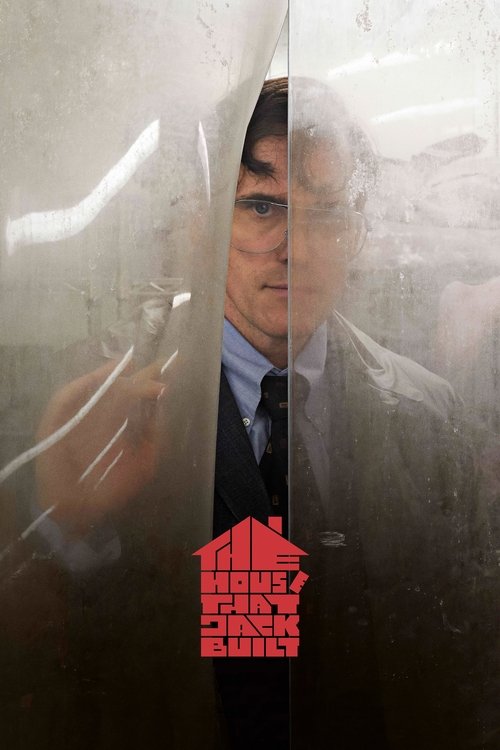
The House That Jack Built
The House That Jack Built Is a Man Performing Alchemy in Reverse, Turning Gold Back Into Corpses
Directed by Lars von Trier
Jack keeps trying to build a house and keeps tearing it down. By the end he understands the only material he can actually work in is dead bodies, and he builds the house out of those.
Lars von Trier structures the film as a confession Jack narrates to a listener named Verge, walking somewhere unseen, recounting five "incidents" from twelve years of murder. Jack is an engineer who wanted to be an architect. He repeatedly buys a plot of land and pours a foundation and demolishes it, dissatisfied, unable to make a house rise. He photographs his victims, arranges them, freezes them in a walk-in locker, insists that the killings are compositions, that decay is a kind of icon-painting, that a stroke of murder is a stroke of art. The surface reading is a provocation about art and cruelty, von Trier trolling his own critics through a serial killer's mouth. The actual film is more precise and more damning. It is a study of a man given the exact machinery of transformation, the vessel, the fire, the work of turning base matter into something higher, and using every piece of it in reverse.
Alchemical Reading: The Nigredo That Never Reaches the Gold
Alchemy's first stage is the nigredo, the blackening, the putrefaction of the prima materia in the sealed vessel. Rot is supposed to come first. It is the necessary death that precedes the albedo and the final gold. Jack is stuck in the nigredo forever, and he has mistaken the stink of the first stage for the whole opus. His freezer full of frozen bodies is a laboratory of arrested putrefaction. He even lectures Verge on grapes and wine, on how the noblest wine comes from grapes touched by rot, gesturing at the truth of transformation while doing the opposite of it.
The tell is the house. Alchemy is called the Great Work, the building of the philosopher's stone, the raising of the temple of the transformed self. Jack cannot raise a house because he has no interior to build from. His prima materia never transmutes because he refuses the actual heat, which is not fire but grief, humility, the dissolution of the ego. So he does the perverse thing available to a man with all the equipment and none of the soul: he builds his house out of the corpses themselves, stacking the frozen bodies into walls. He has all the apparatus of transformation and produces only a colder version of what he started with. The final descent, Verge revealed as Virgil, leading Jack through the circles toward a bridge out of hell, is the last inversion: given even the ladder out, Jack reaches for the far ledge and falls. The one true ascent offered, and he cannot complete it.
Demonological Reading: The Intelligence That Explains Itself Perfectly and Understands Nothing
Classical demonology draws a fine line: the demon is not stupid. It is brilliant, articulate, learned, endlessly able to justify itself in the language of philosophy and theology, and it is precisely this fluency that damns it. The demon knows everything about the good except how to want it.
Jack talks constantly. He discourses on Gothic cathedrals, on Glenn Gould, on Blake's tiger and lamb, on the dignity of the icon. He is culturally omnivorous and morally absent, and von Trier films his mind as a gallery of Speer's architecture, Nazi footage, William Blake, the aestheticized flow of Western achievement pumped through a soul with no floor. Verge, the voice of the accumulated wisdom of the tradition, argues with him the whole way down and cannot reach him, because Jack can answer every argument and feel none of it. That is the demonic condition exactly: intelligence that has severed itself from the capacity to be moved by what it knows, articulate to the last and utterly unreachable.
Questions this film answers
What is the deeper meaning of The House That Jack Built?
Lars von Trier structures the film as a confession Jack narrates to a listener named Verge, walking somewhere unseen, recounting five "incidents" from twelve years of murder. Jack is an engineer who wanted to be an architect. He repeatedly buys a plot of land and pours a foundation and demolishes it, dissatisfied, unable to make a house rise. He photographs his victims, arranges them, freezes them in a walk-in locker, insists that the killings are compositions, that decay is a kind of icon-painting, that a stroke of murder is a stroke of art. The surface reading is a provocation about art and cruelty, von Trier trolling his own critics through a serial killer's mouth. The actual film is more precise and more damning. It is a study of a man given the exact machinery of transformation, the vessel, the fire, the work of turning base matter into something higher, and using every piece of it in reverse.
What is the hidden symbolism in The House That Jack Built?
Alchemy's first stage is the nigredo, the blackening, the putrefaction of the prima materia in the sealed vessel. Rot is supposed to come first. It is the necessary death that precedes the albedo and the final gold. Jack is stuck in the nigredo forever, and he has mistaken the stink of the first stage for the whole opus. His freezer full of frozen bodies is a laboratory of arrested putrefaction. He even lectures Verge on grapes and wine, on how the noblest wine comes from grapes touched by rot, gesturing at the truth of transformation while doing the opposite of it.
What esoteric traditions appear in The House That Jack Built?
The House That Jack Built draws from Alchemy, Demonology traditions. Jack keeps trying to build a house and keeps tearing it down. By the end he understands the only material he can actually work in is dead bodies, and he builds the house out of those.
Is The House That Jack Built worth watching for spiritual seekers?
The House That Jack Built (2018) directed by Lars von Trier is essential viewing for those interested in Alchemy, Demonology. The House That Jack Built Is a Man Performing Alchemy in Reverse, Turning Gold Back Into Corpses. It rewards multiple viewings and contemplation.
Rewatch With New Eyes
Now that you've seen the architecture, experience it again. The same film becomes a different film when you know what to watch for.
This time, watch for:
- Track the stages: blackening, whitening, reddening — death before rebirth
- Identify the hierarchy: which demon, which rank, which grimoire it comes from
Links may include affiliate partnerships that support Media Revelations