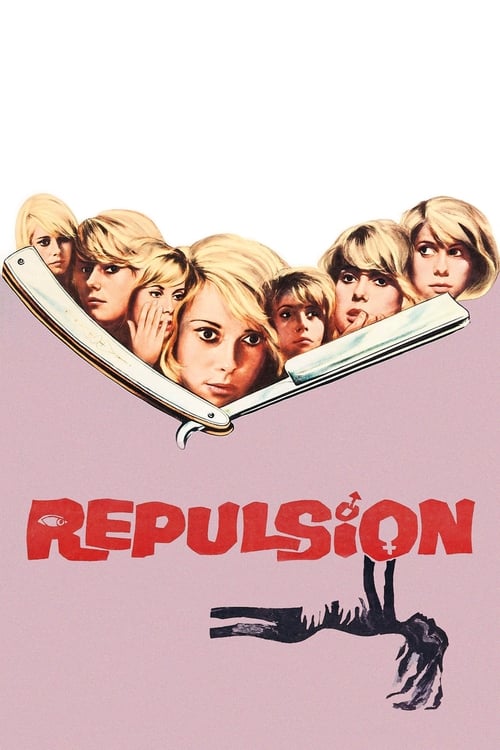
Repulsion
Repulsion Is What a Room Becomes When the Self Inside It Stops Holding Its Walls
Directed by Roman Polanski
Polanski shot a horror film with no monster. The apartment does everything, because the apartment is Carole's mind after the last door fails.
Carole is beautiful, silent, and slowly coming apart inside a London flat she shares with her sister. When the sister leaves for holiday with a married lover, Carole is left alone, and the film becomes a record of a psyche losing containment in real time. A skinned rabbit rots on a plate. Cracks split the plaster with a sound like breaking bone. Hands push out of the corridor walls to grope her. Nothing supernatural is happening. Polanski keeps the camera close and patient so that we cannot escape into the comfort of a ghost; the terror is that all of it is Carole, projected outward because there is no longer an inside strong enough to hold it. The film is not about a woman haunted by an apartment. It is about a woman for whom the boundary between self and room has dissolved, so that her buried horror of male touch now leaks from every surface.
Jungian Reading: The Repressed Returns as Architecture
Jung held that whatever the psyche refuses to make conscious does not vanish; it returns from outside, dressed as fate, as accident, as the world itself gone strange. Carole represses an enormous charge, some unnamed early violation the film only gestures at through the family photograph held on her staring face in the final shot. Because the charge is never made conscious, it cannot stay contained. It becomes the flat.
Watch how precisely the hallucinations track her repression. The grasping hands erupt from the walls the instant she is alone and safe, exactly when the ego's daytime defenses relax. The would-be suitor who forces his way in, whom she kills with a candlestick, is not simply a threat; he is the return of the thing she cannot look at, arriving in a form she can finally strike. The walls do not crack because the building is haunted. They crack because the woman is the wall, and she is failing. Polanski externalizes the entire unconscious onto plaster and plumbing, and the horror is watching a mind with no witness, no analyst, no one to say the thing out loud, decompensate into its own set design.
Shamanic Reading: Soul-Loss With No One to Call It Back
Shamanic traditions describe soul-loss: a fragment of the self splits off after trauma and wanders, leaving the person hollow, dreamy, absent behind the eyes. Carole enters the film already in this state. Her stillness is not calm, it is vacancy; she moves through the salon and the street as though partly elsewhere, flinching from touch as from a wound that has never closed.
In a functioning tradition, a healer would journey to retrieve the lost fragment and reintegrate it through ritual. Carole has no one. Modern London gives her a sister, a boyfriend, a landlord, all of whom read her absence as shyness or moodiness and none of whom can see that she is disintegrating. Without retrieval, soul-loss completes itself. By the final shot she is catatonic under the bed, carried out of frame, the fragment fully gone. The camera drifts to that childhood photograph, the last visible trace of the intact self, the moment before the splitting began.
Questions this film answers
What is the deeper meaning of Repulsion?
Carole is beautiful, silent, and slowly coming apart inside a London flat she shares with her sister. When the sister leaves for holiday with a married lover, Carole is left alone, and the film becomes a record of a psyche losing containment in real time. A skinned rabbit rots on a plate. Cracks split the plaster with a sound like breaking bone. Hands push out of the corridor walls to grope her. Nothing supernatural is happening. Polanski keeps the camera close and patient so that we cannot escape into the comfort of a ghost; the terror is that all of it is Carole, projected outward because there is no longer an inside strong enough to hold it. The film is not about a woman haunted by an apartment. It is about a woman for whom the boundary between self and room has dissolved, so that her buried horror of male touch now leaks from every surface.
What is the hidden symbolism in Repulsion?
Jung held that whatever the psyche refuses to make conscious does not vanish; it returns from outside, dressed as fate, as accident, as the world itself gone strange. Carole represses an enormous charge, some unnamed early violation the film only gestures at through the family photograph held on her staring face in the final shot. Because the charge is never made conscious, it cannot stay contained. It becomes the flat.
What esoteric traditions appear in Repulsion?
Repulsion draws from Jungian, Shamanism traditions. Polanski shot a horror film with no monster. The apartment does everything, because the apartment is Carole's mind after the last door fails.
Is Repulsion worth watching for spiritual seekers?
Repulsion (1965) directed by Roman Polanski is essential viewing for those interested in Jungian, Shamanism. Repulsion Is What a Room Becomes When the Self Inside It Stops Holding Its Walls. It rewards multiple viewings and contemplation.
Rewatch With New Eyes
Now that you've seen the architecture, experience it again. The same film becomes a different film when you know what to watch for.
This time, watch for:
- Meet the shadow: what is rejected, projected, and finally integrated
- Follow the descent: what dies, what guides, what returns transformed
Links may include affiliate partnerships that support Media Revelations
The Descent Continues
Where this thread leads next.
The Tenant 1976
The Tenant Is About How a Building Can Tell You Who to Become
Read the revelation →