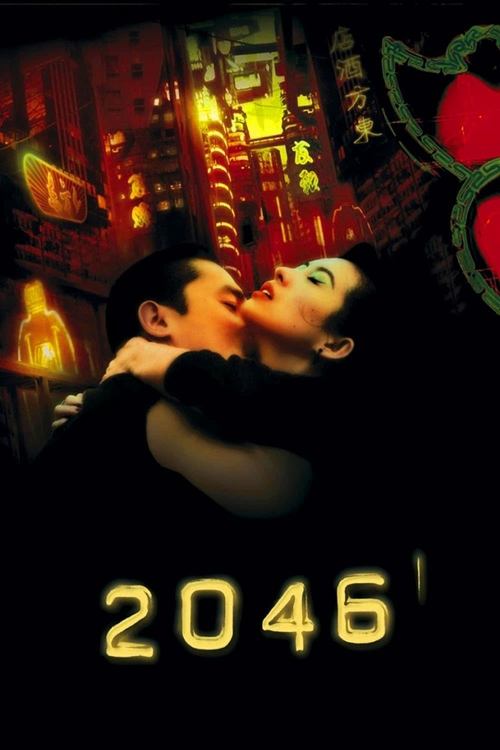
2046
2046 Is the Realm You Enter When You Refuse to Finish Grieving
Directed by Wong Kar-Wai
The train goes there but never comes back. Wong Kar-Wai spent five years making a film about why someone would choose that.
Mr. Chow is a writer. He lives in a Hong Kong hotel room numbered 2047, one door from the room where everything ended. He pours himself into women, then records what he extracts. He writes a science-fiction serial, also called "2046," about a future train that carries passengers to a place where nothing ever changes and no one ever leaves. The surface reading is that this is a romantic film about a man who cannot forget. The film itself is something more specific and more damaging: it is a portrait of a man who has confused the refusal to grieve with faithfulness. Chow does not love the past. He feeds on it. Every woman who passes through his life teaches him something he presses into fiction instead of feeling. The novel is not a monument to loss. It is the strategy for avoiding it.
Buddhist Reading: The Train to 2046 as Bardo Vehicle
In Tibetan Buddhism, the bardo is the intermediate state: the gap between death and rebirth where consciousness encounters what it could not release in life. The bardo teachings are precise about what holds a consciousness in place. Attachment. The refusal to recognize that a form is gone. The mind that keeps addressing someone who is no longer there.
In the film-within-the-film, passengers board a train for 2046 to recover lost memories. They can never return. The android attendants aboard the train respond to declarations of love with a delay: one passenger waits an entire year for an android to answer whether she loves him back. That year of waiting is the whole film's emotional structure compressed into a single image. The android is not slow. The past is already leaving, and it leaves at the speed it chooses. Chow narrates this scene as though it belongs only to his fiction. He has not noticed that he is the passenger. He boards his own bardo vehicle every time he sits at the typewriter, every time he withholds himself from Bai Ling, every time he watches Wang Jingwen's face and sees the woman who is no longer there instead of the woman in front of him. The teachings say that liberation requires recognizing the nature of what you are holding. Chow looks directly at his attachment and gives it a plot.
Alchemical Reading: The Alembic Sealed from the Inside
Alchemy requires that the substance be transformed inside the vessel, not stored there indefinitely. The vessel is a crucible, not a vault. Chow's hotel room is his alembic, and he has sealed it from the inside. Every woman who enters becomes material. Bai Ling, who is all fire and exposure, who demands the full presence Chow cannot offer, undergoes the film's most visible alchemy: she falls in love, is refused, and burns. She is calcinatio. She is the agent of heat that should transform the prima materia and instead transforms only herself because Chow will not submit to the process.
Wang Jingwen, who waits faithfully for her Japanese lover against her father's orders, shows Chow what real waiting looks like. It is not preservation. It is trust in a future that has not arrived. The alchemical distinction is clean: her waiting is directed outward toward something living; Chow's is directed inward toward something sealed. He has confused the vessel with the work. The hotel room accumulates. Nothing is refined. The opus requires loss as its entry fee and Chow has paid every other cost except that one.
Other films where a character mistakes the archive for the living thing: In the Mood for Love (the wound this film is built from), Eternal Sunshine of the Spotless Mind (the opposite question, what if you could erase it), Happy Together (Wong Kar-Wai's other trap: the love that only exists as destruction).
Questions this film answers
What is the deeper meaning of 2046?
Mr. Chow is a writer. He lives in a Hong Kong hotel room numbered 2047, one door from the room where everything ended. He pours himself into women, then records what he extracts. He writes a science-fiction serial, also called "2046," about a future train that carries passengers to a place where nothing ever changes and no one ever leaves. The surface reading is that this is a romantic film about a man who cannot forget. The film itself is something more specific and more damaging: it is a portrait of a man who has confused the refusal to grieve with faithfulness. Chow does not love the past. He feeds on it. Every woman who passes through his life teaches him something he presses into fiction instead of feeling. The novel is not a monument to loss. It is the strategy for avoiding it.
What is the hidden symbolism in 2046?
In Tibetan Buddhism, the bardo is the intermediate state: the gap between death and rebirth where consciousness encounters what it could not release in life. The bardo teachings are precise about what holds a consciousness in place. Attachment. The refusal to recognize that a form is gone. The mind that keeps addressing someone who is no longer there.
What esoteric traditions appear in 2046?
2046 draws from Buddhism, Alchemy traditions. The train goes there but never comes back. Wong Kar-Wai spent five years making a film about why someone would choose that.
Is 2046 worth watching for spiritual seekers?
2046 (2004) directed by Wong Kar-Wai is essential viewing for those interested in Buddhism, Alchemy. 2046 Is the Realm You Enter When You Refuse to Finish Grieving. It rewards multiple viewings and contemplation.
Rewatch With New Eyes
Now that you've seen the architecture, experience it again. The same film becomes a different film when you know what to watch for.
This time, watch for:
- See impermanence: what clings, what releases, what remains
- Track the stages: blackening, whitening, reddening — death before rebirth
Links may include affiliate partnerships that support Media Revelations
The Descent Continues
Where this thread leads next.

Forrest Gump 1994
The Holy Fool and the Feather of Grace
Read the revelation →