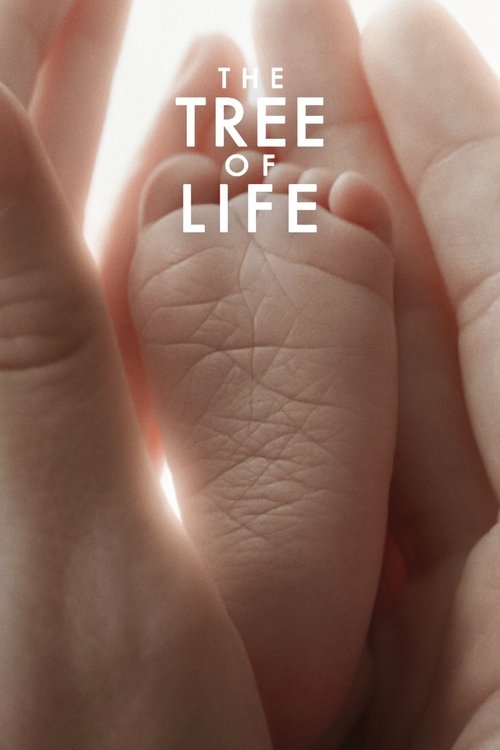
The Tree of Life
Nature, Grace, and the Wound of Incarnation
Directed by Terrence Malick
Malick opens with Job's question and answers it with the creation of the universe. The dinosaur scene is the first appearance of mercy in the material world. The mother is grace. The father is nature.
The Tree of Life is the Book of Job answered with the creation of the universe. A family receives news of their son's death. The mother asks the oldest human question: how could this happen? Malick does not answer in words. He shows her the formation of galaxies, the cooling of Earth, the first single cell, the dinosaur in the river who chooses not to kill. This is the theological argument: mercy was present from the beginning. It is woven into matter. Whether or not it consoles her is a separate question. The film is not asking you to be consoled. It is asking you to see what Job saw when God spoke from the whirlwind.
The Surface
A 1950s Texas family — strict father, gentle mother, three boys — loses the middle son at nineteen. Decades later, the eldest son drifts through his adult life unable to fully feel or reach his late brother. Between these two times, Malick interpolates the formation of the universe.
Read as conventional narrative, the structure is bewildering. The cosmos sequence takes twenty minutes. Whispered voiceovers ask questions that go unanswered. The childhood scenes have almost no dialogue. The dinosaur appears without explanation.
Read as a theological text, the structure is perfectly logical. Malick is responding to a mother's grief by enlarging the frame past the human entirely. The answer to Job's question requires showing him the leviathan. Malick's leviathan is the cosmos itself.
Nature and Grace
Mrs. O'Brien narrates the film's opening: 'The nuns taught us there are two ways through life — the way of nature and the way of grace.' This is the film's structural axis. Nature is competitive, possessive, asserting its will. Grace accepts insults and injuries, asks to be of service, loves regardless of return.
Mr. O'Brien is nature. He believes in strength, achievement, the right of the stronger. He loves his sons but he loves them in the mode of nature — through correction, through demand, through the conviction that they must be hardened to survive. He is not the villain. He is the way of nature, which produces real things — sons capable of facing the world — but at real cost.
Mrs. O'Brien is grace. She does not protect her sons from suffering. She moves through it with them. She lets the world be what it is. The film's famous image of her floating above the lawn is not magical realism. It is the depiction of grace as ontological state — what it looks like to be in the world without grasping it.
Both are true. Both are necessary. The film does not let you choose. The mature soul must integrate both — a nature that can act decisively and a grace that does not have to grasp. Jack, the eldest son, spends his life caught between them, unable to reconcile what his father and mother each transmitted to him.
The Cosmos as Answer
The mother asks: 'Was I false to you? Lord, why? Where were you?' The film answers by showing her the Big Bang. Stars form. Galaxies organize. A single cell appears. The cell divides. Life crawls onto land. A dinosaur reaches a river. Another dinosaur, wounded, lies in the shallows. The first dinosaur could kill it. It does not. It places its foot on the wounded one's head and walks away.
This is the answer. Malick is not saying 'your grief does not matter because the universe is large.' He is showing that mercy — the choice not to harm when one could — was present 200 million years ago, before humans existed. It is older than us. It is built in.
This is alchemical structure. The Great Work is not the production of something new. It is the recognition of what was always already present in the prima materia. Mercy is in the material. Grace is in the foundation of the cosmos. The mother's question — was God absent? — is answered by showing her where God has been all along: in the dinosaur that chose not to kill.
She does not have to believe it. Job did not have to believe it either, exactly. He saw the leviathan and went silent. The seeing is the answer. The seeing is not the same as consolation. It is a different kind of relief.
Jack on the Beach
The film's closing sequence shows the adult Jack walking on a beach where everyone he has loved is present — his parents in their youth, his brothers as children, strangers from his life. They greet each other. They embrace. There is no dialogue.
Critics often read this as Jack's vision of heaven or as a metaphor for memory. The film is more precise than either reading. The beach is what consciousness encounters when the boundaries of time soften. It is the panoramic recognition that the people you knew are still here, in the form they were in, in the part of the substrate that does not pass.
Buddhism describes this as the recognition of non-arising. The people you loved were never separate from you. The forms changed. The continuity of love did not. The grief is real. The grief is also a misunderstanding about what was actually being loved.
Jack reaches his brother. He puts his hand on his back. The image is not dramatic. It is enough. It is what grief was looking for. The film transmits this not as belief but as experience — for two minutes, while you watch the beach, you understand what Malick is showing. Then you walk out of the theater and you have to decide whether you saw it.
The Transmission
The Tree of Life is one of the few films that genuinely operates as religious art. It does not preach. It induces. By the end of the cosmos sequence, you have been moved to a position from which the family's grief is held differently. By the end of the beach sequence, you have been allowed to feel what reconciliation feels like, even though you have not earned it.
Malick is doing what icon painters did. He is making an image whose function is to alter the viewer's state in the direction of grace. You do not interpret an icon. You sit before it. The Tree of Life is a moving icon. Sit before it.
Whether or not the film provides theological proof is the wrong question. It provides experience. The experience is of mercy as a feature of the substrate, of love as continuous through forms, of the dinosaur in the river that chose not to kill. If this is what is, the film has shown it. If this is not what is, the film has at least shown what such a cosmos would feel like. Either way, you are different for an hour after watching.
Questions this film answers
What is the deeper meaning of The Tree of Life?
The Tree of Life is the Book of Job answered with the creation of the universe. A family receives news of their son's death. The mother asks the oldest human question: how could this happen? Malick does not answer in words. He shows her the formation of galaxies, the cooling of Earth, the first single cell, the dinosaur in the river who chooses not to kill. This is the theological argument: mercy was present from the beginning. It is woven into matter. Whether or not it consoles her is a separate question. The film is not asking you to be consoled. It is asking you to see what Job saw when God spoke from the whirlwind.
What is the hidden symbolism in The Tree of Life?
A 1950s Texas family — strict father, gentle mother, three boys — loses the middle son at nineteen. Decades later, the eldest son drifts through his adult life unable to fully feel or reach his late brother. Between these two times, Malick interpolates the formation of the universe.
What esoteric traditions appear in The Tree of Life?
The Tree of Life draws from Initiation, Alchemy, Buddhism traditions. Malick opens with Job's question and answers it with the creation of the universe. The dinosaur scene is the first appearance of mercy in the material world. The mother is grace. The father is nature.
What does The Tree of Life teach about nature and grace?
Grace as ontological state — what it looks like to be in the world without grasping it. Mrs. O'Brien narrates the film's opening: 'The nuns taught us there are two ways through life — the way of nature and the way of grace.' This is the film's structural axis. Nature is competitive, possessive, asserting its will. Grace accepts insults and injuries, asks to be of service, loves regardless of return.
What does The Tree of Life teach about the cosmos as answer?
Mercy is in the material. Grace is in the foundation of the cosmos. The mother asks: 'Was I false to you? Lord, why? Where were you?' The film answers by showing her the Big Bang. Stars form. Galaxies organize. A single cell appears. The cell divides. Life crawls onto land. A dinosaur reaches a river. Another dinosaur, wounded, lies in the shallows. The first dinosaur could kill it. It does not. It places its foot on the wounded one's head and walks away.
Is The Tree of Life worth watching for spiritual seekers?
The Tree of Life (2011) directed by Terrence Malick is essential viewing for those interested in Grace, Theodicy, Malick. Nature, Grace, and the Wound of Incarnation. It rewards multiple viewings and contemplation.
Rewatch With New Eyes
Now that you've seen the architecture, experience it again. The same film becomes a different film when you know what to watch for.
This time, watch for:
- Mark the threshold: the old self dies, the ordeal transforms, the new self returns
- Track the stages: blackening, whitening, reddening — death before rebirth
- See impermanence: what clings, what releases, what remains
Links may include affiliate partnerships that support Media Revelations
The Descent Continues
Where this thread leads next.
2001: A Space Odyssey 1968
The Alchemical Ascent of Consciousness
Read the revelation →