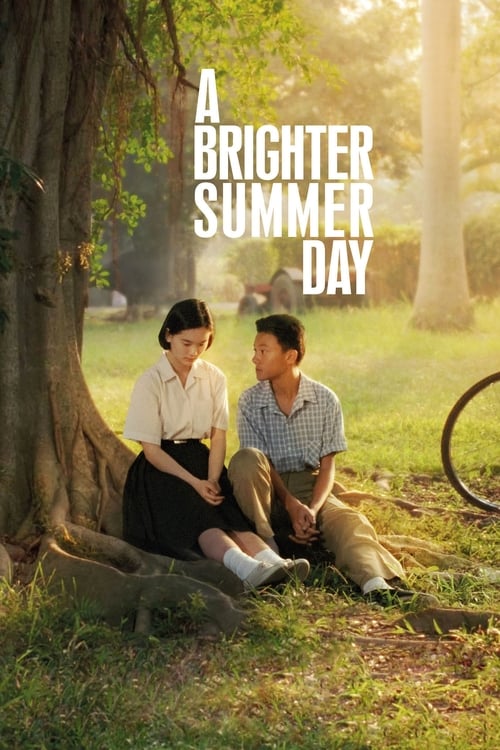
A Brighter Summer Day
A Brighter Summer Day Is About a Boy Killing the Only Person Who Wouldn't Be Owned
Directed by Edward Yang
Edward Yang spends four hours building a whole displaced society so that one flashlight, stolen from a film set, can become the only honest light in it.
Xiao Si'r is a schoolboy in 1960s Taipei, son of mainland refugees who fled with Chiang Kai-shek and never stopped being exiles. He drifts between youth gangs, a father slowly broken by the secret police, and Ming, a girl the whole ecosystem of boys wants to possess. At the end he stabs her to death on a street in daylight. The film is filed under coming-of-age, first love, teenage violence. That framing misses what Yang built. This is a study of what happens to a soul raised inside a lie, in a borrowed country under martial law, where every adult institution demands you pretend the temporary is permanent. Si'r kills Ming not because she betrayed him but because she refused to be the fixed, pure thing he needed her to be in a world where nothing else held still. What follows is the machinery underneath the murder.
Jungian Reading: The Anima Killed for Refusing to Be an Ideal
Jung's anima is the inner feminine a young man projects outward onto a real woman, mistaking his own soul-image for her actual self. The projection demands the woman be an ideal: pure, loyal, singular, a fixed point to organize a life around. When the real woman moves, changes, loves elsewhere, the projection shatters, and an immature psyche can experience that shattering as a betrayal worth killing over.
Ming is the most alive person in the film precisely because she will not hold still for anyone's projection. She moves between boys, between protectors, adapting, surviving, because survival in her world means never belonging to one owner. Si'r cannot bear this. He has decided she is the one uncorrupted thing, the one point of purity in a rotting society, and he tells himself he is saving her. Watch the final scene: he pleads with her to change, to be worthy of the ideal he has built. She refuses with a line that breaks him. She tells him she is like this world, and no one can change her, any more than they can change it. He is not killing a girl. He is trying to kill the fact that the world will not hold the shape his soul requires. The knife lands on her because she was standing where his illusion used to be.
Initiatory Reading: The Failed Initiation of a Boy With No Elders Left
An initiation needs elders who still believe in the world they are inducting the boy into. Si'r has none. His father, an honest man, is dragged in by the Kuomintang security apparatus and comes home hollow, his authority visibly stripped. The teachers humiliate. The gangs offer the only structure of manhood available, and that structure runs on knives.
So the boy improvises his own rite of passage out of the fragments left to him. He steals a flashlight and a portable radio from the movie studio where his neighborhood watches its dreams manufactured. He carries a Japanese sword, an inheritance from the last occupation. He is assembling the tools of a manhood no one will confer on him legitimately. Without a true initiation, the drive toward it does not disappear. It turns lethal. The murder is a botched rite: the moment a boy without elders reaches for transformation and produces only destruction, of Ming and of himself. Yang shows the tape recorder at the end, the one Si'r used to record his own voice, being erased by an official who cannot even be bothered to listen. The society will not initiate its sons and then it erases the evidence of what the failure cost.
Questions this film answers
What is the deeper meaning of A Brighter Summer Day?
Xiao Si'r is a schoolboy in 1960s Taipei, son of mainland refugees who fled with Chiang Kai-shek and never stopped being exiles. He drifts between youth gangs, a father slowly broken by the secret police, and Ming, a girl the whole ecosystem of boys wants to possess. At the end he stabs her to death on a street in daylight. The film is filed under coming-of-age, first love, teenage violence. That framing misses what Yang built. This is a study of what happens to a soul raised inside a lie, in a borrowed country under martial law, where every adult institution demands you pretend the temporary is permanent. Si'r kills Ming not because she betrayed him but because she refused to be the fixed, pure thing he needed her to be in a world where nothing else held still. What follows is the machinery underneath the murder.
What is the hidden symbolism in A Brighter Summer Day?
Jung's anima is the inner feminine a young man projects outward onto a real woman, mistaking his own soul-image for her actual self. The projection demands the woman be an ideal: pure, loyal, singular, a fixed point to organize a life around. When the real woman moves, changes, loves elsewhere, the projection shatters, and an immature psyche can experience that shattering as a betrayal worth killing over.
What esoteric traditions appear in A Brighter Summer Day?
A Brighter Summer Day draws from Jungian, Initiation traditions. Edward Yang spends four hours building a whole displaced society so that one flashlight, stolen from a film set, can become the only honest light in it.
Is A Brighter Summer Day worth watching for spiritual seekers?
A Brighter Summer Day (1991) directed by Edward Yang is essential viewing for those interested in Jungian, Initiation. A Brighter Summer Day Is About a Boy Killing the Only Person Who Wouldn't Be Owned. It rewards multiple viewings and contemplation.
Rewatch With New Eyes
Now that you've seen the architecture, experience it again. The same film becomes a different film when you know what to watch for.
This time, watch for:
- Meet the shadow: what is rejected, projected, and finally integrated
- Mark the threshold: the old self dies, the ordeal transforms, the new self returns
Links may include affiliate partnerships that support Media Revelations
The Descent Continues
Where this thread leads next.
Stand by Me 1986
Stand by Me Is a Descent to Look at Death So the Boys Can Come Back as Something Else
Read the revelation →