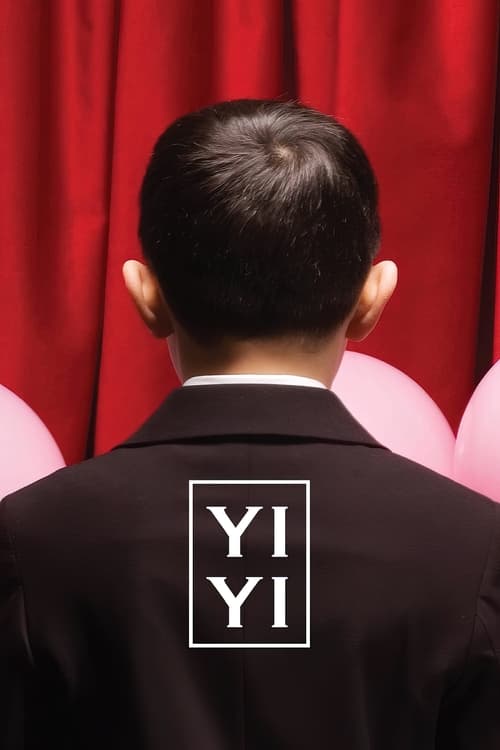
Yi Yi
Yang-Yang Photographs the Back of People's Heads to Show Them What They Cannot See
Directed by Edward Yang
Yi Yi is a three-hour portrait of ordinary life that turns out to be a diagram of ordinary blindness, the half of reality every person walks through without ever facing.
Edward Yang builds Yi Yi around a single architectural fact: we cannot see our own backs. The family at the film's center, each one straining toward connection, meaning, or escape, is constitutionally unable to see what is directly behind them. Yang-Yang, the eight-year-old son, grasps this before any adult does. He begins photographing the backs of people's heads and explaining his project with the flat certainty of someone who has already solved a problem the adults haven't noticed. "I can only see the front," he says. "You can only see the back. Together we see the whole thing." The film ends before any of the adults put the two halves together.
Buddhist Reading: The Coma Is the Mirror
The grandmother lies in a coma for the entire film, and each family member is asked to talk to her daily on the theory that she can still hear. One by one they come to her bedside, and one by one they fall silent. Min-Min, the mother, confesses she has nothing to say because her life contains nothing she hasn't already said. NJ, the father, says almost nothing at all. Ting-Ting, the daughter, tells her grandmother about the boy next door, the guilt over a neighbor's fall, the texture of adolescent confusion.
Buddhist dependent origination holds that suffering arises through contact with objects the mind misperceives as permanent, separate, and capable of delivering lasting satisfaction. The grandmother's coma is Yang's staging of this teaching. She is the perfect mirror: she takes everything in and reflects nothing back. Every character who speaks to her is, in that moment, speaking to the only truly impartial surface in the film. What each person confesses is exactly what they cannot see in the active world. Min-Min eventually flees to a meditation retreat, reaches toward stillness, and returns to the family unchanged. The retreat was another object to contact. The mirror was always already there, in the bed.
Jungian Reading: NJ Searches for His Anima in a Woman He Left Thirty Years Ago
NJ's subplot runs parallel to every other family member's crisis. A failed business negotiation takes him to Tokyo, where he encounters Sherry, the woman he loved before he chose stability over depth. Their scenes together carry the unmistakable quality of Jungian anima-retrieval: he is not seeking Sherry but the part of himself that went dormant when he stopped listening to his own longing.
Jung described the anima not as an external woman but as the soul-image, the part of the psyche that carries feeling, beauty, and erotic aliveness. NJ's marriage is orderly and suffocated. His work is technically competent and spiritually dead. When he sits with Sherry in Tokyo, he is not revisiting a romance, he is revisiting himself before the compromise. He ultimately returns to Taipei and the compromise reasserts itself. The anima was glimpsed, not integrated.
Yang-Yang's photographs appear at the end of the film, laid out for the dead grandmother. He has been collecting the unseen halves the whole time.
Questions this film answers
What is the deeper meaning of Yi Yi?
Edward Yang builds Yi Yi around a single architectural fact: we cannot see our own backs. The family at the film's center, each one straining toward connection, meaning, or escape, is constitutionally unable to see what is directly behind them. Yang-Yang, the eight-year-old son, grasps this before any adult does. He begins photographing the backs of people's heads and explaining his project with the flat certainty of someone who has already solved a problem the adults haven't noticed. "I can only see the front," he says. "You can only see the back. Together we see the whole thing." The film ends before any of the adults put the two halves together.
What is the hidden symbolism in Yi Yi?
The grandmother lies in a coma for the entire film, and each family member is asked to talk to her daily on the theory that she can still hear. One by one they come to her bedside, and one by one they fall silent. Min-Min, the mother, confesses she has nothing to say because her life contains nothing she hasn't already said. NJ, the father, says almost nothing at all. Ting-Ting, the daughter, tells her grandmother about the boy next door, the guilt over a neighbor's fall, the texture of adolescent confusion.
What esoteric traditions appear in Yi Yi?
Yi Yi draws from Buddhism, Jungian traditions. Yi Yi is a three-hour portrait of ordinary life that turns out to be a diagram of ordinary blindness, the half of reality every person walks through without ever facing.
Is Yi Yi worth watching for spiritual seekers?
Yi Yi (2000) directed by Edward Yang is essential viewing for those interested in Buddhism, Jungian. Yang-Yang Photographs the Back of People's Heads to Show Them What They Cannot See. It rewards multiple viewings and contemplation.
Rewatch With New Eyes
Now that you've seen the architecture, experience it again. The same film becomes a different film when you know what to watch for.
This time, watch for:
- See impermanence: what clings, what releases, what remains
- Meet the shadow: what is rejected, projected, and finally integrated
Links may include affiliate partnerships that support Media Revelations
The Descent Continues
Where this thread leads next.
Forrest Gump 1994
The Holy Fool and the Feather of Grace
Read the revelation →