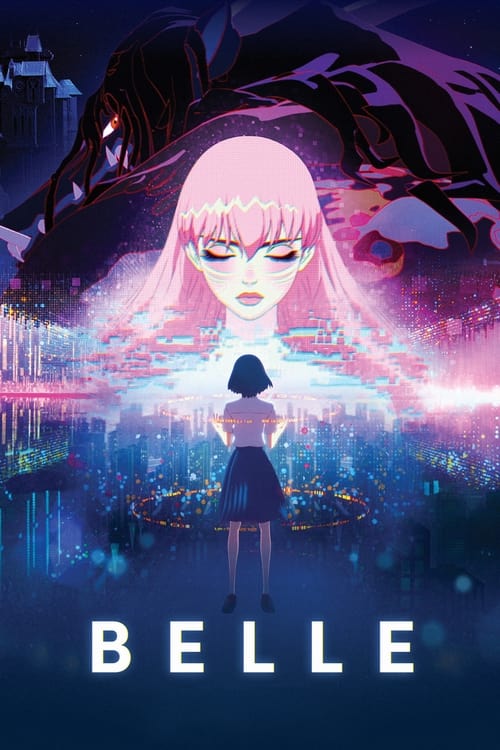
Belle
Belle Is About a Grieving Girl Who Had to Become a Goddess Online Before She Could Speak on Earth
Directed by Mamoru Hosoda
Suzu cannot sing since her mother died. Hosoda's answer is to give her a second face, ten billion strangers, and a Beast she has to learn to see through.
Suzu is a rural high-school girl who lost her mother years earlier to a river she drowned in saving another child. The grief took Suzu's voice; she can no longer sing, though singing was the thing her mother gave her. She enters U, a vast virtual world of five billion users where an algorithm reads your "biometric" true self and builds an avatar from it. In U, Suzu becomes Belle, a luminous singer adored by millions, able to release everything her earthly body has locked away. Then a violent, hunted figure called the Dragon crashes her concert, and the world turns on him as a monster. This is not simply Beauty and the Beast retold in cyberspace, though Hosoda leans on that frame openly. It is a film about how a wounded person sometimes has to build an entire second self, safe behind a mask, before the original self can risk being real, and about the danger of leaving the healing there in the mask forever.
Jungian Reading: Belle Is the Persona, the Dragon Is Everyone's Buried Shadow
Jung distinguished the persona, the polished face we present to the world, from the shadow, the disowned and often wounded material we hide. U is a persona-generation machine, and Belle is Suzu's persona at its most gorgeous, everything she wishes she could be, purged of grief. But the film's real intelligence is the Dragon. The crowd of U reads him as pure shadow, a monster to be exposed and destroyed, and they hunt him with the exact righteous cruelty of an online mob. When Suzu finally sees behind his avatar, she finds not a villain but a boy protecting his younger brother from an abusive father, a child whose bruises are real in the physical world. The Dragon is the collective shadow the network refuses to own, the suffering it would rather brand as monstrousness. Suzu's arc is the integration Jung described: to redeem the shadow she cannot stay Belle, the flawless persona. She must reveal her true, ordinary, grieving face to five billion strangers and sing as herself, persona and shadow reconciled in a single voice.
Initiatory Reading: The Unveiling as the Only Way to Cross Back
Initiation ends not in the other world but in the return, the crossing back to ordinary life carrying what was won. Suzu spends most of the film with her power confined to U, where it is safe because it is masked. The Dragon's crisis forces the initiatory demand: to actually save the abused boy in the physical world, she must prove she is Belle, and the only proof is to drop the avatar and reveal her real face to the entire network. Hosoda stages this as the film's terrifying threshold, Suzu choosing to unveil, her plain human self appearing before billions who adored the goddess and now must accept the girl. She sings anyway, voice cracking, no mask left. That unveiling is what finally lets her act on earth, boarding a train alone across the country to physically confront an abuser and shield two children. The initiate does not stay in the beautiful other world. She brings the recovered voice home and uses it where bodies bleed.
Other Hosoda films about crossing between worlds and the family bonds that survive it: Summer Wars (a virtual world and a real family fighting as one), Wolf Children (a mother raising children between two natures), The Girl Who Leapt Through Time (Hosoda's first study of a girl learning what her power costs).
Questions this film answers
What is the deeper meaning of Belle?
Suzu is a rural high-school girl who lost her mother years earlier to a river she drowned in saving another child. The grief took Suzu's voice; she can no longer sing, though singing was the thing her mother gave her. She enters U, a vast virtual world of five billion users where an algorithm reads your "biometric" true self and builds an avatar from it. In U, Suzu becomes Belle, a luminous singer adored by millions, able to release everything her earthly body has locked away. Then a violent, hunted figure called the Dragon crashes her concert, and the world turns on him as a monster. This is not simply Beauty and the Beast retold in cyberspace, though Hosoda leans on that frame openly. It is a film about how a wounded person sometimes has to build an entire second self, safe behind a mask, before the original self can risk being real, and about the danger of leaving the healing there in the mask forever.
What is the hidden symbolism in Belle?
Jung distinguished the persona, the polished face we present to the world, from the shadow, the disowned and often wounded material we hide. U is a persona-generation machine, and Belle is Suzu's persona at its most gorgeous, everything she wishes she could be, purged of grief. But the film's real intelligence is the Dragon. The crowd of U reads him as pure shadow, a monster to be exposed and destroyed, and they hunt him with the exact righteous cruelty of an online mob. When Suzu finally sees behind his avatar, she finds not a villain but a boy protecting his younger brother from an abusive father, a child whose bruises are real in the physical world. The Dragon is the collective shadow the network refuses to own, the suffering it would rather brand as monstrousness. Suzu's arc is the integration Jung described: to redeem the shadow she cannot stay Belle, the flawless persona. She must reveal her true, ordinary, grieving face to five billion strangers and sing as herself, persona and shadow reconciled in a single voice.
What esoteric traditions appear in Belle?
Belle draws from Jungian, Initiation traditions. Suzu cannot sing since her mother died. Hosoda's answer is to give her a second face, ten billion strangers, and a Beast she has to learn to see through.
Is Belle worth watching for spiritual seekers?
Belle (2021) directed by Mamoru Hosoda is essential viewing for those interested in Jungian, Initiation. Belle Is About a Grieving Girl Who Had to Become a Goddess Online Before She Could Speak on Earth. It rewards multiple viewings and contemplation.
Rewatch With New Eyes
Now that you've seen the architecture, experience it again. The same film becomes a different film when you know what to watch for.
This time, watch for:
- Meet the shadow: what is rejected, projected, and finally integrated
- Mark the threshold: the old self dies, the ordeal transforms, the new self returns
Links may include affiliate partnerships that support Media Revelations