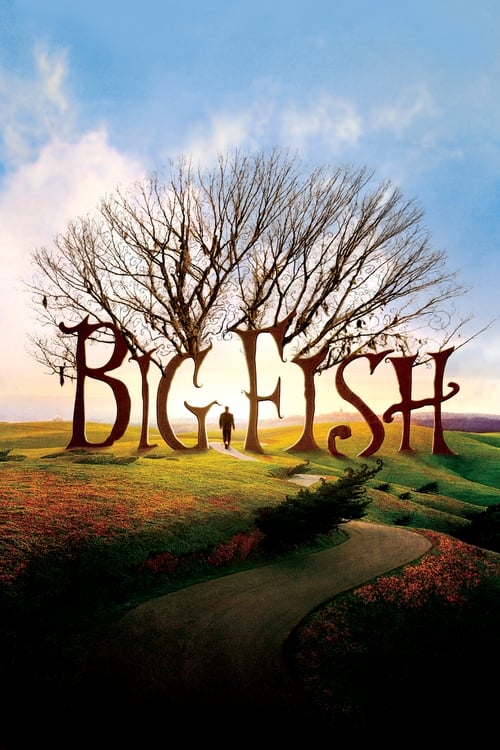
Big Fish
Big Fish Is a Son Learning That the Myth Was the Truer Autobiography
Directed by Tim Burton
Edward Bloom tells the same tall tales his whole life. His son Will spends the film trying to correct them, and only at the deathbed discovers he was correcting the wrong thing.
Will Bloom wants the facts. He is a journalist, and his father is a man who answers every plain question with a giant, a witch, a town called Spectre, a fish no one else has ever caught. Will reads this as evasion, a father who used performance to avoid ever being known. The film agrees with him for two hours and then reverses him completely. When Will finally invents the ending of his father's life, carrying him to the river and returning him to the water as the whole cast of impossible characters waves goodbye, he is not humoring a dying man. He has learned to speak his father's language, and in speaking it he learns that the tales were never the opposite of the truth. They were the shape the truth had to take to be carried. At the funeral, the real people arrive: the giant, the Siamese singers, the man from Spectre. Smaller than the legend, and unmistakably the same. Edward did not lie about his life. He translated it into the only register large enough to hold it.
Jungian Reading: The Father as Living Myth, the Son as the Literal Ego
Jung distinguished the sign, which points to one fixed thing, from the symbol, which points toward something that cannot be said directly. Will treats his father's stories as signs and demands their single referents. Edward has been speaking in symbols his whole life. This is the film's central wound: the ego, personified by Will, insists that a life be reducible to verifiable events, while the deeper psyche, personified by Edward, knows that a life becomes meaningful only when it is mythologized, given archetypal weight, connected to the giants and witches that are the psyche's native inhabitants.
The witch's glass eye, seen early, shows each boy the manner of his death. Edward sees his own end and therefore lives without fear, because he already knows he survives every danger until that final image. This is the individuated relationship to mortality: not denial, but a story about death large enough to make life playable. Will has no such image. He fears the plain fact of his father's dying because he has refused the mythic frame that would let him grieve it as a passage rather than a subtraction. The reconciliation comes when Will stops demanding the facts and supplies the symbol himself. The son integrates the father not by learning what really happened, but by learning to dream him.
Alchemical Reading: The Body Returned to Water as Coniunctio
Alchemy ends where Big Fish ends: at the water, with a dissolution that is also a completion. Edward Bloom is a fish, he says, too big for any pond, always slipping the hook. The alchemists called the volatile principle that will not be fixed the fugitive stag, the fish, the thing that escapes. The opus is the marriage of that volatile spirit with the fixed body, coniunctio, and it is consummated by solutio, the return of the perfected substance to the water it came from.
Will performs exactly this. He carries his father's body, the fixed and dying flesh, to the river and gives it back to the element, and in that moment the father becomes the great fish at last, released rather than caught. Death here is not defeat. It is the fugitive finally at home in the medium it was always trying to reach.
Questions this film answers
What is the deeper meaning of Big Fish?
Will Bloom wants the facts. He is a journalist, and his father is a man who answers every plain question with a giant, a witch, a town called Spectre, a fish no one else has ever caught. Will reads this as evasion, a father who used performance to avoid ever being known. The film agrees with him for two hours and then reverses him completely. When Will finally invents the ending of his father's life, carrying him to the river and returning him to the water as the whole cast of impossible characters waves goodbye, he is not humoring a dying man. He has learned to speak his father's language, and in speaking it he learns that the tales were never the opposite of the truth. They were the shape the truth had to take to be carried. At the funeral, the real people arrive: the giant, the Siamese singers, the man from Spectre. Smaller than the legend, and unmistakably the same. Edward did not lie about his life. He translated it into the only register large enough to hold it.
What is the hidden symbolism in Big Fish?
Jung distinguished the sign, which points to one fixed thing, from the symbol, which points toward something that cannot be said directly. Will treats his father's stories as signs and demands their single referents. Edward has been speaking in symbols his whole life. This is the film's central wound: the ego, personified by Will, insists that a life be reducible to verifiable events, while the deeper psyche, personified by Edward, knows that a life becomes meaningful only when it is mythologized, given archetypal weight, connected to the giants and witches that are the psyche's native inhabitants.
What esoteric traditions appear in Big Fish?
Big Fish draws from Jungian, Alchemy traditions. Edward Bloom tells the same tall tales his whole life. His son Will spends the film trying to correct them, and only at the deathbed discovers he was correcting the wrong thing.
Is Big Fish worth watching for spiritual seekers?
Big Fish (2003) directed by Tim Burton is essential viewing for those interested in Jungian, Alchemy. Big Fish Is a Son Learning That the Myth Was the Truer Autobiography. It rewards multiple viewings and contemplation.
Rewatch With New Eyes
Now that you've seen the architecture, experience it again. The same film becomes a different film when you know what to watch for.
This time, watch for:
- Meet the shadow: what is rejected, projected, and finally integrated
- Track the stages: blackening, whitening, reddening — death before rebirth
Links may include affiliate partnerships that support Media Revelations
The Descent Continues
Where this thread leads next.
The Fall 2006
The Fall: Roy Builds His Own Funeral in Story-Form, and Alexandria Dismantles It
Read the revelation →