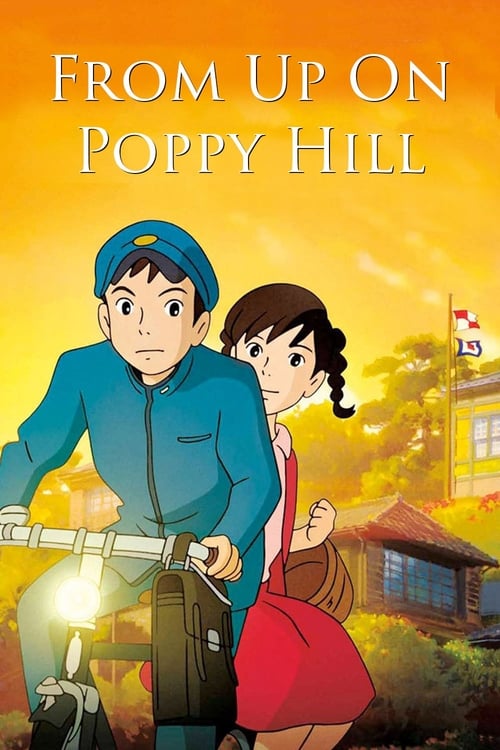
From Up on Poppy Hill
From Up on Poppy Hill Is About a Nation Deciding Whether to Demolish Its Past or Restore It
Directed by Goro Miyazaki
A girl raises signal flags for a father lost at sea, and a boy fights to save a crumbling clubhouse from the wrecking ball. Two forms of the same question about what postwar Japan owed the dead.
Umi raises nautical signal flags from her hilltop boardinghouse every morning, a message to her father who died on a ship in the Korean War, sent to a sea that will never answer. Shun sees them from a tugboat. They meet over the Latin Quarter, a decaying student clubhouse the school wants to demolish and modernize before the 1964 Tokyo Olympics. The surface reading is a gentle period romance complicated by a fear that they might be siblings. The film underneath is set at an exact historical hinge and knows it. 1963 Japan is deciding what to do with everything the war left behind, and the film stages that decision twice: once as a building the young want to tear down, once as the fathers whose deaths the young must correctly understand before they can move forward. Nothing here is really about romance. It is about restoration versus demolition.
Alchemical Reading: The Old Vessel Cleaned Rather Than Destroyed
The Latin Quarter clubhouse is the film's prima materia, a chaotic, filthy, precious mess of accumulated history that everyone assumes must be scrapped to build the new. The modernizing instinct is demolition, erase the old and pour something clean in its place. The students choose the opposite, and the choice is explicitly alchemical. They do not knock the building down. They clean it. In a long, joyful sequence the whole school scrubs decades of grime, sorts the archives, repairs the frame, and reveals the beautiful structure that was always underneath the neglect.
This is the alchemical operation of purification rather than destruction, the washing that removes the corruption while preserving the essential substance. Postwar Japan's temptation was to bury its history under new construction and Olympic optimism, to treat the past as rubble. The clubhouse argues the harder path. The old vessel is not discarded. It is made worthy of what it holds. When the chairman finally sees the restored building, the verdict is the film's quiet thesis: you carry the past forward by refining it, not by paving over it.
Initiatory Reading: You Cannot Marry Until You Know Who the Fathers Were
The love plot turns on a threshold that reads as pure initiation. Umi and Shun cannot proceed until they resolve whether they share a father, and this uncertainty is the film's real gate. They must descend into the confusing history of three men lost to war and postwar chaos, untangle who fathered whom, and only then earn the right to a future. The dead fathers guard the passage. The young cannot cross into adulthood while the truth of the previous generation remains a fog.
This is the initiatory task exactly: the descent into the ancestors, the encounter with the confusion the parents left behind, the return with the truth that permits a life to begin. Umi's signal flags are the ritual gesture of a soul still calling the dead, still unfinished with them. Only when the fathers' story is finally told plainly, by the men who lived it, can she lower the question and raise the flags for something living. The generation crosses the threshold by facing its inheritance rather than fleeing it.
Questions this film answers
What is the deeper meaning of From Up on Poppy Hill?
Umi raises nautical signal flags from her hilltop boardinghouse every morning, a message to her father who died on a ship in the Korean War, sent to a sea that will never answer. Shun sees them from a tugboat. They meet over the Latin Quarter, a decaying student clubhouse the school wants to demolish and modernize before the 1964 Tokyo Olympics. The surface reading is a gentle period romance complicated by a fear that they might be siblings. The film underneath is set at an exact historical hinge and knows it. 1963 Japan is deciding what to do with everything the war left behind, and the film stages that decision twice: once as a building the young want to tear down, once as the fathers whose deaths the young must correctly understand before they can move forward. Nothing here is really about romance. It is about restoration versus demolition.
What is the hidden symbolism in From Up on Poppy Hill?
The Latin Quarter clubhouse is the film's prima materia, a chaotic, filthy, precious mess of accumulated history that everyone assumes must be scrapped to build the new. The modernizing instinct is demolition, erase the old and pour something clean in its place. The students choose the opposite, and the choice is explicitly alchemical. They do not knock the building down. They clean it. In a long, joyful sequence the whole school scrubs decades of grime, sorts the archives, repairs the frame, and reveals the beautiful structure that was always underneath the neglect.
What esoteric traditions appear in From Up on Poppy Hill?
From Up on Poppy Hill draws from Alchemy, Initiation traditions. A girl raises signal flags for a father lost at sea, and a boy fights to save a crumbling clubhouse from the wrecking ball. Two forms of the same question about what postwar Japan owed the dead.
Is From Up on Poppy Hill worth watching for spiritual seekers?
From Up on Poppy Hill (2011) directed by Goro Miyazaki is essential viewing for those interested in Alchemy, Initiation. From Up on Poppy Hill Is About a Nation Deciding Whether to Demolish Its Past or Restore It. It rewards multiple viewings and contemplation.
Rewatch With New Eyes
Now that you've seen the architecture, experience it again. The same film becomes a different film when you know what to watch for.
This time, watch for:
- Track the stages: blackening, whitening, reddening — death before rebirth
- Mark the threshold: the old self dies, the ordeal transforms, the new self returns
Links may include affiliate partnerships that support Media Revelations
The Descent Continues
Where this thread leads next.
Only Yesterday 1991
Only Yesterday Is About the Child Who Waits Inside You Until You Finally Choose the Life She Wanted
Read the revelation →