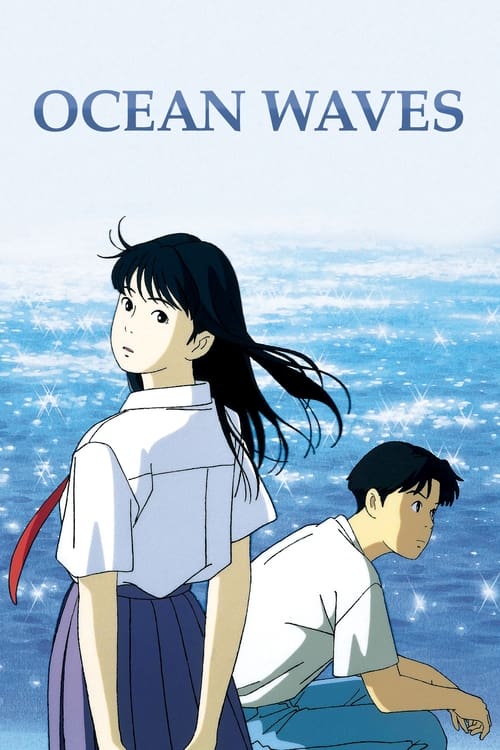
Ocean Waves
Ocean Waves Is a Boy Editing His Own Memory to Avoid Knowing He Was in Love
Directed by Tomomi Mochizuki
Ghibli's forgotten TV movie is the studio's most honest film about how the male mind rewrites a girl into a problem so it never has to admit she was a door.
The whole film is a flashback. Taku sees a woman on a Tokyo train platform, and the sight unspools two years of memory: Rikako, the transfer student from Tokyo, brilliant, cold, manipulative, impossible. He narrates her as a difficulty he endured, a selfish girl who used him for a trip and lied to her friends. The genius of the film is that his narration is wrong, and he does not know it. Every scene he offers as evidence of her coldness is, watched clearly, a scene of a lonely girl reaching toward him and a boy too defended to feel it. Taku is not remembering Rikako. He is defending himself against having loved her. The film is the slow failure of that defense, the moment the edited story cracks and the truth he buried, that this was the most alive he has ever been, floods back up on a train platform years too late.
Jungian Reading: Rikako as the Anima He Cannot Metabolize
In Jung's framework the anima is the feminine image in a man's unconscious, and her first appearance is almost always disruptive. She does not arrive as comfort. She arrives as fascination that disorders the settled personality, and the immature ego meets her by labeling her a problem. This is Taku's entire relationship to Rikako. She is beautiful, moody, unreadable, and she detonates the tidy friendship between him and his best friend Yutaka. Taku experiences all of this as her fault.
But watch what he actually does. He flies to Tokyo on her word. He hits a classmate who insults her. He remembers, in obsessive detail, the exact fall of her hair and the precise words of arguments he claims not to care about. The anima is projected until it is withdrawn and recognized as one's own depth. Taku's recognition comes last, when his friends casually observe that he and Rikako were obviously in love and always had been. The projection collapses in one sentence from someone else. He had to be told what his own memory had been screaming.
Initiatory Reading: The Threshold He Walked Away From, Then Back Toward
Adolescence is the first true initiation, the crossing from the parental world into selfhood, and it requires an encounter with something that will not let you stay who you were. Rikako is Taku's threshold guardian. She is the disruption that could have made a man of the boy, the confrontation that initiation demands. And he flinches from it. He returns to Kochi, to safety, to the comfortable narrative that she was merely troublesome, and the crossing goes uncompleted.
The film understands that initiations refused do not disappear. They wait. The final image, Taku and Rikako recognizing each other across the platform and moving toward one another, is the delayed completion of the crossing, the threshold reopening because the psyche never accepted the flinch as final. This is why the film feels larger than its small story. It is about the specific ache of the initiation you almost had, the door you told yourself was a wall.
Other Ghibli films about young hearts on the threshold: Whisper of the Heart (the courage Taku lacks, given to Shizuku), Only Yesterday (the adult reopening the sealed file of youth), From Up on Poppy Hill (first love tangled in the past).
Questions this film answers
What is the deeper meaning of Ocean Waves?
The whole film is a flashback. Taku sees a woman on a Tokyo train platform, and the sight unspools two years of memory: Rikako, the transfer student from Tokyo, brilliant, cold, manipulative, impossible. He narrates her as a difficulty he endured, a selfish girl who used him for a trip and lied to her friends. The genius of the film is that his narration is wrong, and he does not know it. Every scene he offers as evidence of her coldness is, watched clearly, a scene of a lonely girl reaching toward him and a boy too defended to feel it. Taku is not remembering Rikako. He is defending himself against having loved her. The film is the slow failure of that defense, the moment the edited story cracks and the truth he buried, that this was the most alive he has ever been, floods back up on a train platform years too late.
What is the hidden symbolism in Ocean Waves?
In Jung's framework the anima is the feminine image in a man's unconscious, and her first appearance is almost always disruptive. She does not arrive as comfort. She arrives as fascination that disorders the settled personality, and the immature ego meets her by labeling her a problem. This is Taku's entire relationship to Rikako. She is beautiful, moody, unreadable, and she detonates the tidy friendship between him and his best friend Yutaka. Taku experiences all of this as her fault.
What esoteric traditions appear in Ocean Waves?
Ocean Waves draws from Jungian, Initiation traditions. Ghibli's forgotten TV movie is the studio's most honest film about how the male mind rewrites a girl into a problem so it never has to admit she was a door.
Is Ocean Waves worth watching for spiritual seekers?
Ocean Waves (1993) directed by Tomomi Mochizuki is essential viewing for those interested in Jungian, Initiation. Ocean Waves Is a Boy Editing His Own Memory to Avoid Knowing He Was in Love. It rewards multiple viewings and contemplation.
Rewatch With New Eyes
Now that you've seen the architecture, experience it again. The same film becomes a different film when you know what to watch for.
This time, watch for:
- Meet the shadow: what is rejected, projected, and finally integrated
- Mark the threshold: the old self dies, the ordeal transforms, the new self returns
Links may include affiliate partnerships that support Media Revelations