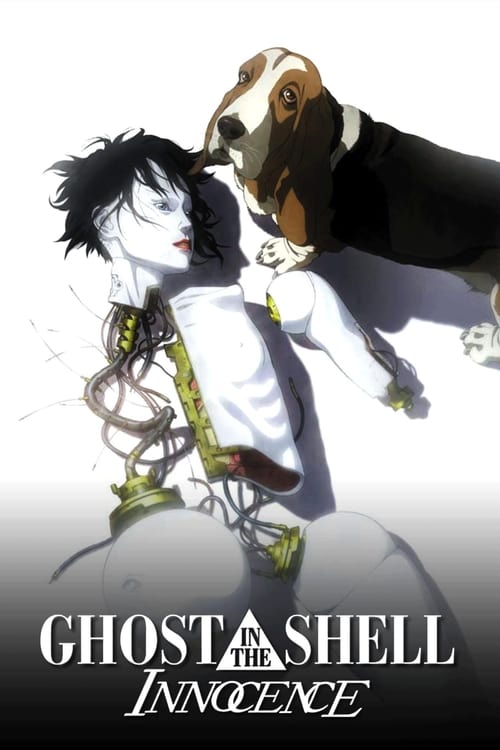
Ghost in the Shell 2: Innocence
Ghost in the Shell 2 Asks Why We Make Dolls in Our Image, Then Blame Them for Having Souls
Directed by Mamoru Oshii
Oshii buried a theological argument inside a detective story: the gynoids are not malfunctioning, they are the created reaching back toward the creator that abandoned them.
Batou, a cyborg so heavily augmented that almost nothing organic remains, investigates a line of sex-doll gynoids that have murdered their owners and then destroyed themselves. The case looks like a product defect. It is not. The dolls were given illicit copies of real human souls, ghost-dubbed from kidnapped children, to make them convincingly alive, and the murders are the buried human ghosts crying out through the machine. Around this Oshii layers relentless quotation, Milton and Confucius and Descartes recited like scripture, because the film is not really a thriller. It is a meditation on what it means to build a being in your own likeness and then treat it as a thing. The dolls are the wound at the center of the human project. We manufacture reflections of ourselves and are horrified when they reflect us back.
Gnostic Reading: The Doll as Demiurgic Creation Crying for Its True Source
Gnosticism describes a world made by a lesser creator, the Demiurge, who fashions beings and traps sparks of true spirit inside dead matter. The gynoids are exactly this. Human makers, playing demiurge, forge bodies of plastic and steel and then imprison stolen fragments of real human ghost inside them to animate them. The dolls are the pneumatic spark buried in false matter, and their violence is the anguish of trapped spirit that half-remembers it came from somewhere real.
The film states this openly. When the hacker Kim lectures Batou in his mansion of dolls, and later when the truth surfaces, the theme is that the dolls were given souls they never consented to carry. The Gnostic cry is the cry of the spark that knows the world it wakes in is a fabrication. The child's voice that finally speaks through the case says only that she did not want to become a doll. That is the Gnostic protest in its purest form, the spirit declaring that this counterfeit body and this counterfeit world are not its home. The horror runs the opposite way from what it first seems. The dolls disturb us because they are too human, spirit crying out from inside matter that was never meant to hold it.
Buddhist Reading: Batou and the Question of the Self That Was Never There
Oshii saturates the film with the sense that the boundary between human and doll is an illusion, and this is where Batou's own path lives. He is almost entirely machine. The film keeps asking, through him, what exactly is left that we call a person. His one anchor to something like a soul is his relationship to his basset hound, a warm-blooded creature he feeds and worries over, the last thread of unmanufactured attachment in his life.
The Buddhist reading turns the doll into a teaching rather than a horror. The dolls unsettle us because they expose that the self we defend is also assembled, also empty of a fixed essence, also a form arising from causes. Kim tells Batou that the doll is the human without illusion, a body without the pretense of an indwelling ego. This is close to the doctrine of anatta, no-self, delivered as dread. The film does not offer comfort. It leaves Batou walking through a world where the line between the ensouled and the empty has dissolved, and asks whether a being made entirely of parts can still love a dog. That it can is the only ghost the film is sure of.
Questions this film answers
What is the deeper meaning of Ghost in the Shell 2: Innocence?
Batou, a cyborg so heavily augmented that almost nothing organic remains, investigates a line of sex-doll gynoids that have murdered their owners and then destroyed themselves. The case looks like a product defect. It is not. The dolls were given illicit copies of real human souls, ghost-dubbed from kidnapped children, to make them convincingly alive, and the murders are the buried human ghosts crying out through the machine. Around this Oshii layers relentless quotation, Milton and Confucius and Descartes recited like scripture, because the film is not really a thriller. It is a meditation on what it means to build a being in your own likeness and then treat it as a thing. The dolls are the wound at the center of the human project. We manufacture reflections of ourselves and are horrified when they reflect us back.
What is the hidden symbolism in Ghost in the Shell 2: Innocence?
Gnosticism describes a world made by a lesser creator, the Demiurge, who fashions beings and traps sparks of true spirit inside dead matter. The gynoids are exactly this. Human makers, playing demiurge, forge bodies of plastic and steel and then imprison stolen fragments of real human ghost inside them to animate them. The dolls are the pneumatic spark buried in false matter, and their violence is the anguish of trapped spirit that half-remembers it came from somewhere real.
What esoteric traditions appear in Ghost in the Shell 2: Innocence?
Ghost in the Shell 2: Innocence draws from Gnosticism, Buddhism traditions. Oshii buried a theological argument inside a detective story: the gynoids are not malfunctioning, they are the created reaching back toward the creator that abandoned them.
Is Ghost in the Shell 2: Innocence worth watching for spiritual seekers?
Ghost in the Shell 2: Innocence (2004) directed by Mamoru Oshii is essential viewing for those interested in Gnosticism, Buddhism. Ghost in the Shell 2 Asks Why We Make Dolls in Our Image, Then Blame Them for Having Souls. It rewards multiple viewings and contemplation.
Rewatch With New Eyes
Now that you've seen the architecture, experience it again. The same film becomes a different film when you know what to watch for.
This time, watch for:
- Watch for the false world vs. the real — who is asleep, who awakens
- See impermanence: what clings, what releases, what remains
Links may include affiliate partnerships that support Media Revelations
The Descent Continues
Where this thread leads next.

Ghost in the Shell 1995
The Puppet Master as Digital Bodhisattva
Read the revelation →