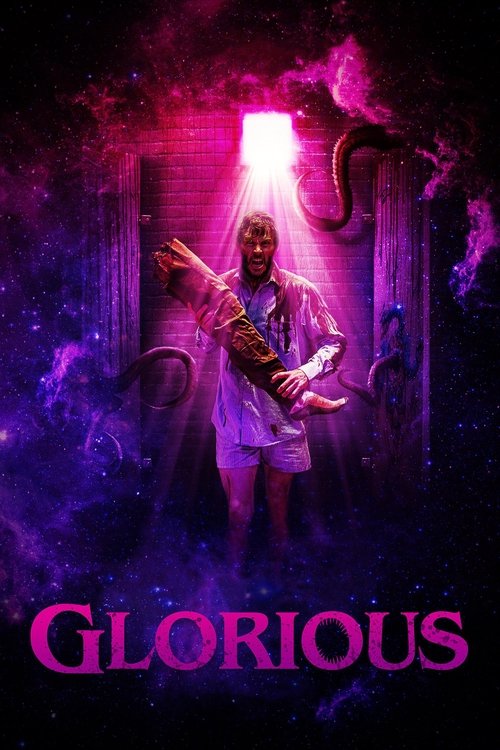
Glorious
Glorious Puts a Cosmic God in a Rest Stop Bathroom Because That Is Where You Actually Meet Him
Directed by Rebekah McKendry
Wes wakes up hungover in a highway toilet. The voice in the next stall is one of the beings that keeps the universe from ending, and it needs a favor.
Glorious looks like a joke that got out of hand: a Lovecraftian deity conducting theology through a glory hole. Take it seriously for eighty minutes and the joke inverts into one of the more honest cosmic-horror films of its decade. The entity behind the wall, Ghatanothoa, is the offspring of an Elder God, and it is asking Wes for a sacrifice that will keep its dying father from waking and unmaking everything. The whole film is a single conversation in a filthy public restroom, and that setting is not a gimmick. It is the argument. The divine does not meet you in a temple you prepared. It meets you at your lowest, in the place you go to be alone with your worst self, and it asks you for the one thing you have spent your whole life refusing to give up. Wes thinks he is trapped by a monster. He is trapped by a confession he has not made yet.
Gnostic Reading: The God Behind the Wall Is Not the One You Were Told About
Gnosticism divides the divine order into two: the Demiurge, the lower maker who runs the material prison, and the true remote God beyond him, unknowable and asleep to this world. Glorious literalizes the stack. Ghatanothoa, the voice in the stall, is a middle being, a caretaker of reality who is himself terrified of the thing above him, the parent whose waking would dissolve all creation. This is the Gnostic cosmos exactly: a lower divinity keeping the machinery running out of dread of a higher power it cannot control.
Wes is offered gnosis in the ugliest possible form. The entity slowly reveals what Wes has hidden from himself: that his breakup was not a breakup, that he killed the woman he claims to be mourning, that the guilt he has been drinking away is real blood. The Gnostic path is knowledge that liberates by devastating you, and Wes receives the full download against his will. When he finally reaches through the hole and gives the sacrifice the god requires, he is not defeated. He is, in the specific Gnostic sense, saved: the illusion he built his identity on is stripped, and what remains is true.
Demonological Reading: The Sacrifice Was Always Going to Be a Part of You
Every genuine demonological pact runs on the same law. The entity cannot simply take what it wants. It must be given. Ghatanothoa spends the film negotiating, coaxing, deceiving, because the offering has to come from Wes's own hand or it does not count. The film stages the oldest bargain in the grimoires: the god that needs a mortal to complete a rite the god itself cannot perform.
The demand escalates with terrible logic. First Wes is asked for blood, then for a finger through the hole, then for the truth about the body in his trunk. Each step the price rises exactly as far as Wes will go. That is how the pact works. The demon does not name its full price at the start, because you would run. It reveals the cost only as fast as you are already committing. By the time Wes understands what he has agreed to, he has agreed to all of it, and the door that was locked the whole time was never the thing keeping him in.
Questions this film answers
What is the deeper meaning of Glorious?
Glorious looks like a joke that got out of hand: a Lovecraftian deity conducting theology through a glory hole. Take it seriously for eighty minutes and the joke inverts into one of the more honest cosmic-horror films of its decade. The entity behind the wall, Ghatanothoa, is the offspring of an Elder God, and it is asking Wes for a sacrifice that will keep its dying father from waking and unmaking everything. The whole film is a single conversation in a filthy public restroom, and that setting is not a gimmick. It is the argument. The divine does not meet you in a temple you prepared. It meets you at your lowest, in the place you go to be alone with your worst self, and it asks you for the one thing you have spent your whole life refusing to give up. Wes thinks he is trapped by a monster. He is trapped by a confession he has not made yet.
What is the hidden symbolism in Glorious?
Gnosticism divides the divine order into two: the Demiurge, the lower maker who runs the material prison, and the true remote God beyond him, unknowable and asleep to this world. Glorious literalizes the stack. Ghatanothoa, the voice in the stall, is a middle being, a caretaker of reality who is himself terrified of the thing above him, the parent whose waking would dissolve all creation. This is the Gnostic cosmos exactly: a lower divinity keeping the machinery running out of dread of a higher power it cannot control.
What esoteric traditions appear in Glorious?
Glorious draws from Gnosticism, Demonology traditions. Wes wakes up hungover in a highway toilet. The voice in the next stall is one of the beings that keeps the universe from ending, and it needs a favor.
Is Glorious worth watching for spiritual seekers?
Glorious (2022) directed by Rebekah McKendry is essential viewing for those interested in Gnosticism, Demonology. Glorious Puts a Cosmic God in a Rest Stop Bathroom Because That Is Where You Actually Meet Him. It rewards multiple viewings and contemplation.
Rewatch With New Eyes
Now that you've seen the architecture, experience it again. The same film becomes a different film when you know what to watch for.
This time, watch for:
- Watch for the false world vs. the real — who is asleep, who awakens
- Identify the hierarchy: which demon, which rank, which grimoire it comes from
Links may include affiliate partnerships that support Media Revelations
The Descent Continues
Where this thread leads next.
In the Mouth of Madness 1995
Sutter Cane Is the Demiurge. His Readers Are the Archons Who Built the World.
Read the revelation →