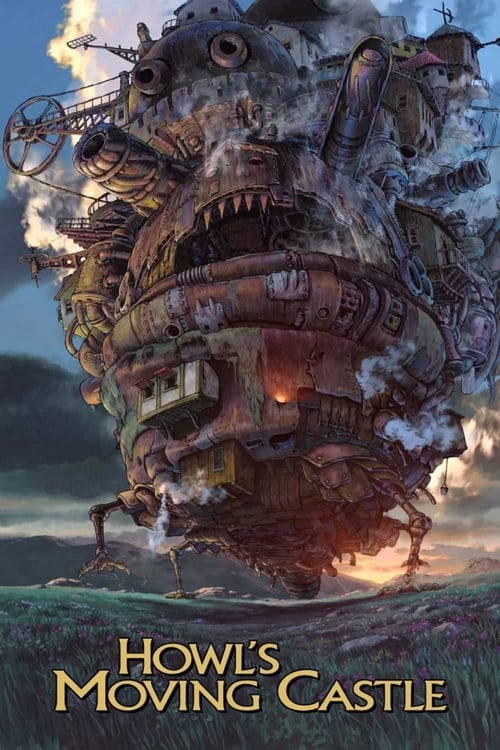
Howl's Moving Castle
The Heart That Had to Be Given Away to Be Found
Directed by Hayao Miyazaki
Sophie's curse reveals her inner state — she felt old before the spell. Howl gave his heart to Calcifer and lost himself to beauty and fear. Love breaks both curses. The castle is Howl's fragmented psyche, finally integrated when Sophie reaches in and returns what he surrendered.
Howl's Moving Castle is Miyazaki's most complete alchemical text — a story about transformation through love that literalizes the alchemical operation: the surrender of the heart, the dissolution of false form, and the reconstitution of the self through relationship. Every character is cursed, and every curse reveals something true. Sophie is cursed into an old woman's body, but she was already living as one — small, invisible, waiting for a life that would never start. The curse makes visible what was already real. Howl gave his heart to the fire demon Calcifer in exchange for power, and now flees endlessly from a war he helped create. He has become pure surface: beautiful, vain, terrified of being seen as he actually is. The castle itself is the fragmented psyche — rooms that don't connect, a door that opens to different places depending on a dial, propelled by the heart that should be inside its master. Sophie's love does not fix Howl. It returns something he cannot return himself. The heart reaches back because someone reached in.
The Surface
Sophie, a young hat-maker, meets the wizard Howl while walking through town and is briefly rescued by him from soldiers. That night, the Witch of the Waste curses her into an old woman's body. Unable to explain her transformation, Sophie leaves home and wanders into the wastelands, where she encounters Howl's moving castle — a walking structure of towers and mismatched architecture.
She lets herself in and begins working as a cleaning lady, meeting the fire demon Calcifer who powers the castle and makes a bargain: if she can break the contract between him and Howl, he will break her curse. The war between kingdoms intensifies. Howl is summoned by both sides to fight. He transforms into a monstrous bird form to fight, and each transformation makes it harder to return to human shape.
Sophie must save Howl before he is lost completely — and to do so, she must discover the nature of his contract with Calcifer, which involves the heart Howl surrendered as a child.
Sophie and the Curse That Reveals
Sophie begins the film young but acting old. She defers to her sisters. She claims no space for herself. She speaks of her life as though it is already over. When the Witch curses her, she becomes on the outside what she was already on the inside.
This is the nature of psychological curses: they do not create wounds. They reveal them. Sophie's transformation into an old woman is liberation as much as punishment — she no longer has to perform youth. She can stop pretending to have a future she never believed in.
Throughout the film, Sophie's age fluctuates. When she is confident, she appears younger. When she retreats into self-doubt, she ages again. Miyazaki is showing the curse as psychological mirror: Sophie is exactly as old as she feels herself to be.
Her love for Howl does not cure her because love is the cure — it is because in loving him, she discovers she has a self worth loving with. The curse breaks when Sophie no longer needs it. The old woman form was a hiding place. She steps out of it when she is ready.
Howl and the Heart Given Away
Howl, as a child, gave his heart to a falling star — the demon Calcifer, who would have died otherwise. In exchange, Howl gained magical power beyond any ordinary wizard. But without his heart, he cannot feel deeply. He can only simulate feeling through surface: beauty, charm, endless redecoration of his castle.
The alchemical operation requires the surrender of something precious. But Howl surrendered too much, too young. The heart is not a down payment on power. It is the container of the self. Without it, Howl is magnificent and empty.
His vanity is not shallow. It is survival. If his surface is beautiful enough, perhaps no one will notice there is nothing beneath. When Sophie accidentally ruins his hair, he collapses — because the surface is all he has. If it fails, he has nothing left.
Howl's bird form — the monstrous shape he takes to fight in the war — shows what happens when transformation lacks a heart. Each transformation takes him further from human. Eventually he will not return. He will be the bird forever, with no humanity to call back.
The Castle as Psyche
Howl's moving castle is Howl himself — fragmented, mobile, refusing to be located. The door opens to different places depending on the setting: the port town, the capital, the wastelands, his childhood home. He can be anywhere and therefore is nowhere.
The castle's interior is equally fragmented. Rooms don't connect logically. Stairs lead to unexpected places. The bathroom contains a bath that is also a portal. Nothing is stable because Howl himself is not stable.
Sophie cleans the castle compulsively, and as she cleans, it begins to cohere. Her presence gives it order. This is not metaphor — her integration literally integrates his space. By the end of the film, the castle is simpler, more compact, held together not by Calcifer's fire but by the relationships of those who live in it.
When the castle is destroyed and rebuilt, it is rebuilt around the family that now inhabits it: Sophie, Howl, Markl, Calcifer, the Witch, the scarecrow prince. The new castle is not magnificent. It is home.
The Return of the Heart
The climax requires Sophie to enter the past — to witness the child Howl making his bargain with Calcifer — and then return with understanding. She sees what he gave away and why. The falling star was dying. Howl saved it with his heart.
Sophie takes the heart from Calcifer and returns it to Howl. The operation is literal: she puts her hands into his chest and gives him back what he surrendered. He wakes transformed — not into something new, but into what he was before the loss.
Calcifer survives. The contract is broken but the fire demon, empowered by Sophie's love, can now live independently. The symbiotic relationship that trapped both parties becomes genuine friendship. Nothing is lost. Everything is reconstituted at a higher level.
This is the rubedo — the reddening, the final stage of the alchemical work where the transformed substance appears. Howl's heart returns red and beating. Sophie's curse ends. The war ends. The movement was always toward this: the heart that had to be given away to be found.
The Transmission
Miyazaki made Howl's Moving Castle during the Iraq War. The film's war is deliberately ugly — metal machines that bomb villages, wizards turned into monsters to fight for their countries. Miyazaki hates war with precision and makes it visible.
But the film's answer to war is not political. It is personal: the restoration of the capacity to feel. Howl fights because he has no heart. The war machine requires participants who have given their hearts away. Recovery of the heart is refusal to participate.
Sophie's love is not passive. It is ferociously active. She cleans, she argues, she storms into the king's palace, she walks through fire to recover Howl's heart. The feminine principle here is not waiting to be saved. It is reaching into the chest of the beloved and returning what was lost.
This is Miyazaki's most hopeful film. The castle settles into flowers. The family sits together. The war is over. Someone went into the fire, took the heart, and brought it back. That is what love does. That is all love does. It is enough.
Questions this film answers
What is the deeper meaning of Howl's Moving Castle?
Howl's Moving Castle is Miyazaki's most complete alchemical text — a story about transformation through love that literalizes the alchemical operation: the surrender of the heart, the dissolution of false form, and the reconstitution of the self through relationship. Every character is cursed, and every curse reveals something true. Sophie is cursed into an old woman's body, but she was already living as one — small, invisible, waiting for a life that would never start. The curse makes visible what was already real. Howl gave his heart to the fire demon Calcifer in exchange for power, and now flees endlessly from a war he helped create. He has become pure surface: beautiful, vain, terrified of being seen as he actually is. The castle itself is the fragmented psyche — rooms that don't connect, a door that opens to different places depending on a dial, propelled by the heart that should be inside its master. Sophie's love does not fix Howl. It returns something he cannot return himself. The heart reaches back because someone reached in.
What is the hidden symbolism in Howl's Moving Castle?
Sophie, a young hat-maker, meets the wizard Howl while walking through town and is briefly rescued by him from soldiers. That night, the Witch of the Waste curses her into an old woman's body. Unable to explain her transformation, Sophie leaves home and wanders into the wastelands, where she encounters Howl's moving castle — a walking structure of towers and mismatched architecture.
What esoteric traditions appear in Howl's Moving Castle?
Howl's Moving Castle draws from Alchemy, Jungian traditions. Sophie's curse reveals her inner state — she felt old before the spell. Howl gave his heart to Calcifer and lost himself to beauty and fear. Love breaks both curses. The castle is Howl's fragmented psyche, finally integrated when Sophie reaches in and returns what he surrendered.
What does Howl's Moving Castle teach about the return of the heart?
She puts her hands into his chest and gives him back what he surrendered. The climax requires Sophie to enter the past — to witness the child Howl making his bargain with Calcifer — and then return with understanding. She sees what he gave away and why. The falling star was dying. Howl saved it with his heart.
Is Howl's Moving Castle worth watching for spiritual seekers?
Howl's Moving Castle (2004) directed by Hayao Miyazaki is essential viewing for those interested in Alchemy, Heart, Miyazaki. The Heart That Had to Be Given Away to Be Found. It rewards multiple viewings and contemplation.
Rewatch With New Eyes
Now that you've seen the architecture, experience it again. The same film becomes a different film when you know what to watch for.
This time, watch for:
- Track the stages: blackening, whitening, reddening — death before rebirth
- Meet the shadow: what is rejected, projected, and finally integrated
Links may include affiliate partnerships that support Media Revelations
The Descent Continues
Where this thread leads next.
Spirited Away 2001
The Shamanic Descent of the Child Soul
Read the revelation →