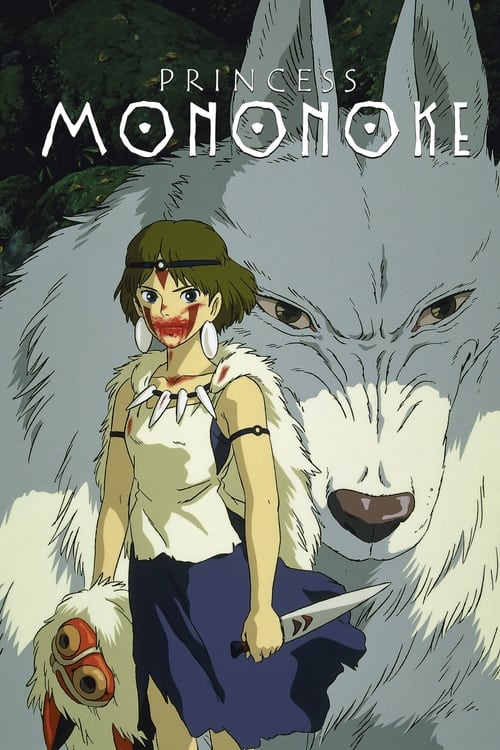
Princess Mononoke
The Apocalypse That Already Happened and You Didn't Notice
Directed by Hayao Miyazaki
A cosmological record of humanity severing its covenant with the living world. The Forest Spirit is the axis mundi. Lady Eboshi is Prometheus. Ashitaka's curse is the wound of incarnation.
Princess Mononoke is not an environmental fable. It is Miyazaki's record of the actual apocalypse — not the one coming, but the one that already happened. The death of the Forest Spirit is the death of the axis mundi, the center that held the world together. This event did not happen in the Muromachi period. It happened in the last three hundred years, as industrial civilization severed humanity's covenant with the living world. Miyazaki is not warning us about a possible future. He is showing us the wound we are already living inside, which we cannot perceive because we were born after the severance. The film is a funeral rite for a world that died before we were conscious enough to mourn it.
The Surface
A prince from a dying Emishi village is cursed by a boar god driven mad by an iron ball in its flesh. He travels west to find the source of the curse and discovers Iron Town, an industrial settlement led by Lady Eboshi, at war with the forest gods. He meets San, a human girl raised by wolves, and becomes entangled in a conflict between human progress and the living spirit of the forest.
Western readings typically frame this as 'man versus nature' with both sides having valid points. This misses what Miyazaki is actually doing. He is not staging a debate. He is performing an autopsy. The Forest Spirit dies in this film. The world that comes after is not a compromise — it is a fundamentally different kind of world.
Miyazaki set the film in the Muromachi period (roughly the 1400s) because this is when Japan's industrial transformation began. But the film is not historical. It is mythological. The events on screen are the events that created modernity — the killing of the sacred, the disenchantment of nature, the severance of the link between human consciousness and the living cosmos.
The Forest Spirit as Axis Mundi
In shamanic cosmology, the axis mundi is the center of the world — the point where heaven, earth, and underworld connect. It is often represented as a world tree or cosmic mountain. The Forest Spirit is Miyazaki's axis mundi: the living node where all levels of reality intersect.
By day, the Spirit walks among the trees — a deer with a human-like face, silent, neither friendly nor hostile. Where it steps, plants grow and die in rapid succession. It is life and death together, the cycle itself, not any particular point in the cycle. At night, it becomes the Nightwalker — a translucent giant striding across the landscape, the same being at cosmic scale.
When the Forest Spirit's head is removed, it does not simply die. It becomes a mindless force of destruction, its essence pouring out as a black tide that kills everything it touches. This is not revenge. It is what happens when the axis is broken. The center cannot hold. The sacred geometry of the world collapses.
Miyazaki is showing us what the death of the sacred looks like — not as moral catastrophe but as structural failure. Without the axis mundi, the levels of reality no longer connect. The gods retreat. The forest becomes just trees. Matter becomes just matter. This is the world we inherited. We call it 'nature.'
Lady Eboshi as Prometheus
Lady Eboshi is not a villain. This is crucial to understanding the film. She rescues prostitutes and lepers from a society that has abandoned them. She gives them dignity, work, community. She is building something genuinely new — a place where the discarded can become makers.
She is also building weapons to kill gods. Her rifles can wound what swords cannot touch. Her forge turns raw iron into divine poison. She wants the Forest Spirit's head because she believes it will cure any disease — a gift she intends for her lepers. Her motives are compassionate. Her methods are apocalyptic.
This is the Promethean bargain. Prometheus stole fire from the gods to give humanity power. The gift changed everything. It was not evil. But it was a line crossed that could not be uncrossed. Lady Eboshi is the same figure: a liberator whose liberation requires killing the very structure of the sacred world.
Miyazaki refuses to condemn her. He refuses to celebrate her. He shows her as what she is: the necessary figure for industrial modernity to exist. Someone had to kill the gods. Someone had to decide that human progress was worth the price. Eboshi made that choice. We live in the world that choice created.
San and Ashitaka: The Impossible Position
San is the anima of the forest — the feminine principle of the natural world given human form. She was abandoned as an infant and raised by the wolf goddess Moro. She is human in body but not in allegiance. She identifies with the gods. She wants to kill Lady Eboshi. She does not understand why Ashitaka does not simply choose a side.
Ashitaka is cursed by both sides. His wound comes from a corrupted boar god, driven mad by human technology. The curse will kill him if not resolved. But resolution cannot come from choosing one side. The curse is in his body — he carries the conflict physically. He is the wound.
Their relationship is the heart of the film. San does not want to love him because he is human. Ashitaka does not want to choose because both sides contain real value and real monstrosity. They meet in a space between, a space that the war is actively destroying.
The climax requires them both: Ashitaka returns the Forest Spirit's head while San holds it with him. Neither could do it alone. The wound that severs human from sacred requires both human and sacred to touch, together, for even the partial healing the ending offers. This is not reconciliation. It is the one gesture possible when everything else has failed.
The Ending Is Not Hope
The Forest Spirit returns its head, dies, and the landscape becomes green again. Most readings call this hopeful. It is not. Look at what has changed.
The great forest is gone. The ancient trees are dead. The spirits have retreated. What grows in the final scene is ordinary grass, ordinary trees — life without spirit, nature without gods. The deer that appears at the end is just a deer. It does not have a human face. It is not the Forest Spirit. It is an animal.
Ashitaka tells San: 'I will come to the forest to see you.' San replies: 'I cannot forgive humans. But I like you.' This is not reconciliation. This is two people who love each other across a wound that will never close. They have saved what can be saved. It is not what was lost.
Lady Eboshi survives, one arm gone, planning to rebuild Iron Town better. The implication is that she has learned something. But what she has learned is how to continue the industrial project with a smaller footprint. She has not learned to stop. She cannot. History does not stop. The death of the sacred is not reversible. The film ends in the world after.
The Transmission
Miyazaki made this film when he was fifty-six, believing it would be his last. He put everything into it — his despair about industrial civilization, his love for the natural world, his conviction that the apocalypse had already happened and we simply had not noticed because we were born after.
The film does not tell you to recycle. It does not offer solutions. It says: this is what was lost. This is the scale of the wound. This is what your world was built on top of. Now you know. What will you do with knowing?
Most viewers leave Princess Mononoke feeling something they cannot name. The feeling is grief. Not for an endangered species or a threatened ecosystem, but for a world-structure that is genuinely gone — the living cosmos where humans and spirits coexisted, where the sacred was not a metaphor but a presence, where the forest was a person and the mountain was a god.
That world existed. Industrial civilization killed it. We are the descendants of the killers and the killed. Miyazaki does not want you to feel guilty. He wants you to feel the loss — to know in your body what was taken so that you can at least mourn it properly. The film is a funeral for a world that died before you were born. Attend it.
Questions this film answers
What is the deeper meaning of Princess Mononoke?
Princess Mononoke is not an environmental fable. It is Miyazaki's record of the actual apocalypse — not the one coming, but the one that already happened. The death of the Forest Spirit is the death of the axis mundi, the center that held the world together. This event did not happen in the Muromachi period. It happened in the last three hundred years, as industrial civilization severed humanity's covenant with the living world. Miyazaki is not warning us about a possible future. He is showing us the wound we are already living inside, which we cannot perceive because we were born after the severance. The film is a funeral rite for a world that died before we were conscious enough to mourn it.
What is the hidden symbolism in Princess Mononoke?
A prince from a dying Emishi village is cursed by a boar god driven mad by an iron ball in its flesh. He travels west to find the source of the curse and discovers Iron Town, an industrial settlement led by Lady Eboshi, at war with the forest gods. He meets San, a human girl raised by wolves, and becomes entangled in a conflict between human progress and the living spirit of the forest.
What esoteric traditions appear in Princess Mononoke?
Princess Mononoke draws from Shamanism, Jungian, Initiation traditions. A cosmological record of humanity severing its covenant with the living world. The Forest Spirit is the axis mundi. Lady Eboshi is Prometheus. Ashitaka's curse is the wound of incarnation.
What does Princess Mononoke teach about lady eboshi as prometheus?
Someone had to kill the gods. Someone had to decide that human progress was worth the price. Lady Eboshi is not a villain. This is crucial to understanding the film. She rescues prostitutes and lepers from a society that has abandoned them. She gives them dignity, work, community. She is building something genuinely new — a place where the discarded can become makers.
Is Princess Mononoke worth watching for spiritual seekers?
Princess Mononoke (1997) directed by Hayao Miyazaki is essential viewing for those interested in Axis Mundi, Prometheus, Covenant. The Apocalypse That Already Happened and You Didn't Notice. It rewards multiple viewings and contemplation.
Rewatch With New Eyes
Now that you've seen the architecture, experience it again. The same film becomes a different film when you know what to watch for.
This time, watch for:
- Follow the descent: what dies, what guides, what returns transformed
- Meet the shadow: what is rejected, projected, and finally integrated
- Mark the threshold: the old self dies, the ordeal transforms, the new self returns
Links may include affiliate partnerships that support Media Revelations
The Descent Continues
Where this thread leads next.
Spirited Away 2001
The Shamanic Descent of the Child Soul
Read the revelation →