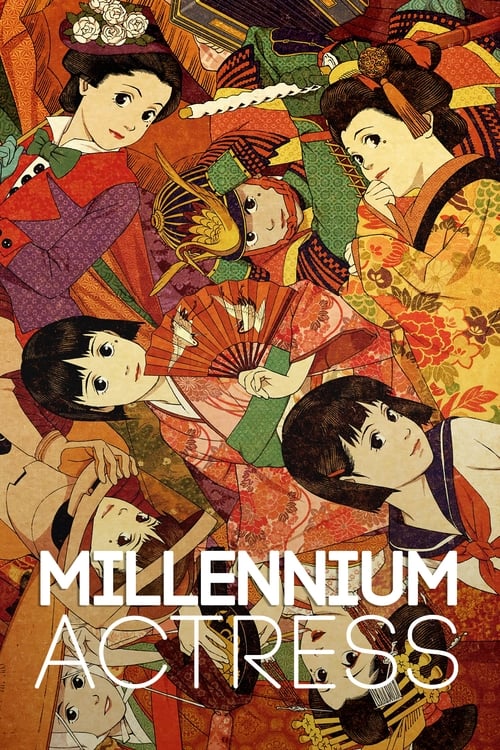
Millennium Actress
Millennium Actress Reveals the Beloved Was Only the Pretext for the Chase
Directed by Satoshi Kon
Chiyoko spends her whole life pursuing a man she met for one afternoon and never saw again. On her deathbed she says the thing the entire film has been circling: it was never about catching him. She loved the chasing.
Satoshi Kon builds a film with no seam between memory, cinema, and reality. A documentary crew arrives to interview a legendary retired actress, and as she tells the story of the man she has pursued across sixty years, the interviewer and his cameraman fall bodily into her recollections, running through her period dramas, her war films, her science-fiction epics, always chasing the same fleeing figure across every genre she ever performed. The man was a painter and dissident who once left a key in her care, promising to return for it. He never did. She chased that promise through her entire career, and every role she played was secretly the same role: the woman running after the one who is always just ahead. At the end she learns he died decades ago, that the pursuit was toward a man long gone. And she is not destroyed by this. She smiles and delivers the film's revelation. What she loved was not him. What she loved was the state of reaching toward him. The object was always a doorway to the movement.
Buddhist Reading: The Key to a Lock That Was Never the Point
The key Chiyoko carries her whole life is the film's cruelest and kindest joke. She never learns what it opens. She guards it, chases the man who can tell her, and dies without the lock. Buddhism would say she has been holding the perfect teaching object without seeing it: an attachment whose entire function is to keep her reaching, a symbol of a fulfillment that recedes the instant it is approached. This is trishna, thirst, the craving that renews itself by never being satisfied. The tragedy would be a life wasted chasing an empty promise.
But Kon delivers the Buddhist turn precisely at the end. Chiyoko's last line is that she loved chasing him, "the me who was chasing after him." She has seen through the object entirely. The man was empty, the key opened nothing, and the chasing itself was the whole life, complete in every moment of its motion. This is close to the deepest Buddhist recognition: that liberation is not attaining the goal but seeing that the goal was always a device the mind used to be fully alive in the reaching. She dies awake, laughing at the beautiful trick her own longing played, grateful for the run rather than bitter at the empty destination.
Alchemical Reading: The Fleeing Figure as the Volatile Spirit
Alchemy pictures its central mystery as a pursuit: the operator chasing Mercurius, the trickster spirit who slips every grasp, who must be followed through fire and water and every changing form. Chiyoko's beloved is a near-perfect Mercurius. He appears and vanishes, he leaves a key and no lock, he shifts shape as she chases him through every genre, samurai and soldier and astronaut, never once allowing capture. The volatile principle cannot be seized directly. It can only be pursued until the pursuit itself transforms the pursuer.
That is the opus completed. Chiyoko never captures Mercurius, and the alchemists warned that you never do, not by grasping. The transformation happens in the chasing. Sixty years of running after the fugitive spirit through every form her art could take have refined Chiyoko into someone who, at the last, no longer needs the substance. She has become gold by pursuing what she was never meant to hold.
Questions this film answers
What is the deeper meaning of Millennium Actress?
Satoshi Kon builds a film with no seam between memory, cinema, and reality. A documentary crew arrives to interview a legendary retired actress, and as she tells the story of the man she has pursued across sixty years, the interviewer and his cameraman fall bodily into her recollections, running through her period dramas, her war films, her science-fiction epics, always chasing the same fleeing figure across every genre she ever performed. The man was a painter and dissident who once left a key in her care, promising to return for it. He never did. She chased that promise through her entire career, and every role she played was secretly the same role: the woman running after the one who is always just ahead. At the end she learns he died decades ago, that the pursuit was toward a man long gone. And she is not destroyed by this. She smiles and delivers the film's revelation. What she loved was not him. What she loved was the state of reaching toward him. The object was always a doorway to the movement.
What is the hidden symbolism in Millennium Actress?
The key Chiyoko carries her whole life is the film's cruelest and kindest joke. She never learns what it opens. She guards it, chases the man who can tell her, and dies without the lock. Buddhism would say she has been holding the perfect teaching object without seeing it: an attachment whose entire function is to keep her reaching, a symbol of a fulfillment that recedes the instant it is approached. This is trishna, thirst, the craving that renews itself by never being satisfied. The tragedy would be a life wasted chasing an empty promise.
What esoteric traditions appear in Millennium Actress?
Millennium Actress draws from Buddhism, Alchemy traditions. Chiyoko spends her whole life pursuing a man she met for one afternoon and never saw again. On her deathbed she says the thing the entire film has been circling: it was never about catching him. She loved the chasing.
Is Millennium Actress worth watching for spiritual seekers?
Millennium Actress (2001) directed by Satoshi Kon is essential viewing for those interested in Buddhism, Alchemy. Millennium Actress Reveals the Beloved Was Only the Pretext for the Chase. It rewards multiple viewings and contemplation.
Rewatch With New Eyes
Now that you've seen the architecture, experience it again. The same film becomes a different film when you know what to watch for.
This time, watch for:
- See impermanence: what clings, what releases, what remains
- Track the stages: blackening, whitening, reddening — death before rebirth
Links may include affiliate partnerships that support Media Revelations