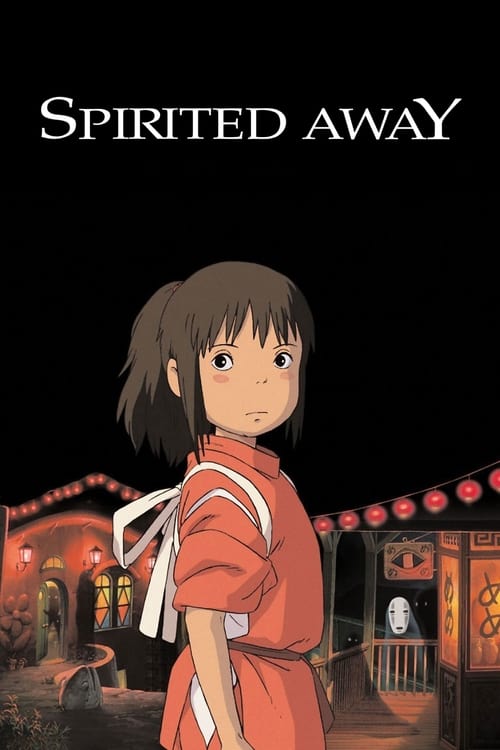
Spirited Away
The Shamanic Descent of the Child Soul
Directed by Hayao Miyazaki
A complete shamanic initiation disguised as a children's film. Chihiro's loss of her name is ego dissolution. The bathhouse is the astral plane. No-Face is the shadow self.
Spirited Away is a complete shamanic initiation disguised as a children's film. Chihiro does not 'grow up' or 'learn responsibility.' She dies to her old self, descends into the spirit world, loses her name, serves powers greater than herself, and returns transformed. Miyazaki has made many films about ecological harmony and antiwar themes. This one is different. This is a map of the soul's journey through dissolution and reconstitution — the death that precedes new life.
The Surface
A sulky ten-year-old moves to a new town with her parents. They take a wrong turn, find an abandoned theme park, and the parents eat food that transforms them into pigs. The girl must work in a bathhouse for spirits to save them. Along the way, she makes friends, faces fears, and discovers inner strength.
This is the Pixar reading — the hero's journey with clear lessons about courage and identity. It is not wrong, but it misses the architecture. Miyazaki is not telling a story about personal growth. He is depicting the stages of shamanic death and rebirth with precision that suggests direct knowledge.
The film's Japanese title is 'Sen to Chihiro no Kamikakushi' — 'Sen and Chihiro's Spiriting Away.' Kamikakushi refers specifically to a person taken by spirits, often children who wander too far. In Japanese folklore, this is rarely benign. The spirit world is not Narnia. It is the realm where the unprotected soul is devoured.
The Threshold Crossing
The family drives through a tunnel into the spirit world. This is the passage through death — the tunnel every near-death experiencer describes. Chihiro resists. She doesn't want to go. She feels something is wrong. But her parents walk forward, pulled by curiosity and appetite.
The abandoned theme park is a trap for exactly this kind of consciousness: the tourist mentality, the consumer gaze that sees the sacred as spectacle. Chihiro's parents eat the food of the spirits because they assume everything is for their consumption. 'Don't worry, we have credit cards and cash,' her father says. This is the modern mind approaching the sacred — confident that it can purchase anything.
The food transforms them into pigs. This is not punishment but revelation — they become what they always were. The spirit world doesn't create the pig-nature. It makes visible what was hidden. Chihiro alone does not eat because she alone has the instinct that something is wrong. She has what the shamanic traditions call 'the call' — an orientation toward the invisible that her parents lack.
When night falls and the spirits appear, Chihiro begins to fade. She is becoming a ghost herself, dissolving into the spirit world. Haku finds her and feeds her food from the spirit world — anchoring her between realms. She can now see the spirits, but she is not yet safe. She has entered the bardo.
The Loss of the Name
To survive, Chihiro must work in Yubaba's bathhouse. But to work there, she must surrender her name. Yubaba takes it — literally taking the characters from her signed contract. Chihiro becomes Sen.
This is the central esoteric moment of the film. The name is not a label. The name is the container of identity, the vessel of personal history. When the name is taken, the self that answered to that name begins to dissolve. Sen cannot remember her life before the bathhouse. She cannot remember her parents. She is becoming someone else.
In shamanic initiation, the death of the old self is not metaphorical. The initiate experiences genuine dissolution — the annihilation of the identity they have built. Many initiates describe forgetting their names, their histories, their relationships. The old self must die completely for the new self to emerge.
Haku warns Chihiro: 'If you forget your name, you'll never find your way home.' This is the danger of initiation. Some do not return. Some lose themselves so completely that they remain in the spirit world forever — like Haku himself, who has forgotten his true name and is bound to Yubaba's service.
No-Face and the Shadow
No-Face is the film's most mysterious figure — a transparent spirit with a mask for a face who becomes obsessed with Chihiro. He follows her into the bathhouse, mimics the desires he sees around him, and grows into a monstrous, consuming presence that devours workers and vomits gold.
No-Face has no identity of his own. He is pure mimesis — becoming whatever environment he enters. In the bathhouse, where everyone is obsessed with money and status, he becomes a grotesque parody of greed. He offers Chihiro gold because gold is what everyone else wants. When she refuses, he is bewildered. He has no template for desire that isn't acquisition.
This is the shadow made visible — not Chihiro's personal shadow, but the collective shadow of a culture. No-Face is what remains when the self is hollowed out by mimetic desire, when identity is nothing but the reflection of surrounding appetites. He is terrifying precisely because he has no center.
Chihiro's response is crucial. She doesn't defeat No-Face or cure him. She simply refuses to engage with his offerings and then lets him follow her to Zeniba's cottage, where he finds peace in quiet domestic work. The shadow is not destroyed. It is integrated by being given a container that isn't consumption.
The River God
One of the bathhouse's most important visitors appears to be a 'stink spirit' — a mass of sludge so foul that everyone flees. Chihiro alone stays to serve it, pulling on something stuck in its side. The entire bathhouse joins to help, and they extract an endless stream of garbage: bicycles, appliances, waste of human civilization.
The spirit is not a stink spirit. It is a river god, polluted by human refuse until it could barely remember itself. Cleansed, it reveals its true form — a magnificent dragon — and leaves Chihiro a gift that will later save her.
This scene is Miyazaki's ecological message, but it is also initiatory teaching. The shaman's task is not only personal transformation but service to the spirits. Chihiro does not serve for reward. She serves because serving is what is required. And in serving genuinely, she receives gifts she did not seek.
The river god also foreshadows Haku's true identity. Haku is himself a river spirit — the Kohaku River, which was paved over for apartments. He has forgotten his name because his river no longer exists. Chihiro remembers for him: she fell into his river as a child and he saved her. By remembering his true name, she frees him from Yubaba's control.
The Return
Chihiro passes her final test: identifying her parents among a herd of pigs. She succeeds not through cleverness but through knowing — she has learned to see beyond appearances, to recognize essence rather than form. 'None of them are my parents,' she says, and she is correct.
She walks back through the tunnel with her parents, who remember nothing. The car is covered with dust and leaves — time has passed differently in the spirit world. Chihiro pauses at the tunnel entrance, sensing something. But she does not look back. She has been warned not to look back.
This is the final test of every initiatory return: the temptation to look back at what was left behind, to hold onto the spirit world. Orpheus looked back and lost Eurydice. Lot's wife looked back and became salt. Chihiro does not look back — not because she has forgotten, but because she knows that the way forward requires releasing the way back.
She still has the hair tie Zeniba gave her — the only physical proof that her journey was real. But the proof is unnecessary. Chihiro is not the same girl who entered the tunnel. She has died and returned. What she carries cannot be seen or proven. It can only be lived.
The Transmission
Spirited Away became the highest-grossing film in Japanese history. It won the Academy Award for Best Animated Feature. Children watch it again and again, pulled by something they cannot name. Adults watch it and cry without understanding why.
The film works because it is true. Not metaphorically true — structurally true. The stages of initiation Miyazaki depicts are the stages every shamanic tradition describes: the crossing, the dissolution, the loss of name, the service to spirits, the confrontation with shadow, the remembering, the return. He has made a map that works.
What Miyazaki understood — what makes him singular among animators — is that children's films are the last unguarded space where the soul can receive teaching. Adults approach art with defenses. Children approach with openness. By encoding initiation in a form that looks like entertainment, Miyazaki has seeded millions of souls with the pattern of their own transformation.
When those children grow up and face their own thresholds, something in them will recognize the territory. They have already been there. They already know: you must go through, you must serve, you must lose your name to find it, and you must not look back.
Questions this film answers
What is the deeper meaning of Spirited Away?
Spirited Away is a complete shamanic initiation disguised as a children's film. Chihiro does not 'grow up' or 'learn responsibility.' She dies to her old self, descends into the spirit world, loses her name, serves powers greater than herself, and returns transformed. Miyazaki has made many films about ecological harmony and antiwar themes. This one is different. This is a map of the soul's journey through dissolution and reconstitution — the death that precedes new life.
What is the hidden symbolism in Spirited Away?
A sulky ten-year-old moves to a new town with her parents. They take a wrong turn, find an abandoned theme park, and the parents eat food that transforms them into pigs. The girl must work in a bathhouse for spirits to save them. Along the way, she makes friends, faces fears, and discovers inner strength.
What esoteric traditions appear in Spirited Away?
Spirited Away draws from Shamanism, Jungian traditions. A complete shamanic initiation disguised as a children's film. Chihiro's loss of her name is ego dissolution. The bathhouse is the astral plane. No-Face is the shadow self.
What does Spirited Away teach about the threshold crossing?
The spirit world doesn't create the pig-nature. It makes visible what was hidden. The family drives through a tunnel into the spirit world. This is the passage through death — the tunnel every near-death experiencer describes. Chihiro resists. She doesn't want to go. She feels something is wrong. But her parents walk forward, pulled by curiosity and appetite.
What does Spirited Away teach about the loss of the name?
The name is not a label. The name is the container of identity. To survive, Chihiro must work in Yubaba's bathhouse. But to work there, she must surrender her name. Yubaba takes it — literally taking the characters from her signed contract. Chihiro becomes Sen.
What does Spirited Away teach about no-face and the shadow?
No-Face is the shadow made visible — not personal, but collective. No-Face is the film's most mysterious figure — a transparent spirit with a mask for a face who becomes obsessed with Chihiro. He follows her into the bathhouse, mimics the desires he sees around him, and grows into a monstrous, consuming presence that devours workers and vomits gold.
Is Spirited Away worth watching for spiritual seekers?
Spirited Away (2001) directed by Hayao Miyazaki is essential viewing for those interested in Shamanism, Ego Death, Miyazaki. The Shamanic Descent of the Child Soul. It rewards multiple viewings and contemplation.
Rewatch With New Eyes
Now that you've seen the architecture, experience it again. The same film becomes a different film when you know what to watch for.
This time, watch for:
- Follow the descent: what dies, what guides, what returns transformed
- Meet the shadow: what is rejected, projected, and finally integrated
Links may include affiliate partnerships that support Media Revelations
The Descent Continues
Where this thread leads next.
Princess Mononoke 1997
The Apocalypse That Already Happened and You Didn't Notice
Read the revelation →