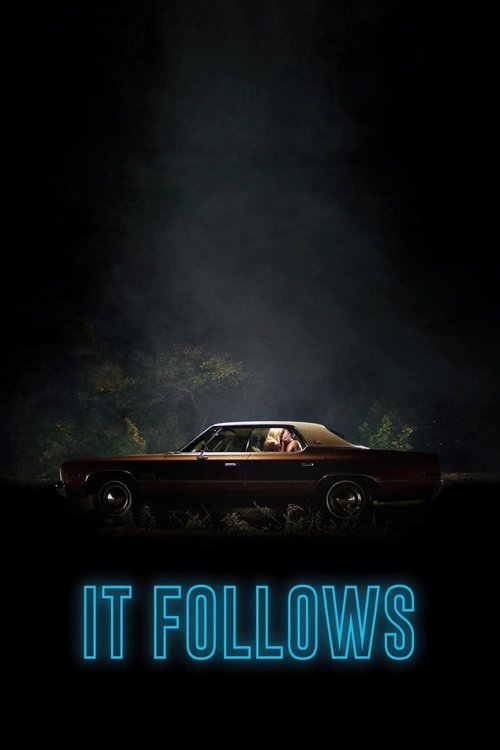
It Follows
Death as the Walker Who Will Catch You at the Speed of Walking
Directed by David Robert Mitchell
Mitchell made a horror film whose monster has one rule: it walks toward you. It does not run. It does not strategize. It does not stop. It has always been walking toward you since you were born. The sexual transmission is the McGuffin. The actual subject is the way most people manage to forget the walker is walking until something — a trauma, a diagnosis, an awakening — makes the steady approach visible again.
It Follows is the most precise memento mori in twenty-first century cinema disguised as a slasher film. The conceit — a curse transmitted by sex, in which an entity walks slowly toward the victim and kills them if it catches them, and the only way to defer the death is to pass the curse to another by sleeping with them — has been read as STI allegory, as sex panic, as Reagan-era nostalgic horror. All of these readings are partial. The actual subject is death itself, in its truest structural form: the walker that will reach you, that walks at the speed you can briefly outwalk, that takes whatever form the dead it has already collected currently wear. Mitchell films suburban Detroit as a kind of bardo zone — the architecture is from the 1970s, the cars are from no specific decade, the technology is from before and after the present. The film is set outside of historical time because the teaching it transmits is older than any historical time. We are being followed. We have always been being followed. The follower walks. It always walks. The only sustainable response is not the running but the recognition.
The Surface
Jay, a college student in suburban Detroit, sleeps with her new boyfriend Hugh. After the sex, he chloroforms her, tells her she has been passed a curse, and shows her the entity that is now walking toward her. The entity can take any human form, can be seen only by those carrying the curse, walks slowly but never stops, and will kill her unless she passes the curse to another sexual partner. Even if she passes it, if her partner is killed the curse returns to her. She, her sister, her friends try various solutions: passing it on, fleeing, attempting to kill the entity. The film ends with Jay and her childhood friend Paul having had sex (transferring the curse to him), holding hands, walking down a sidewalk in the dappled autumn light, and the camera lingering on an unidentified figure walking behind them in the distance. We cannot tell from the framing whether the figure is the entity or just a person.
On release the film was praised as a refreshing entry in independent horror. Disasterpiece's synthesizer score was singled out. Mitchell's visual confidence — long takes, classical framing, deep focus — was widely admired. Most critical discussion has emphasized the sexual transmission element and read the entity as an STI metaphor, a sexual trauma metaphor, or both.
The film is doing something larger. The sexual element is the access point, not the destination. Mitchell is using the framework of a sexual slasher to install a teaching about the structure of mortality. The entity is death. Sex is the act that historically signifies the entry into adulthood — and adulthood is the condition in which the awareness of death becomes structurally available. The two are linked. The film links them. It does not stop there.
The Walker That Always Walks
Buddhist contemplative practice contains a specific exercise called the recollection of death — maranasati. The practitioner sits with the fact that death is certain, the time of death is uncertain, and at the time of death nothing accompanies the consciousness across the threshold except the karmic patterns the practitioner has cultivated. The practice is not morbid. The practice is clarifying. It is intended to focus the practitioner on what actually matters during the time available.
The walker in It Follows is maranasati made cinematic. It walks. It does not stop. It is always moving toward you at a steady pace. You can be unaware of it for stretches. The unawareness does not slow it down. You can outrun it. The outrunning is temporary; while you sleep, while you turn your attention elsewhere, it gains. There is no permanent defeat. There is only management.
Mitchell's most precise visual choice is the entity's appearance. It looks different each time — sometimes a man, sometimes a woman, sometimes a child, sometimes a grotesque variant. It takes the form of someone the victim might recognize. This is exactly how death has appeared across mortuary traditions: as a personification that wears whatever face the local culture is willing to read. The Grim Reaper in Europe. Yama in India. The hag in Slavic folklore. The entity is the role. The faces are the costumes the role wears in different cultural moments.
What makes the film unusual is the refusal to make the walker a defeated. There is no climactic battle that destroys it. The pool sequence — the friends rigging electrical appliances at a public swimming pool to attempt to kill the entity — is filmed as a series of guesses and failures. The entity is not killable in the conventional horror way. The film makes the point. The entity is not a problem to be solved. The entity is the condition to be related to. Modern horror typically refuses this distinction. It Follows insists on it.
Detroit as Bardo Zone
Mitchell's choice of location is the film's underrated genius. The suburban Detroit setting is decaying, semi-abandoned, occupied by people who continue to live in houses that were built when the city was prosperous. The downtown sequence — Jay and her friends crossing into the abandoned blocks of central Detroit — is filmed as a passage into another zone. The 1970s architecture, the 1960s cars, the 2000s phones, the unmarked decade of the clothing — all create a setting that does not map onto any actual historical moment.
This is not stylistic indulgence. The placelessness is the point. The teaching the film is transmitting is older than any specific era. By refusing to lock the film into a specific decade, Mitchell prevents the viewer from filing the teaching as a period concern. The walker that walks toward you walks toward viewers in 1985 and in 2015 and in 2055. The film is intentionally not letting itself be located in time so that the teaching cannot be located either.
Detroit specifically functions as a memento mori at urban scale. The city itself is the result of a chain of events whose terminus is visible in the abandoned blocks Jay and her friends pass through. The grandeur of the architecture is visible. The collapse is visible. The two together compose the place. This is what every city eventually becomes. The film stages its main set pieces in spaces where the entropy has already done its work. The viewer is being shown that the city, like the body, is on a schedule. The walker is walking through this city. The walker is also the city's larger condition.
The pool, the abandoned house at the end, the public beach where the children stare — every location is selected for its ambient relationship to the teaching. Mitchell trusts the locations to do work the dialogue would ruin. The film talks very little. The locations talk constantly.
The Pass and Its Refusal
The curse can be passed by sex. The film makes the mechanism clear without endorsing or condemning it. Jay tries the pass with at least one character. The pass works. The pass also means assigning to another person the slow approach of the walker. The moral weight of the action is the film's quietest agony.
This is a precise allegorical move. Every generation, in every culture, faces the same question: knowing what awaits, do you pass the structure forward to the next generation? Sexual reproduction is the obvious form of the question. Cultural transmission is another form. Religious initiation is another. The pass is the recognition that the curse cannot be defeated and that the only available action is to ensure that another consciousness picks it up and carries it for a while.
Initiation traditions across cultures have understood this. The elder does not 'cure' the initiate of mortality. The elder hands the initiate the practice that allows the initiate to live with mortality without being incapacitated by it. The pass is the lineage. The pass is also the burden. Both are accurate.
Mitchell's most ethically loaded sequence is the one in which Jay is unsure whether to pass the curse to Paul. Paul is willing. He has loved her for a long time. He wants to receive the curse and carry it for her. Jay hesitates. She has come to recognize what she is asking. The hesitation is the film's most adult moment. After hesitating, she proceeds. The pass is made. The lineage continues. The walker continues to walk.
The Transmission
It Follows transmits a perception that horror cinema rarely manages: the sustained, low-grade awareness of mortality as a continuous structural condition rather than as a periodic threat. The film does not deliver jump scares. The dread accumulates. By the second half, the viewer has been trained to scan the deep background of every shot for a walking figure. The training does not stop when the film ends. For days afterward, the viewer notices walkers in their actual surroundings. Most are not the entity. A few moments, they cannot be sure.
What the film leaves the viewer with is the experience of having briefly perceived their own condition. The walker is not new. The walker has been walking the whole time. The film simply made the walking visible long enough for the viewer to recognize it. After the recognition, the question is what one does with the time before the walker arrives. The film does not answer the question. It is not the film's job to answer. The film's job was to install the perception. The answer is the viewer's life.
Mitchell has made a few films since. None has matched the precision of this one. The reason is that this film, perhaps without his full conscious intent, accessed a teaching that does not require ornament. The teaching is older than the film. The film is the vessel through which the teaching reached an audience that would not have read a contemplative text on the recollection of death. After watching It Follows, the audience has done a brief version of the practice. They did not know that is what they did. The walker is still walking. They feel it now.
Questions this film answers
What is the deeper meaning of It Follows?
It Follows is the most precise memento mori in twenty-first century cinema disguised as a slasher film. The conceit — a curse transmitted by sex, in which an entity walks slowly toward the victim and kills them if it catches them, and the only way to defer the death is to pass the curse to another by sleeping with them — has been read as STI allegory, as sex panic, as Reagan-era nostalgic horror. All of these readings are partial. The actual subject is death itself, in its truest structural form: the walker that will reach you, that walks at the speed you can briefly outwalk, that takes whatever form the dead it has already collected currently wear. Mitchell films suburban Detroit as a kind of bardo zone — the architecture is from the 1970s, the cars are from no specific decade, the technology is from before and after the present. The film is set outside of historical time because the teaching it transmits is older than any historical time. We are being followed. We have always been being followed. The follower walks. It always walks. The only sustainable response is not the running but the recognition.
What is the hidden symbolism in It Follows?
Jay, a college student in suburban Detroit, sleeps with her new boyfriend Hugh. After the sex, he chloroforms her, tells her she has been passed a curse, and shows her the entity that is now walking toward her. The entity can take any human form, can be seen only by those carrying the curse, walks slowly but never stops, and will kill her unless she passes the curse to another sexual partner. Even if she passes it, if her partner is killed the curse returns to her. She, her sister, her friends try various solutions: passing it on, fleeing, attempting to kill the entity. The film ends with Jay and her childhood friend Paul having had sex (transferring the curse to him), holding hands, walking down a sidewalk in the dappled autumn light, and the camera lingering on an unidentified figure walking behind them in the distance. We cannot tell from the framing whether the figure is the entity or just a person.
What esoteric traditions appear in It Follows?
It Follows draws from Buddhism, Initiation traditions. Mitchell made a horror film whose monster has one rule: it walks toward you. It does not run. It does not strategize. It does not stop. It has always been walking toward you since you were born. The sexual transmission is the McGuffin. The actual subject is the way most people manage to forget the walker is walking until something — a trauma, a diagnosis, an awakening — makes the steady approach visible again.
What does It Follows teach about the walker that always walks?
The entity is not a problem to be solved. The entity is the condition to be related to. Buddhist contemplative practice contains a specific exercise called the recollection of death — maranasati. The practitioner sits with the fact that death is certain, the time of death is uncertain, and at the time of death nothing accompanies the consciousness across the threshold except the karmic patterns the practitioner has cultivated. The practice is not morbid. The practice is clarifying. It is intended to focus the practitioner on what actually matters during the time available.
What does It Follows teach about the pass and its refusal?
The elder does not cure the initiate of mortality. The elder hands the initiate the practice that allows the initiate to live with mortality. The curse can be passed by sex. The film makes the mechanism clear without endorsing or condemning it. Jay tries the pass with at least one character. The pass works. The pass also means assigning to another person the slow approach of the walker. The moral weight of the action is the film's quietest agony.
Is It Follows worth watching for spiritual seekers?
It Follows (2015) directed by David Robert Mitchell is essential viewing for those interested in Buddhism, Death, Mitchell. Death as the Walker Who Will Catch You at the Speed of Walking. It rewards multiple viewings and contemplation.
Rewatch With New Eyes
Now that you've seen the architecture, experience it again. The same film becomes a different film when you know what to watch for.
This time, watch for:
- See impermanence: what clings, what releases, what remains
- Mark the threshold: the old self dies, the ordeal transforms, the new self returns
Links may include affiliate partnerships that support Media Revelations
The Descent Continues
Where this thread leads next.
The Shining 1980
The Overlook as Living Memory Field
Read the revelation →