Mandy
The Man Who Entered Hell and Became Its Weapon
Directed by Panos Cosmatos
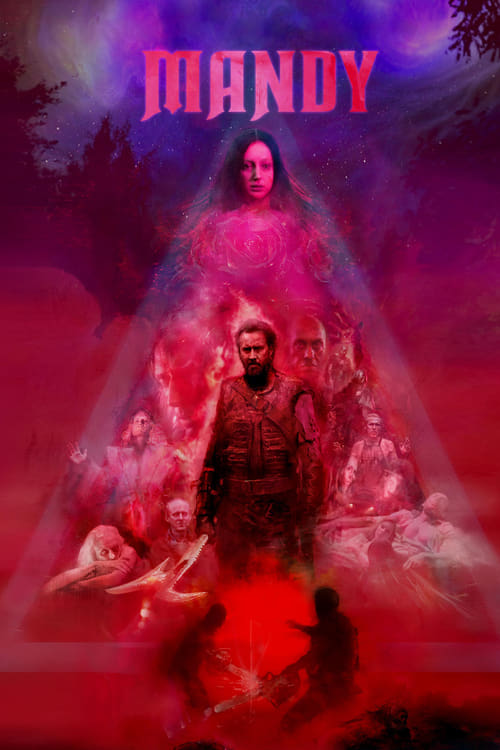
Red loses Mandy. He is burned alive with her. What rises from the ashes is not grieving — it is berserker. Cosmatos builds a metal-album Orpheus myth: descend to hell, but instead of singing for the dead, forge a weapon and kill everyone on the way down. The acid kicks in. The chainsaw duel begins. Grief becomes apocalypse.
Mandy is a heavy metal Orpheus myth — the man who loses his beloved and descends to recover her. But Red does not descend to rescue. He descends to destroy. Cosmatos builds a grief ritual in neon and blood: the beloved is murdered, the lover is burned, what rises from the flames is no longer human. Red becomes a berserker, a vessel for violence so pure that hell itself offers him weapons. The film's first half is slow, domestic, painfully tender. Red and Mandy exist in a love that needs no explanation. They read in bed. They watch the sky. They are complete. The cult that destroys them — Jeremiah Sand's Children of the New Dawn — intrudes like cancer. The leader wants Mandy. Mandy laughs at him. He burns her alive in front of Red. The second half is the transformation. Red forges a custom axe. He takes acid. He fights demonic bikers summoned from another dimension. He chainsaw-duels a cultist. He kills Jeremiah Sand while covered in blood. None of this is redemption. All of it is descent. Red does not come back. He goes all the way down.
The Surface
Red Miller and Mandy Bloom live in an isolated cabin in the Shadow Mountains in 1983. He cuts trees. She reads fantasy novels. They love each other with the completeness that needs no performance. Cosmatos bathes their scenes in soft light and slow dissolves. This is paradise.
Jeremiah Sand, leader of a failed cult called the Children of the New Dawn, sees Mandy walking by the road. He wants her. He sends his followers to take her. When Mandy laughs at his pathetic seduction attempt, Sand orders her burned alive. Red is forced to watch, then left for dead.
Red survives. He finds a friend who gives him a crossbow and a bottle of vodka. He forges a custom battle-axe. He locates the Black Skulls — demonic bikers summoned by the cult — and kills them one by one. He finds the cult's compound. He destroys everyone inside. He sits in Jeremiah Sand's sports car covered in blood, driving nowhere.
Orpheus Inverted
Orpheus descended to the underworld to rescue Eurydice. He could not fight his way to her — he sang. His music moved Hades. Eurydice was released. He lost her by looking back. The myth is about love's limit: even the perfect artist cannot recover the dead.
Red inverts this structure. He does not descend to recover Mandy. He descends to become something that can destroy what killed her. The underworld is not moved by his grief. The underworld is conquered by his violence. He looks back constantly. Mandy appears to him as vision, as memory, as the thing he cannot stop seeing.
There is no rescue. There is only destruction. Red knows Mandy is dead. His descent is not hope — it is completion. The cult destroyed his life. He will destroy everything associated with it. The descent is its own purpose.
Cosmatos films Red's transformation in real time. The extended scene of him screaming in the bathroom, covered in blood, drinking vodka — this is not dramatic convenience. This is the ego dissolving under weight it cannot carry. What emerges from the bathroom is not Red. It is Red's body with something else driving.
The Black Skulls
The Black Skulls are demonic bikers summoned by the cult using LSD and dark ritual. They are not human anymore. They are monstrous, sexually perverted, almost impossible to kill. They exist somewhere between this world and wherever they came from.
Red fights them anyway. The chainsaw duel is the film's most famous sequence — two monstrous figures sawing at each other until one falls. Red wins not because he is stronger but because he is more committed. He has nothing left to lose. The Skulls still want to live. Red does not care if he lives.
In shamanic terms, Red is becoming the thing he fights. He crosses into the demons' territory. He uses their weapons. He takes their drugs. The boundary between hero and monster dissolves. By the end, covered in blood, he is no more human than they were.
The LSD that transforms the Skulls also transforms Red. The animated sequence — Red falling through psychedelic space, becoming one with Mandy's image — is the shamanic journey. He descends through the altered state and emerges different. The drug is the initiatory substance.
Jeremiah Sand and the Failed Messiah
Jeremiah Sand is the film's true horror — more than the demons, more than the violence. He is the man who believes he is special, who believes the universe owes him worship, who destroys what he cannot possess.
Sand's seduction of Mandy is excruciatingly pathetic. He plays his own folk album. He strips naked and demands she recognize his divinity. She laughs. She laughs at his body, his music, his claims. This is why she must die — not because she refused him, but because she saw through him.
When Red finally reaches Sand, the cult leader begs. He is weak. He has always been weak. The power was all performed. Red does not give him a warrior's death. He gives him a victim's death — prolonged, humiliating, the fear that Sand has always inflicted finally returned.
Sand represents every false prophet, every narcissist who demands worship because he cannot earn respect. He destroys lives because he cannot face his own smallness. Red destroying him is not justice. It is the universe correcting an error.
The Transmission
Mandy is grief made visible — not as sadness but as transformation. Red does not cry for Mandy. He becomes something that could never exist in the world they shared. The man who watched the stars with her could not kill demons with a forged axe. A different man can.
Cosmatos built the film for his father, who had recently died. The movie's entire aesthetic — the 1983 setting, the fantasy paperbacks, the soft-rock radio stations — is his father's world recreated in neon. The destruction of that world, and the violent transformation that follows, is his own grief rendered literal.
The film does not offer catharsis. Red's revenge does not bring peace. The final shot — Red driving Sand's car, covered in blood, hallucinating Mandy beside him — shows someone who has gone too far to return. He won. He destroyed everything. He is still in hell.
This is the transmission: grief can transform you into something powerful enough to destroy what hurt you. But that transformation is not recovery. It is becoming something that can never return to the world before the loss. Red got his revenge. Red is gone.
Questions this film answers
What is the deeper meaning of Mandy?
Mandy is a heavy metal Orpheus myth — the man who loses his beloved and descends to recover her. But Red does not descend to rescue. He descends to destroy. Cosmatos builds a grief ritual in neon and blood: the beloved is murdered, the lover is burned, what rises from the flames is no longer human. Red becomes a berserker, a vessel for violence so pure that hell itself offers him weapons. The film's first half is slow, domestic, painfully tender. Red and Mandy exist in a love that needs no explanation. They read in bed. They watch the sky. They are complete. The cult that destroys them — Jeremiah Sand's Children of the New Dawn — intrudes like cancer. The leader wants Mandy. Mandy laughs at him. He burns her alive in front of Red. The second half is the transformation. Red forges a custom axe. He takes acid. He fights demonic bikers summoned from another dimension. He chainsaw-duels a cultist. He kills Jeremiah Sand while covered in blood. None of this is redemption. All of it is descent. Red does not come back. He goes all the way down.
What is the hidden symbolism in Mandy?
Red Miller and Mandy Bloom live in an isolated cabin in the Shadow Mountains in 1983. He cuts trees. She reads fantasy novels. They love each other with the completeness that needs no performance. Cosmatos bathes their scenes in soft light and slow dissolves. This is paradise.
What esoteric traditions appear in Mandy?
Mandy draws from Shamanism, Initiation traditions. Red loses Mandy. He is burned alive with her. What rises from the ashes is not grieving — it is berserker. Cosmatos builds a metal-album Orpheus myth: descend to hell, but instead of singing for the dead, forge a weapon and kill everyone on the way down. The acid kicks in. The chainsaw duel begins. Grief becomes apocalypse.
What does Mandy teach about orpheus inverted?
He does not descend to recover Mandy. He descends to become something that can destroy what killed her. Orpheus descended to the underworld to rescue Eurydice. He could not fight his way to her — he sang. His music moved Hades. Eurydice was released. He lost her by looking back. The myth is about love's limit: even the perfect artist cannot recover the dead.
What does Mandy teach about the black skulls?
The boundary between hero and monster dissolves. By the end, covered in blood, he is no more human than they were. The Black Skulls are demonic bikers summoned by the cult using LSD and dark ritual. They are not human anymore. They are monstrous, sexually perverted, almost impossible to kill. They exist somewhere between this world and wherever they came from.
Is Mandy worth watching for spiritual seekers?
Mandy (2018) directed by Panos Cosmatos is essential viewing for those interested in Grief, Shamanism, Revenge. The Man Who Entered Hell and Became Its Weapon. It rewards multiple viewings and contemplation.
Rewatch With New Eyes
Now that you've seen the architecture, experience it again. The same film becomes a different film when you know what to watch for.
This time, watch for:
- Follow the descent: what dies, what guides, what returns transformed
- Mark the threshold: the old self dies, the ordeal transforms, the new self returns
Links may include affiliate partnerships that support Media Revelations
The Descent Continues
Where this thread leads next.

Only God Forgives 2013
Only God Forgives Is a Tarot Card Where the Son Must Cut Off His Own Hands to Face the Mother
Read the revelation →