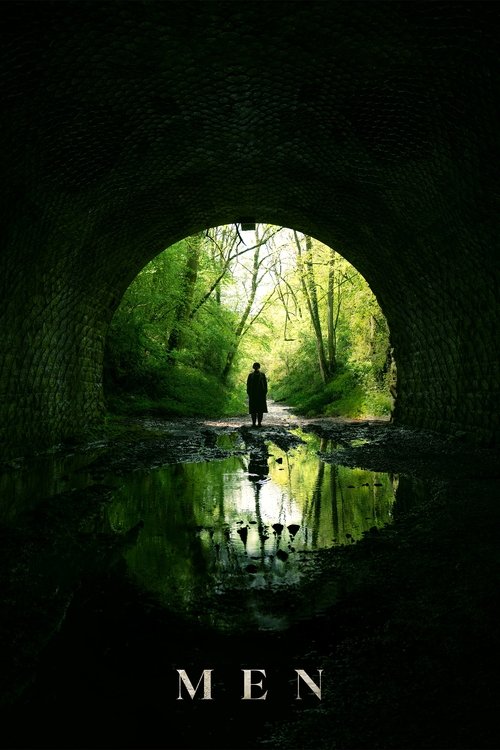
Men
Men Is Not About Every Man. It Is About the One Face Grief Keeps Casting on All of Them
Directed by Alex Garland
Harper's husband fell to his death after threatening to kill himself if she left. Then she goes to the country, and every man she meets has Rory Kinnear's face.
Alex Garland gives the whole cast of village men to one actor. The landlord, the vicar, the naked stalker in the woods, the policeman, the boy who calls her a bitch: all of them are Rory Kinnear wearing different bodies. Critics read this as a blunt thesis about masculinity. The film is more precise and more interior than that. Harper's husband James died in the fall, and she does not know if it was suicide or accident, and she is carrying the accusation he threw at her: that his death would be her fault. The single face is not a claim about all men. It is the mechanism of guilt. Grief that has fused with blame cannot see individual faces anymore. It sees the same wound staring back from every doorway, wearing every mask, asking the same question she cannot answer.
Jungian Reading: The Animus That Fissioned Into a Mob
Jung named the animus the inner masculine figure in a woman's psyche, the internalized voice that can judge, possess, and condemn as easily as it can guide. Harper's animus has curdled. James, in death, has colonized her inner world, and the film externalizes him as a whole village of variations. Each Kinnear-figure carries one facet of the possessive masculine: the landlord's smothering solicitude, the vicar's oily suggestion that she provoked her husband, the child's raw contempt. These are not separate men. They are the animus split into its components and projected onto the landscape.
The final act makes the psychology literal in a way that horror rarely dares. The naked man gives birth, in agony, to the next man, who gives birth to the next, a chain of male figures generating each other until the last one is James himself. Harper watches the entire lineage of her inner accuser reproduce in front of her. When she finally sits with him and asks what he wants, and he answers "your love," the possession names its own hunger. The confrontation is not violence. It is her refusing to keep birthing him.
Shamanic Reading: The Sin-Eater in the Green Man's Church
The film buries a folk-horror substrate under the psychological one. The stone Sheela na gig carving, splayed and grinning, sits in the same church as the leaf-wreathed Green Man face on the font. Harper touches both. These are pre-Christian fertility figures, the divine feminine and the vegetal masculine, and Garland stages her whole ordeal inside their overlapping territory. The village itself functions like a shamanic sickness-realm: she has entered a place where the ordinary rules of persons dissolve and she must meet the spirit that is eating her.
Shamanic tradition holds that some spirits must be confronted rather than fled, faced until they exhaust their power to terrify. Harper's night siege by the multiplying man is exactly this vigil. The green world does not attack her to destroy her. It stages the grotesque birth-chain so she can watch her guilt manufacture itself, generation after generation, and see that it has no author but her own held-in blame. When dawn comes and her friend arrives to find her calm amid the wreckage, Harper has done the shaman's work. She sat through the night with the thing and let it use itself up.
Questions this film answers
What is the deeper meaning of Men?
Alex Garland gives the whole cast of village men to one actor. The landlord, the vicar, the naked stalker in the woods, the policeman, the boy who calls her a bitch: all of them are Rory Kinnear wearing different bodies. Critics read this as a blunt thesis about masculinity. The film is more precise and more interior than that. Harper's husband James died in the fall, and she does not know if it was suicide or accident, and she is carrying the accusation he threw at her: that his death would be her fault. The single face is not a claim about all men. It is the mechanism of guilt. Grief that has fused with blame cannot see individual faces anymore. It sees the same wound staring back from every doorway, wearing every mask, asking the same question she cannot answer.
What is the hidden symbolism in Men?
Jung named the animus the inner masculine figure in a woman's psyche, the internalized voice that can judge, possess, and condemn as easily as it can guide. Harper's animus has curdled. James, in death, has colonized her inner world, and the film externalizes him as a whole village of variations. Each Kinnear-figure carries one facet of the possessive masculine: the landlord's smothering solicitude, the vicar's oily suggestion that she provoked her husband, the child's raw contempt. These are not separate men. They are the animus split into its components and projected onto the landscape.
What esoteric traditions appear in Men?
Men draws from Jungian, Shamanism traditions. Harper's husband fell to his death after threatening to kill himself if she left. Then she goes to the country, and every man she meets has Rory Kinnear's face.
Is Men worth watching for spiritual seekers?
Men (2022) directed by Alex Garland is essential viewing for those interested in Jungian, Shamanism. Men Is Not About Every Man. It Is About the One Face Grief Keeps Casting on All of Them. It rewards multiple viewings and contemplation.
Rewatch With New Eyes
Now that you've seen the architecture, experience it again. The same film becomes a different film when you know what to watch for.
This time, watch for:
- Meet the shadow: what is rejected, projected, and finally integrated
- Follow the descent: what dies, what guides, what returns transformed
Links may include affiliate partnerships that support Media Revelations
The Descent Continues
Where this thread leads next.
Antichrist 2009
Antichrist Is an Alchemical Nigredo (She Always Knew What Had to Die)
Read the revelation →