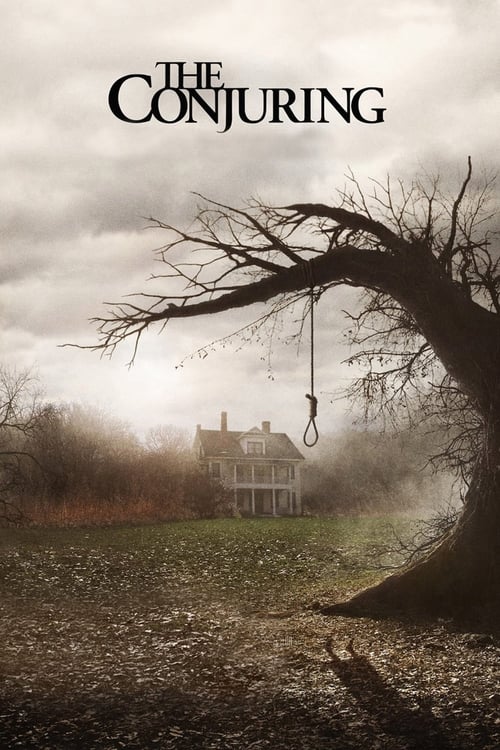
The Conjuring
The Conjuring Is Built on the Doctrine That a House Is a Body and a Family Is a Soul
Directed by James Wan
James Wan made the most successful haunted-house film in decades by taking traditional demonology at its word: the demon does not want the house. It wants the mother.
The Perron family buys a Rhode Island farmhouse and finds it occupied by something that predates them by centuries. Wan stages it with masterful craft, but the craft rests on a theological spine most horror films lack. The entity in the house is not a restless ghost with unfinished business. It is a demon, and demonology draws a hard line between the two: a ghost is a human remnant, a demon is an intelligence that was never human and hates what is. Everything that happens follows from that distinction. The demon does not haunt to frighten. It haunts to acquire. Its target across the entire film is not the property but the person, and specifically the person at the family's spiritual center. The house is only the ground it fights on.
Demonological Reading: Possession Requires an Opening, and the Demon Manufactures One
Classical demonology holds that a demon cannot simply seize a soul. It requires an invitation, a rupture, an opening created through despair, isolation, or invited sin. The film's mythology is exact about this. Bathsheba, the witch who once occupied the land, sacrificed her own child and cursed the ground, and the demon now works to make each new mother repeat that original act. It does not attack the children directly. It attacks the mother's mind, isolating Carolyn, exhausting her, feeding her a despair engineered to become the opening through which it can enter and turn her against her own.
The demon's strategy is patient and doctrinally sound. It first breaks the family's sense of safety, then their sanity, then their unity, because a soul in community is defended and a soul alone is available. A demon does not want a haunted house. It wants a mother willing to kill her children, and it will spend a century arranging the conditions. The possession, when it comes for Carolyn, is not random malice. It is the culmination of a deliberate campaign to recreate the exact spiritual state in which the first murder occurred.
Initiatory Reading: The Warrens as Guides Who Have Paid the Price
Ed and Lorraine Warren function as initiators, and the film is careful to show that their authority is earned rather than assumed. Lorraine has seen something in a prior case, the Amityville exorcism, that damaged her, and she carries that wound as the source of her sight. In the initiatory pattern, the guide can lead others through the dark only because he has been broken by it first. The Warrens do not confront the demon from a position of safety. They confront it from a position of scars.
Their real function is to give the Perrons the knowledge the family lacks: that the enemy has a name, a history, and a rule set, and that it can be fought. Naming Bathsheba is the initiatory act, the moment the formless terror becomes a defined adversary who can be opposed. The climactic exorcism is not the Warrens defeating the demon by force. It is Lorraine reaching the possessed Carolyn by invoking her love for her children, using the demon's own chosen battleground, the mother's soul, to expel it. The initiate is saved not by the guide's power but by being reminded of what she already is.
Questions this film answers
What is the deeper meaning of The Conjuring?
The Perron family buys a Rhode Island farmhouse and finds it occupied by something that predates them by centuries. Wan stages it with masterful craft, but the craft rests on a theological spine most horror films lack. The entity in the house is not a restless ghost with unfinished business. It is a demon, and demonology draws a hard line between the two: a ghost is a human remnant, a demon is an intelligence that was never human and hates what is. Everything that happens follows from that distinction. The demon does not haunt to frighten. It haunts to acquire. Its target across the entire film is not the property but the person, and specifically the person at the family's spiritual center. The house is only the ground it fights on.
What is the hidden symbolism in The Conjuring?
Classical demonology holds that a demon cannot simply seize a soul. It requires an invitation, a rupture, an opening created through despair, isolation, or invited sin. The film's mythology is exact about this. Bathsheba, the witch who once occupied the land, sacrificed her own child and cursed the ground, and the demon now works to make each new mother repeat that original act. It does not attack the children directly. It attacks the mother's mind, isolating Carolyn, exhausting her, feeding her a despair engineered to become the opening through which it can enter and turn her against her own.
What esoteric traditions appear in The Conjuring?
The Conjuring draws from Demonology, Initiation traditions. James Wan made the most successful haunted-house film in decades by taking traditional demonology at its word: the demon does not want the house. It wants the mother.
Is The Conjuring worth watching for spiritual seekers?
The Conjuring (2013) directed by James Wan is essential viewing for those interested in Demonology, Initiation. The Conjuring Is Built on the Doctrine That a House Is a Body and a Family Is a Soul. It rewards multiple viewings and contemplation.
Rewatch With New Eyes
Now that you've seen the architecture, experience it again. The same film becomes a different film when you know what to watch for.
This time, watch for:
- Identify the hierarchy: which demon, which rank, which grimoire it comes from
- Mark the threshold: the old self dies, the ordeal transforms, the new self returns
Links may include affiliate partnerships that support Media Revelations
The Descent Continues
Where this thread leads next.
The Exorcist 1973
The Exorcist Is Not About a Possessed Girl. It Is About a Priest Who Loses His Faith and Gets It Back by Dying for It
Read the revelation →