Microcosmos
Microcosmos Films the Meadow at the One Scale Where the Human Ego Cannot Follow
Directed by Claude Nuridsany
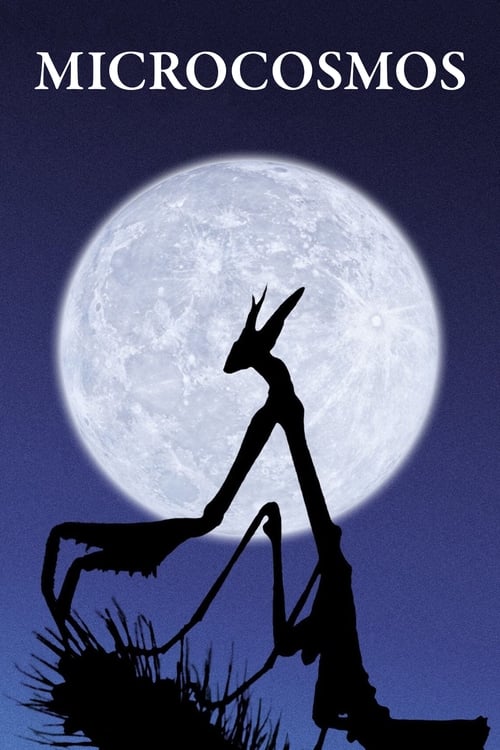
A summer day in a French field, shot so close that a raindrop becomes a catastrophe and a snail's courtship becomes an epic. There is almost no narration. That absence is the whole method.
Microcosmos does something almost no nature documentary allows itself to do: it removes the human voice. For ninety minutes there is no naturalist explaining what you are seeing, no framework telling you which creature is the hero and which is the pest. A bee drinks. A dung beetle rolls its impossible sphere over stones, loses it, retrieves it, begins again. Two snails press their bodies together in a slow spiral that the film treats with the reverence usually reserved for human lovers. The surface reading is that this is a beautiful curiosity, a technical achievement in macro photography. What the film actually does is far more disorienting. It insists that the meadow was already a complete world before you arrived to name it, and it stays there, at the scale of the grass blade, until your habit of standing at the center quietly dissolves.
Buddhist Reading: The Field Without a Center
The Buddhist teaching of dependent origination holds that no thing possesses a separate, standing self. Everything arises in relation, momentarily, and passes. Microcosmos is that doctrine filmed rather than argued. Watch the ant colony milking aphids for their sugar, then defending them from a ladybug: there is no villain and no protagonist here, only a web of mutual conditioning where each creature is the ground of another's life and death. The famous sequence of the dung beetle laboring its ball up an incline, impaled for a moment on a thorn, is the film at its most patient. We want it to be a fable about perseverance. The film refuses to supply the moral. The beetle is not brave. The beetle is simply what it is doing, with no narrator to convert its labor into meaning.
The rainstorm sequence makes the teaching physical. Ordinary drops become bombs that shatter across leaves and flatten insects into the mud, and the film shows this at full weight, without pity and without cruelty. Impermanence at that scale is not a sad idea. It is simply the weather. The camera holds on the field until you stop asking who the storm is for.
Jungian Reading: Descending Beneath the Threshold of the Ego
Jung located the ego as one small lit island in a far larger psyche, most of which operates below awareness in forms the conscious mind finds alien. Microcosmos performs that descent as a literal change of scale. To enter the grass at insect height is to leave the human vantage entirely and meet a domain that runs on drives the ego does not recognize as its own: pure appetite, pure reproduction, pure territorial defense, unmediated by story or shame.
The mating snails are the key image. Malick would later reach for cosmic scale to dissolve the self; Nuridsany and Perennou reach for the opposite pole and find the same dissolution. The snails' union is slow, glistening, utterly indifferent to being watched, and the film's tenderness toward it asks the viewer to recognize these drives as the underworld of their own body. What lives in the meadow lives in you, beneath the island of the "I." The film's real revelation is that the unconscious is not dark. It is teeming, luminous, and busy in the light, one blade of grass away.
Questions this film answers
What is the deeper meaning of Microcosmos?
Microcosmos does something almost no nature documentary allows itself to do: it removes the human voice. For ninety minutes there is no naturalist explaining what you are seeing, no framework telling you which creature is the hero and which is the pest. A bee drinks. A dung beetle rolls its impossible sphere over stones, loses it, retrieves it, begins again. Two snails press their bodies together in a slow spiral that the film treats with the reverence usually reserved for human lovers. The surface reading is that this is a beautiful curiosity, a technical achievement in macro photography. What the film actually does is far more disorienting. It insists that the meadow was already a complete world before you arrived to name it, and it stays there, at the scale of the grass blade, until your habit of standing at the center quietly dissolves.
What is the hidden symbolism in Microcosmos?
The Buddhist teaching of dependent origination holds that no thing possesses a separate, standing self. Everything arises in relation, momentarily, and passes. Microcosmos is that doctrine filmed rather than argued. Watch the ant colony milking aphids for their sugar, then defending them from a ladybug: there is no villain and no protagonist here, only a web of mutual conditioning where each creature is the ground of another's life and death. The famous sequence of the dung beetle laboring its ball up an incline, impaled for a moment on a thorn, is the film at its most patient. We want it to be a fable about perseverance. The film refuses to supply the moral. The beetle is not brave. The beetle is simply what it is doing, with no narrator to convert its labor into meaning.
What esoteric traditions appear in Microcosmos?
Microcosmos draws from Buddhism, Jungian traditions. A summer day in a French field, shot so close that a raindrop becomes a catastrophe and a snail's courtship becomes an epic. There is almost no narration. That absence is the whole method.
Is Microcosmos worth watching for spiritual seekers?
Microcosmos (1996) directed by Claude Nuridsany is essential viewing for those interested in Buddhism, Jungian. Microcosmos Films the Meadow at the One Scale Where the Human Ego Cannot Follow. It rewards multiple viewings and contemplation.
Rewatch With New Eyes
Now that you've seen the architecture, experience it again. The same film becomes a different film when you know what to watch for.
This time, watch for:
- See impermanence: what clings, what releases, what remains
- Meet the shadow: what is rejected, projected, and finally integrated
Links may include affiliate partnerships that support Media Revelations