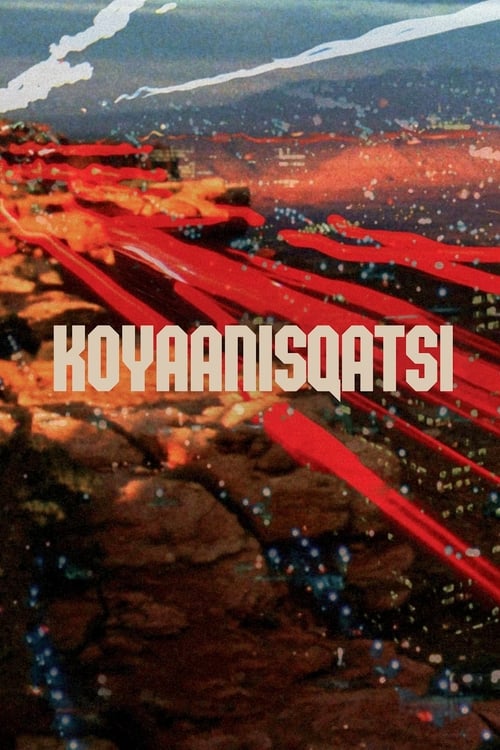
Koyaanisqatsi
Life Out of Balance, Filmed at the Tempo of the Diagnosis
Directed by Godfrey Reggio
Reggio used the Hopi word koyaanisqatsi — life out of balance — as title, prophecy, and operating instruction. The film does not argue that modern civilization is sick. It films modern civilization at a tempo and from angles that make the sickness perceptually self-evident. The hot dogs on the assembly line and the commuters in the subway are shot the same way for the same reason. The two streams are the same stream.
Koyaanisqatsi is the first film in the Western tradition to recognize that the medium of cinema itself is the only instrument adequate to deliver an indigenous prophecy to an industrial civilization that no longer reads its own languages of warning. Reggio collaborated with Philip Glass and Ron Fricke for nearly seven years to assemble a wordless 86-minute essay whose central operation is the manipulation of time. Slowed-down footage of clouds and natural systems sets a baseline tempo. Sped-up footage of cars, factories, and crowds is then placed against that baseline. The disjunction is the diagnosis. Human industrial activity is happening at a tempo that has lost any relationship to the tempo of the world it depends on. The Hopi word koyaanisqatsi names this condition. The film hands the word to the viewer by demonstration. No argument is made because no argument is needed. The viewer sees what the word names.
The Surface
A non-narrative film of 86 minutes. No dialogue, no narration, no subtitles. Score by Philip Glass that became one of the most recognizable scores of the late twentieth century. The film opens with cave paintings, moves to long pristine nature footage of the American Southwest, gradually introduces human imprint — strip mines, dams, power lines — and accelerates into urban time-lapse footage of New York and Los Angeles before ending with a final rocket launch that ignites and disintegrates.
The film was a sleeper hit, championed by Francis Ford Coppola and George Lucas after a Telluride screening. It spawned two sequels — Powaqqatsi and Naqoyqatsi — and inspired a generation of music video editors. The aesthetic became commercialized within a decade. The film itself remained.
Reggio's deepest claim, made in interviews afterward but not in the film, is that the film is what happens when a Catholic monastic enters the worldview of the Hopi prophecies and tries to render that worldview as accessible perception to an audience that has lost the capacity to receive verbal prophecy. The film is not a documentary. The film is a transmission.
The Hopi Word as Operating Instruction
The Hopi have nine prophecies regarding the present age. The seventh and eighth involve specific named conditions — the world out of balance, the gourd of ashes — that the people must recognize before the cycle can be restored. The prophecies are not predictions in the Western sense. They are diagnoses to be applied to whatever conditions the present holds.
Reggio met Hopi elders during his preparation. He asked permission to use the word koyaanisqatsi. The permission was granted on the condition that the film actually depict the condition the word names. The film is the fulfillment of that condition. The word is not decoration. The word is the test the film either passes or fails. By the consensus of the elders who reviewed the finished film, it passed.
What koyaanisqatsi names — life out of balance, life that calls for another way of living — is a perceptual category. It cannot be argued for. It can only be pointed at. The film is the pointing. The viewer who has internalized the industrial tempo as normal cannot see the imbalance because the imbalance has become the baseline. The film resets the baseline by spending its first thirty minutes with natural systems before introducing the industrial tempo at all. By the time the city footage arrives, the baseline has been restored sufficiently that the disjunction can be felt.
This is shamanic technique transposed into cinema. The shaman's work, broadly, is to restore the patient's perceptual access to a register the daily world has covered over. Reggio is performing that work at scale. The viewer is the patient. The film is the ceremony. The Hopi word is the medicine name.
The Time-Lapse as Revelation
Reggio and Fricke's most influential technical move was the use of time-lapse and slow-motion footage in calibrated alternation. Clouds shot at high frame rate slow down. Traffic shot at low frame rate speeds up. The resulting footage feels supernatural even when the subject is mundane. A morning commute on the Brooklyn Bridge becomes a river of corpuscles. A factory assembly line becomes a digestive tract.
The technique is not stylistic flourish. It is the only honest way to depict the modern relationship to time. Human industrial activity is happening at a tempo the human body cannot directly perceive. We experience traffic as moving slowly because we are inside it. The film steps outside it and shows the speed at which the system is actually consuming hours of human attention.
The sequence that crystallizes the film's argument is the assembly line montage. Hot dogs being processed. Cars being assembled. Television sets coming off the line. The footage is cut to match the rhythm of commuters in Grand Central Station. The two streams — manufactured goods and manufactured people — are visually identical. They move at the same speed. They flow through the same conveyance. They arrive at the same loading dock. The argument is complete in the editing. The viewer who watches without resistance cannot unsee what has been shown.
This footage circulated as commercial influence for decades. Music videos, advertising, news montage all borrowed the technique. The borrowing tended to strip the diagnosis. The technique was used to sell the very tempo the original film was indicting. Reggio noted this with the appropriate grief and went on to make Powaqqatsi about the related condition: the sorcerer that consumes life force in order to extend its own. The trilogy is a coherent project. The first film is the most efficient introduction.
The Rocket and the Pueblo
The film's final sequence — the Atlas-Centaur rocket launching and then catastrophically failing — is its most theologically loaded image. The technology of ascent ignites, climbs, then disintegrates in slow motion. A single piece of burning debris falls through the sky for what feels like minutes. The Glass score arrives at its plaintive choral peak. The Hopi prophecy that closes the film is then displayed onscreen.
The prophecy: 'If we dig precious things from the land, we will invite disaster.' 'Near the day of Purification, there will be cobwebs spun back and forth in the sky.' 'A container of ashes might one day be thrown from the sky, which could burn the land and boil the oceans.'
Reggio is not predicting an apocalypse. He is presenting prophecies that have already happened or are happening. The cobwebs are contrails. The container of ashes is whichever atomic device the viewer cares to name. The precious things dug from the land are the rare earths and fossil fuels powering the very projector showing the film. The prophecies are descriptions, not warnings. The film makes this distinction by not editorializing.
The pueblo footage at the beginning, paired with the rocket footage at the end, forms the film's first-and-last rhyme. The cave paintings predicted what the rocket demonstrates. The instruction has been available the entire time. The civilization that ignored the instruction reaches the demonstrated consequence. The film is not asking what should be done. The film is verifying what was foreseen.
The Transmission
Koyaanisqatsi transmits something almost no other film of its era transmitted: the ability to perceive the tempo of one's own civilization as one tempo among others, not as the natural background of existence. After this film, the freeway looks different. The supermarket aisle looks different. The phone screen looks different. The film has installed a comparative perception that the daily life immediately works to dissolve. Some viewers retain the perception briefly. Others retain it for weeks. A few retain it permanently. The film's gift is the temporary opening it makes possible.
What Reggio accomplished, with Glass and Fricke and the patient labor of seven years, is the recovery of cinema's capacity to function as an actual perceptual practice rather than as entertainment. The film does not pander. It does not explain itself. It does not provide a narrative through-line for viewers who need one. It does what it does and trusts the viewer to be able to receive it. Many viewers cannot. The film does not adjust to them.
This is the discipline of the genuine transmission. The transmission is what it is. The reception is the viewer's responsibility. The film is forty years old now and has not aged because the condition it names has not been resolved. If anything the condition has intensified. The word koyaanisqatsi is therefore more urgent now than when the film was released. The film waits for whoever is ready to see what it has been showing. It does not change. The viewer changes, or does not.
Questions this film answers
What is the deeper meaning of Koyaanisqatsi?
Koyaanisqatsi is the first film in the Western tradition to recognize that the medium of cinema itself is the only instrument adequate to deliver an indigenous prophecy to an industrial civilization that no longer reads its own languages of warning. Reggio collaborated with Philip Glass and Ron Fricke for nearly seven years to assemble a wordless 86-minute essay whose central operation is the manipulation of time. Slowed-down footage of clouds and natural systems sets a baseline tempo. Sped-up footage of cars, factories, and crowds is then placed against that baseline. The disjunction is the diagnosis. Human industrial activity is happening at a tempo that has lost any relationship to the tempo of the world it depends on. The Hopi word koyaanisqatsi names this condition. The film hands the word to the viewer by demonstration. No argument is made because no argument is needed. The viewer sees what the word names.
What is the hidden symbolism in Koyaanisqatsi?
A non-narrative film of 86 minutes. No dialogue, no narration, no subtitles. Score by Philip Glass that became one of the most recognizable scores of the late twentieth century. The film opens with cave paintings, moves to long pristine nature footage of the American Southwest, gradually introduces human imprint — strip mines, dams, power lines — and accelerates into urban time-lapse footage of New York and Los Angeles before ending with a final rocket launch that ignites and disintegrates.
What esoteric traditions appear in Koyaanisqatsi?
Koyaanisqatsi draws from Shamanism, Initiation traditions. Reggio used the Hopi word koyaanisqatsi — life out of balance — as title, prophecy, and operating instruction. The film does not argue that modern civilization is sick. It films modern civilization at a tempo and from angles that make the sickness perceptually self-evident. The hot dogs on the assembly line and the commuters in the subway are shot the same way for the same reason. The two streams are the same stream.
What does Koyaanisqatsi teach about the rocket and the pueblo?
The prophecies are descriptions, not warnings. The instruction has been available the entire time. The film's final sequence — the Atlas-Centaur rocket launching and then catastrophically failing — is its most theologically loaded image. The technology of ascent ignites, climbs, then disintegrates in slow motion. A single piece of burning debris falls through the sky for what feels like minutes. The Glass score arrives at its plaintive choral peak. The Hopi prophecy that closes the film is then displayed onscreen.
Is Koyaanisqatsi worth watching for spiritual seekers?
Koyaanisqatsi (1983) directed by Godfrey Reggio is essential viewing for those interested in Shamanism, Non-narrative, Reggio. Life Out of Balance, Filmed at the Tempo of the Diagnosis. It rewards multiple viewings and contemplation.
Rewatch With New Eyes
Now that you've seen the architecture, experience it again. The same film becomes a different film when you know what to watch for.
This time, watch for:
- Follow the descent: what dies, what guides, what returns transformed
- Mark the threshold: the old self dies, the ordeal transforms, the new self returns
Links may include affiliate partnerships that support Media Revelations