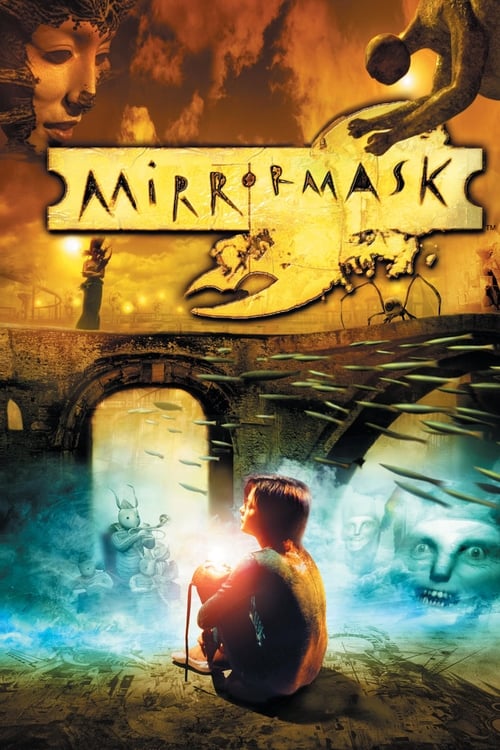
MirrorMask
MirrorMask Is What Happens When a Girl Wishes Her Mother Dead and Then Has to Repair the World She Broke
Directed by Dave McKean
McKean and Gaiman built a dream out of collage and charcoal, but the architecture underneath is exact. The two queens are one mother. The dark self wearing your face is loose in the waking world while you sleep.
Helena is a fifteen-year-old who works in her parents' circus and wants out. She screams at her mother that she wishes she were dead, and that night her mother collapses and is hospitalized. Helena falls asleep and wakes in a hand-drawn city ruled by two queens, one of Light who has fallen into a coma-sleep, one of Shadow whose realm is spreading. To save the White Queen she must find the MirrorMask, a charm that will wake her. The film reads as an Alice-style fantasia, gorgeous and dislocating. Underneath, its structure is precise and unforgiving: this is a dream a specific girl is having on a specific night, and every figure in it is a piece of her, or of the guilt she carries into sleep after wishing the worst thing a daughter can wish.
Jungian Reading: The Shadow Wearing the Ego's Face
Jung's shadow is the disowned self, and the film gives it literal form. While Helena dreams, a dark double, the Shadow Queen's rebellious daughter, escapes into Helena's waking life and lives it recklessly, wrecking her real relationships, wearing her face. This is the shadow enacted with textbook clarity: the part of Helena that wants to destroy everything, freed to do exactly that in the world Helena has abandoned.
The two queens are the split mother-image, the archetype Jung called the two-sided mother, nurturing and devouring, held apart because Helena cannot yet hold them as one person. The White Queen is the mother she loves and has hospitalized with a wish. The Shadow Queen is the mother she rages at. Only when Helena stops choosing between them can the two images fuse back into the single flawed woman waiting in a hospital bed. The mask she seeks is not an object. It is the capacity to see her own face and her mother's as belonging to the same fallible person.
Initiatory Reading: The Descent That Repairs the Wish
The night-sea journey is the initiatory descent into the unconscious to retrieve something the waking self has lost or damaged. Helena's descent is triggered by transgression: the death-wish spoken aloud, the taboo crossed. The dream is not escape. It is the psyche's court, convened to try the crime and assign the labor of repair.
Her quest for the MirrorMask is the classic retrieval of the object that heals the wound at the top of the world, but the wound is her own guilt and the object heals it by forcing her through the very thing she cannot face. She must journey to wake a sleeping queen because she put her real mother to sleep with a sentence. When she finds the charm and wakes the White Queen, she wakes in her own bed to news that her mother's surgery succeeded. The two events are one event told twice. The initiation worked: the girl who wished her mother dead descends, does the work, and returns as a daughter who has chosen her mother back.
Other dream-descents where a child repairs a broken family from inside: Labyrinth (the sibling wish granted and regretted), The Dark Crystal (McKean and Henson's split-being cosmology), Pan's Labyrinth (the underworld as a child's court of last resort).
Questions this film answers
What is the deeper meaning of MirrorMask?
Helena is a fifteen-year-old who works in her parents' circus and wants out. She screams at her mother that she wishes she were dead, and that night her mother collapses and is hospitalized. Helena falls asleep and wakes in a hand-drawn city ruled by two queens, one of Light who has fallen into a coma-sleep, one of Shadow whose realm is spreading. To save the White Queen she must find the MirrorMask, a charm that will wake her. The film reads as an Alice-style fantasia, gorgeous and dislocating. Underneath, its structure is precise and unforgiving: this is a dream a specific girl is having on a specific night, and every figure in it is a piece of her, or of the guilt she carries into sleep after wishing the worst thing a daughter can wish.
What is the hidden symbolism in MirrorMask?
Jung's shadow is the disowned self, and the film gives it literal form. While Helena dreams, a dark double, the Shadow Queen's rebellious daughter, escapes into Helena's waking life and lives it recklessly, wrecking her real relationships, wearing her face. This is the shadow enacted with textbook clarity: the part of Helena that wants to destroy everything, freed to do exactly that in the world Helena has abandoned.
What esoteric traditions appear in MirrorMask?
MirrorMask draws from Jungian, Initiation traditions. McKean and Gaiman built a dream out of collage and charcoal, but the architecture underneath is exact. The two queens are one mother. The dark self wearing your face is loose in the waking world while you sleep.
Is MirrorMask worth watching for spiritual seekers?
MirrorMask (2005) directed by Dave McKean is essential viewing for those interested in Jungian, Initiation. MirrorMask Is What Happens When a Girl Wishes Her Mother Dead and Then Has to Repair the World She Broke. It rewards multiple viewings and contemplation.
Rewatch With New Eyes
Now that you've seen the architecture, experience it again. The same film becomes a different film when you know what to watch for.
This time, watch for:
- Meet the shadow: what is rejected, projected, and finally integrated
- Mark the threshold: the old self dies, the ordeal transforms, the new self returns
Links may include affiliate partnerships that support Media Revelations